Barnstable County launches roadshow to develop "safe gathering spaces" for youth
May 14, 2026 | Barnstable County, Massachusetts
This article was created by AI summarizing key points discussed. AI makes mistakes, so for full details and context, please refer to the video of the full meeting. Please report any errors so we can fix them. Report an error »
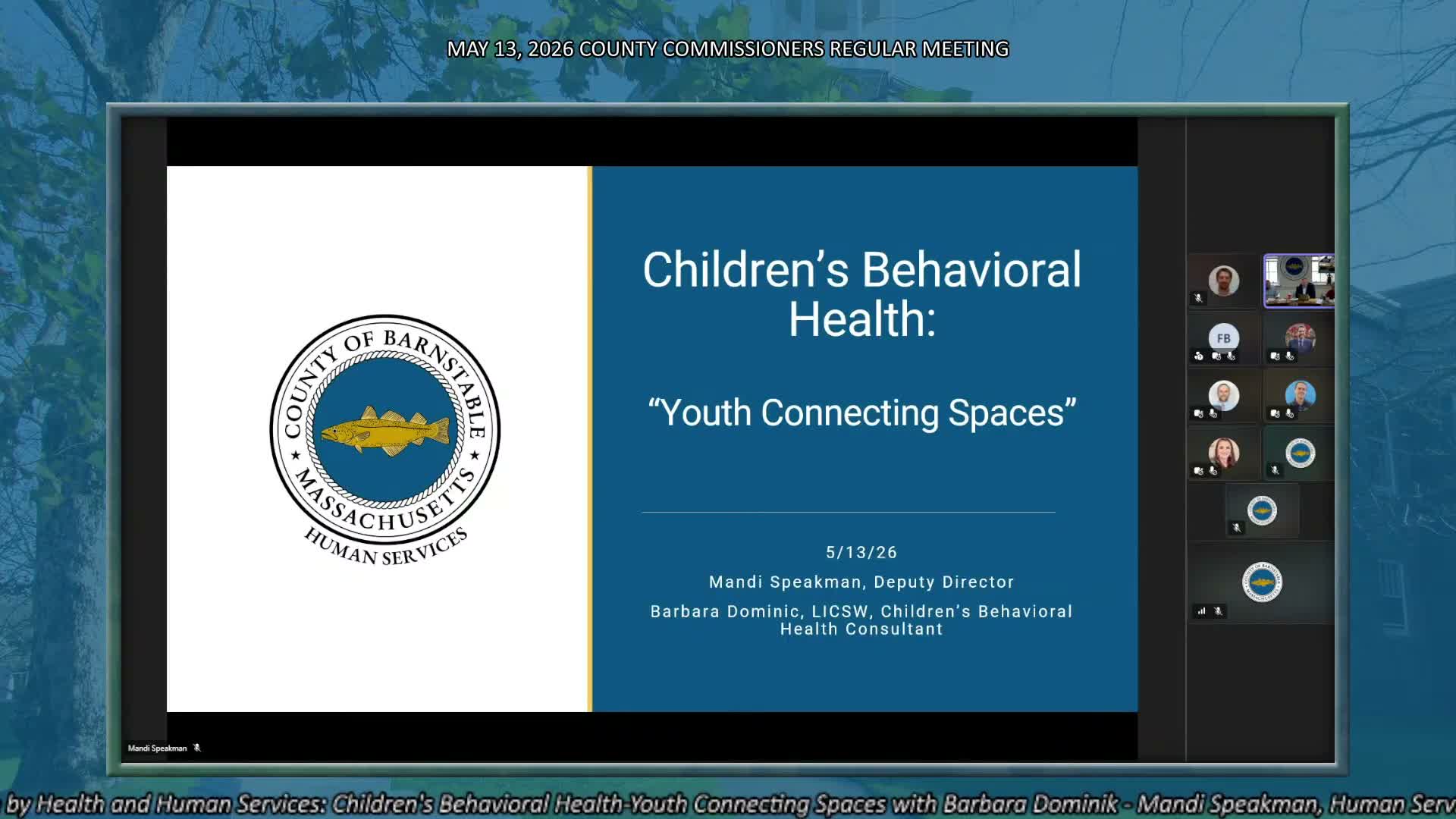
Barnstable County officials on May 13 outlined the first steps of a countywide effort to reduce youth isolation and improve behavioral‑health supports by creating community "safe gathering spaces." Mandy Speakman, deputy director of the Barnstable County Department of Human Services, told commissioners the initiative builds on a year‑long needs assessment funded in part with county ARPA dollars and led with consultant HRIA.
"We decided to look back at the results and focus on one priority area to begin with," Speakman said, describing a task group drawn from assessment stakeholders. The group prioritized reducing youth isolation — which Speakman said is associated on Cape Cod with higher rates of suicide, limited provider access and geographic barriers to care — by expanding informal, accessible places where young people can connect with peers and trusted adults.
Barbara Dominic, a DHS consultant on youth and young‑adult behavioral health, described the task group's outreach and a deliberately brief, four‑question youth survey designed to respect young people's attention spans. "We received an amazing 757 responses from the kids who took this survey with a 100% completion rate," Dominic said, reporting that most respondents prefer informal places such as friends' homes, town centers, libraries and lightly supervised spaces.
Dominic and Speakman said the survey and earlier assessment showed key gaps: limited direct youth engagement in planning, uneven participation from priority populations (including Mashpee Wampanoag tribal youth, Spanish‑ and Portuguese‑speaking families and LGBTQ+ youth), and a need for navigation supports for families and providers. They emphasized partnerships with libraries, schools, local nonprofits (including Family Table) and the Cape Cod Regional Transit Authority to address transportation and privacy needs.
The county plans a "roadshow" of community conversations to raise awareness, solicit ideas and engage local decision‑makers and funders. Speakman said the county's role will be convener and facilitator — not immediately building a new county center — and the group will prioritize short, achievable pilot activities while documenting needs for later larger investments.
Next steps include prioritizing target communities for outreach, continuing to refine youth engagement methods and reporting back to the commissioners. Commissioners expressed support and asked DHS to return with recommended pilot sites, partners and budget estimates.
"We decided to look back at the results and focus on one priority area to begin with," Speakman said, describing a task group drawn from assessment stakeholders. The group prioritized reducing youth isolation — which Speakman said is associated on Cape Cod with higher rates of suicide, limited provider access and geographic barriers to care — by expanding informal, accessible places where young people can connect with peers and trusted adults.
Barbara Dominic, a DHS consultant on youth and young‑adult behavioral health, described the task group's outreach and a deliberately brief, four‑question youth survey designed to respect young people's attention spans. "We received an amazing 757 responses from the kids who took this survey with a 100% completion rate," Dominic said, reporting that most respondents prefer informal places such as friends' homes, town centers, libraries and lightly supervised spaces.
Dominic and Speakman said the survey and earlier assessment showed key gaps: limited direct youth engagement in planning, uneven participation from priority populations (including Mashpee Wampanoag tribal youth, Spanish‑ and Portuguese‑speaking families and LGBTQ+ youth), and a need for navigation supports for families and providers. They emphasized partnerships with libraries, schools, local nonprofits (including Family Table) and the Cape Cod Regional Transit Authority to address transportation and privacy needs.
The county plans a "roadshow" of community conversations to raise awareness, solicit ideas and engage local decision‑makers and funders. Speakman said the county's role will be convener and facilitator — not immediately building a new county center — and the group will prioritize short, achievable pilot activities while documenting needs for later larger investments.
Next steps include prioritizing target communities for outreach, continuing to refine youth engagement methods and reporting back to the commissioners. Commissioners expressed support and asked DHS to return with recommended pilot sites, partners and budget estimates.
View the Full Meeting & All Its Details
This article offers just a summary. Unlock complete video, transcripts, and insights as a Founder Member.
✓
Watch full, unedited meeting videos
✓
Search every word spoken in unlimited transcripts
✓
AI summaries & real-time alerts (all government levels)
✓
Permanent access to expanding government content
30-day money-back guarantee
