Herriman staff warn of worsening drought, outline voluntary cuts and potential Jordan Valley surcharges
May 14, 2026 | Herriman City Council, Herriman , Salt Lake County, Utah
This article was created by AI summarizing key points discussed. AI makes mistakes, so for full details and context, please refer to the video of the full meeting. Please report any errors so we can fix them. Report an error »
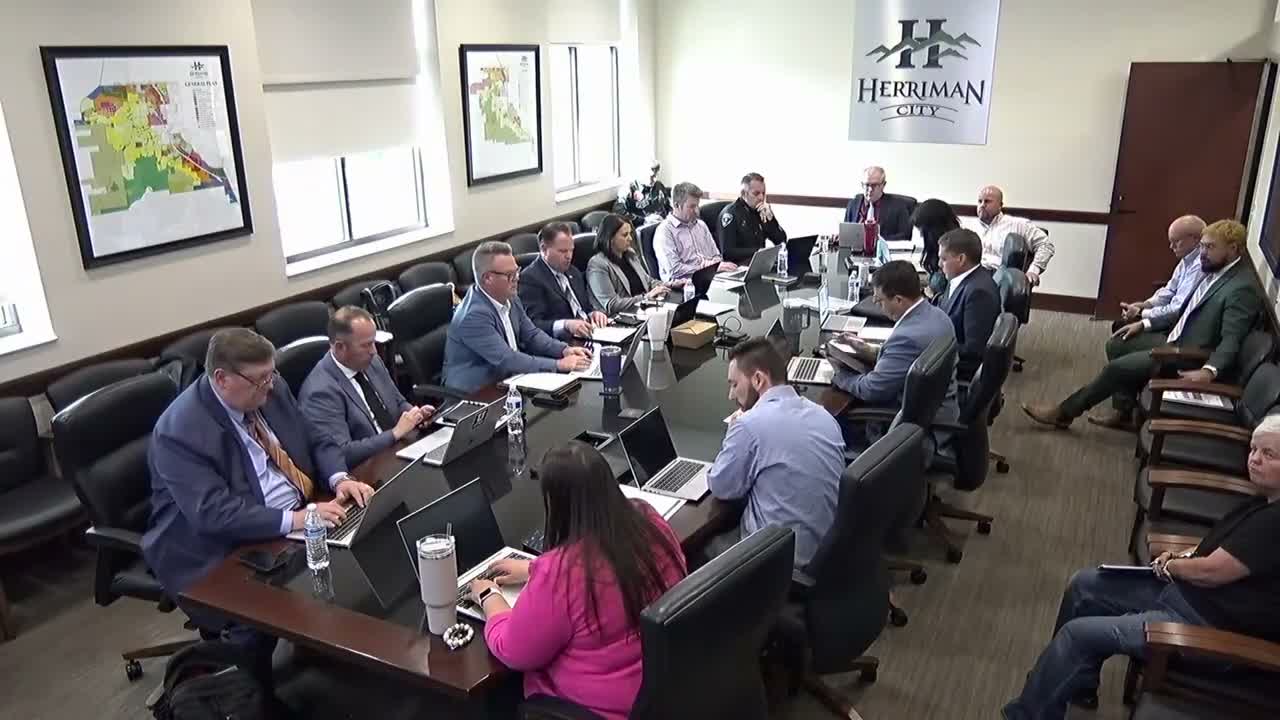
At the Herriman City Council work meeting on May 13, city water staff told councilors that unusually low snowpack and reservoir conditions have pushed regional supplies into higher drought levels, prompting a move by the Jordan Valley water board to a Level 2 drought response and the need for local conservation measures.
Justin (staff) said snow‑water equivalents and runoff timing show the region is “way below what we typically get,” and that Jordan Valley’s contingency plan defines drought levels (0–5) with Level 1 targeting a 5% demand reduction and Level 2 a 10% target. He described the governance process: a Jordan Valley drought committee voted 10–6 for Level 1, but three weeks later the Jordan Valley board set Level 2 after supplies fell further.
Staff explained that Levels 1–2 rely largely on voluntary, educational conservation steps across member agencies but that the Valley’s contract surcharges can apply when a member exceeds contract volumes. Justin outlined the surcharge triggers: exceeding 110%–120% of contract volumes brings escalating surcharges; he gave an example that maintaining 2025 usage would yield a roughly $70,000 surcharge for the city and that continued growth could push that exposure toward about $130,000.
Councilors and staff discussed operational options to reduce Jordan Valley purchases, including gradually increasing the share of city well water in the blend so the city stays below contract thresholds. Justin said staff monitor monthly usage and can adjust the blend slowly to avoid a sudden shift in water quality for residents.
The presentation also reviewed local conservation programs and outreach: a public water‑use dashboard with roughly 800–850 users, targeted education and possible site visits for high water users, a subsidized rain‑barrel program (about $6,000 spent for roughly 200 barrels), Landscape/LocalScapes classes and parks best management practices. Justin said the city will coordinate messaging with Jordan Valley to maintain consistent public communications.
Next steps: staff will continue monthly monitoring, work with communications on targeted conservation messaging, and report back to the council mid‑summer and again toward the end of the irrigation season on usage and whether contract thresholds or surcharges are likely to be triggered.
Justin (staff) said snow‑water equivalents and runoff timing show the region is “way below what we typically get,” and that Jordan Valley’s contingency plan defines drought levels (0–5) with Level 1 targeting a 5% demand reduction and Level 2 a 10% target. He described the governance process: a Jordan Valley drought committee voted 10–6 for Level 1, but three weeks later the Jordan Valley board set Level 2 after supplies fell further.
Staff explained that Levels 1–2 rely largely on voluntary, educational conservation steps across member agencies but that the Valley’s contract surcharges can apply when a member exceeds contract volumes. Justin outlined the surcharge triggers: exceeding 110%–120% of contract volumes brings escalating surcharges; he gave an example that maintaining 2025 usage would yield a roughly $70,000 surcharge for the city and that continued growth could push that exposure toward about $130,000.
Councilors and staff discussed operational options to reduce Jordan Valley purchases, including gradually increasing the share of city well water in the blend so the city stays below contract thresholds. Justin said staff monitor monthly usage and can adjust the blend slowly to avoid a sudden shift in water quality for residents.
The presentation also reviewed local conservation programs and outreach: a public water‑use dashboard with roughly 800–850 users, targeted education and possible site visits for high water users, a subsidized rain‑barrel program (about $6,000 spent for roughly 200 barrels), Landscape/LocalScapes classes and parks best management practices. Justin said the city will coordinate messaging with Jordan Valley to maintain consistent public communications.
Next steps: staff will continue monthly monitoring, work with communications on targeted conservation messaging, and report back to the council mid‑summer and again toward the end of the irrigation season on usage and whether contract thresholds or surcharges are likely to be triggered.
View the Full Meeting & All Its Details
This article offers just a summary. Unlock complete video, transcripts, and insights as a Founder Member.
✓
Watch full, unedited meeting videos
✓
Search every word spoken in unlimited transcripts
✓
AI summaries & real-time alerts (all government levels)
✓
Permanent access to expanding government content
30-day money-back guarantee
