Sedro-Woolley council holds first reading to repeal arts commission after hours of public comment
May 14, 2026 | Sedro-Woolley, Skagit County, Washington
This article was created by AI summarizing key points discussed. AI makes mistakes, so for full details and context, please refer to the video of the full meeting. Please report any errors so we can fix them. Report an error »
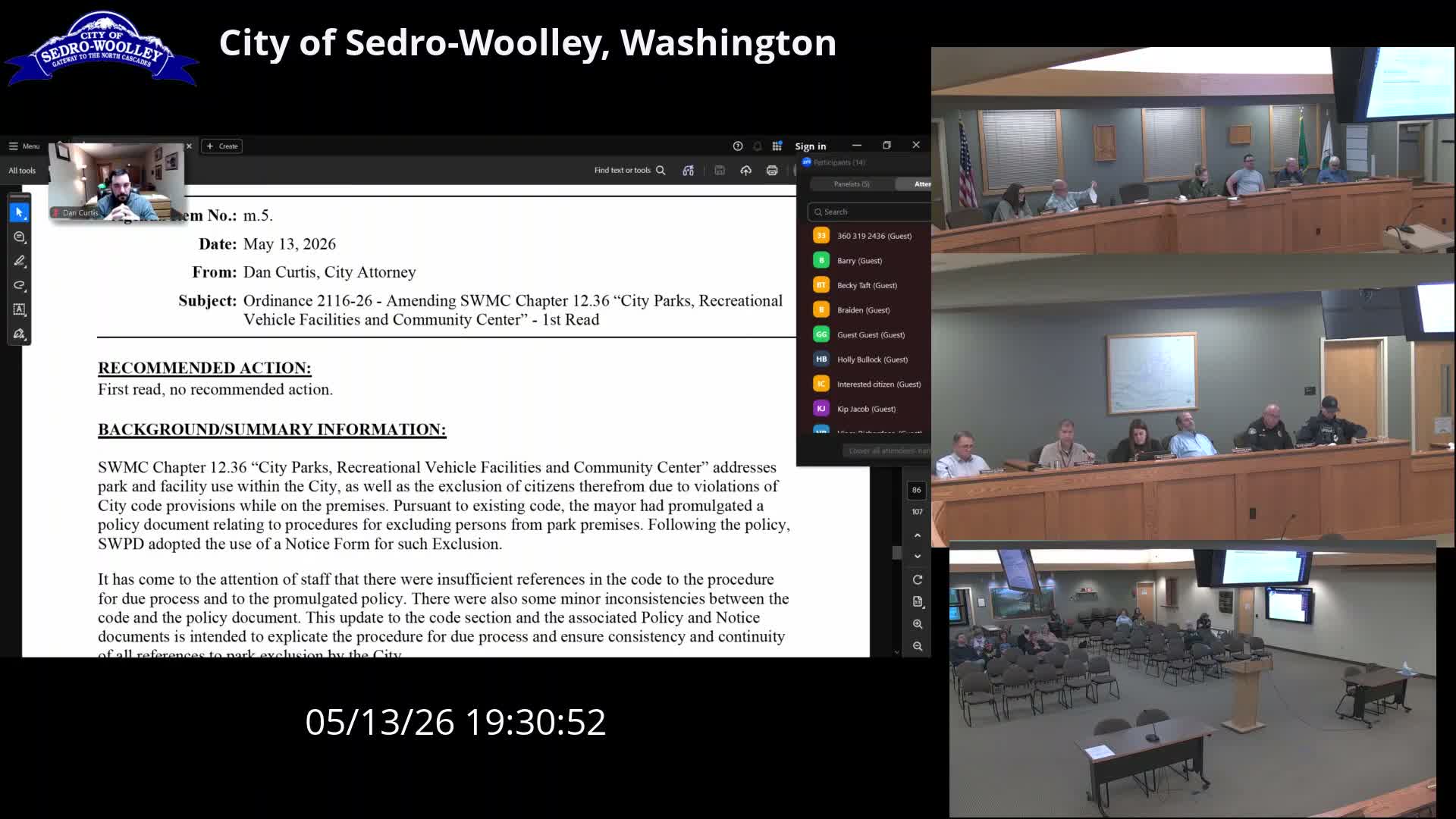
Mayor Joellen Kestie opened a lengthy first-reading debate on a proposed repeal of Sedro-WoolleyMunicipal Code provisions that establish the cityarts commission, saying she had removed the mayoral liaison to ensure any change followed proper process and to reduce potential liability for the city.
Charlie, the city administrator, framed the proposal as a streamlining measure driven by limited staff capacity: staff recommended repealing most code that codifies the commission while retaining the municipal arts fund and moving decisions about disbursements to the council, with the option to form short-term advisory boards for specific projects.
The proposal drew extensive public opposition. Kathleen Roche Zuzo, a Mount Vernon resident and long-time arts volunteer, told the council, "Iam standing before you tonight to urge this council to reject any efforts to disband or in any way remove city recognition of Woolley's volunteer arts commission." Randy Collins, the commissionchair, said the group had not requested city funding and asked the council to "carefully consider" the consequences of eliminating a volunteer body that secures grants and organizes events.
Supporters emphasized economic and civic benefits. Damon Morris, who worked on lodging-tax grants in nearby Mount Vernon, said lodging-tax funding can pay for murals and performances that attract visitors; Sam Irons with the Skagit tourism arts task force said public art "cultivates a vibrant community" and drives visitation. Artist Peter Whited offered to fund the commission for a year if the council would allow it to continue.
Council members asked for clarifying information before any vote. Council member DeYoung praised volunteers and requested that staff identify "any current projects, assets, funds, pending donations, or obligations connected to the arts commission" and confirm that the municipal arts fund would be preserved. Council member Peterson said shewould be willing to provide meeting minutes and agendas to reduce staff burden, but noted the legal distinctions between a codified commission and an advisory board under the Open Public Meetings Act.
City Attorney Dan Curtis confirmed the proposal is a first read and that an advisory board could be stood up for specific purposes with fewer formal requirements than a codified commission. Charlie said staff and the mayor had drafted the code changes with the intention of retaining the arts fund and ensuring a public pathway for artists and donors.
No formal action was taken at the meeting; the ordinance remained at first reading. Councilmembers asked staff to return with a clear record of ongoing projects, any funds or donations tied to the commission, and a description of how community groups would forward public-art proposals under the revised code.
Charlie, the city administrator, framed the proposal as a streamlining measure driven by limited staff capacity: staff recommended repealing most code that codifies the commission while retaining the municipal arts fund and moving decisions about disbursements to the council, with the option to form short-term advisory boards for specific projects.
The proposal drew extensive public opposition. Kathleen Roche Zuzo, a Mount Vernon resident and long-time arts volunteer, told the council, "Iam standing before you tonight to urge this council to reject any efforts to disband or in any way remove city recognition of Woolley's volunteer arts commission." Randy Collins, the commissionchair, said the group had not requested city funding and asked the council to "carefully consider" the consequences of eliminating a volunteer body that secures grants and organizes events.
Supporters emphasized economic and civic benefits. Damon Morris, who worked on lodging-tax grants in nearby Mount Vernon, said lodging-tax funding can pay for murals and performances that attract visitors; Sam Irons with the Skagit tourism arts task force said public art "cultivates a vibrant community" and drives visitation. Artist Peter Whited offered to fund the commission for a year if the council would allow it to continue.
Council members asked for clarifying information before any vote. Council member DeYoung praised volunteers and requested that staff identify "any current projects, assets, funds, pending donations, or obligations connected to the arts commission" and confirm that the municipal arts fund would be preserved. Council member Peterson said shewould be willing to provide meeting minutes and agendas to reduce staff burden, but noted the legal distinctions between a codified commission and an advisory board under the Open Public Meetings Act.
City Attorney Dan Curtis confirmed the proposal is a first read and that an advisory board could be stood up for specific purposes with fewer formal requirements than a codified commission. Charlie said staff and the mayor had drafted the code changes with the intention of retaining the arts fund and ensuring a public pathway for artists and donors.
No formal action was taken at the meeting; the ordinance remained at first reading. Councilmembers asked staff to return with a clear record of ongoing projects, any funds or donations tied to the commission, and a description of how community groups would forward public-art proposals under the revised code.
View the Full Meeting & All Its Details
This article offers just a summary. Unlock complete video, transcripts, and insights as a Founder Member.
✓
Watch full, unedited meeting videos
✓
Search every word spoken in unlimited transcripts
✓
AI summaries & real-time alerts (all government levels)
✓
Permanent access to expanding government content
30-day money-back guarantee
