Clackamas County Solid Waste Commission approves fee increases and 75% low‑income discount
May 14, 2026 | Clackamas County, Oregon
This article was created by AI summarizing key points discussed. AI makes mistakes, so for full details and context, please refer to the video of the full meeting. Please report any errors so we can fix them. Report an error »
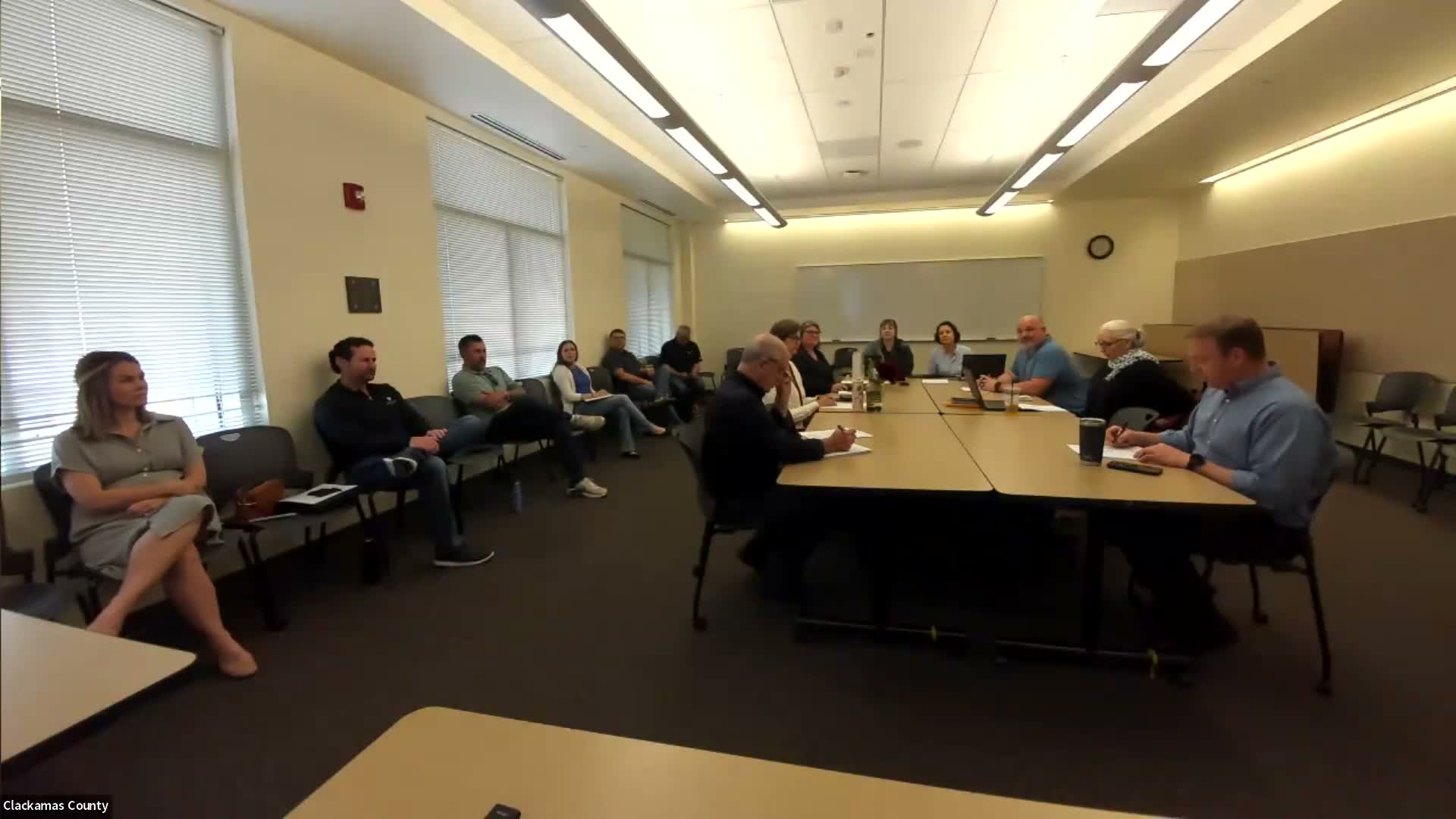
The Clackamas County Solid Waste Commission voted May 12 to approve a package of fee increases for solid‑waste services and to recommend a 75% reduced‑fee program for eligible low‑income residential cart customers.
Kate Taylor, a county sustainability and solid‑waste staffer, told the commission the annual review examines franchisee cost reports and seeks to keep fees aligned with “real costs” to ensure a fair return to collectors while protecting ratepayers. Taylor said staff’s modeling shows the proposed increases would move the county composite operating return to about 8.12%; without an increase, the composite would fall to roughly 4.8%.
The staff proposal covered cart and container service rates (the 35‑gallon cart was used as the baseline for residential estimates), drop‑box and transfer‑station fees and a restructuring of infectious/medical‑waste fees to reflect differing autoclave versus incineration transport and disposal costs. Taylor said transfer‑station fees in the proposal average about a 24% increase (with the smallest increases near 14% and the largest near 28%).
On the reduced‑fee program, staff recommended the commission consider either a 50% or 75% discount and proposed setting income eligibility at 60% of the state median income, with two‑year renewals. To minimize barriers, staff said enrollment could be verified by confirmation letters from existing assistance programs rather than new income paperwork; acceptable confirmations named in the presentation included HUD housing assistance, LIHEAP, Oregon Energy Assistance, Oregon Health Plan, SNAP, TANF and WIC. Staff estimated initial program participation at 3% of residential customers (with expectations that participation could grow over time).
Pam Bloom, representing the Clackamas County Refuse and Recycling Association (CCRRA) and speaking for a group of county haulers including B and B Leasing, Waste Connections and others, urged the commission to recommend the haulers’ requested rates. “Due to surrounding circumstances involving cost pressures from economic uncertainty, increased disposal tip fees, fuel, labor, and insurance, we may remain concerned that the recommended rates fall below the needed increase to get the haulers' target operating margin to 10%,” Bloom said, asking the commission to forward a favorable recommendation to the Clackamas County Board of Commissioners.
Commissioners asked staff detailed questions about the reduced‑fee mechanics: which assistance programs would qualify for verification (the list above), how the discount would apply across different cart sizes (staff said it would apply by service level rather than as a flat per‑household credit) and how staff estimated roughly 2,000 potentially eligible customers from franchisee cost reports. Staff also explained forecasting limits: the rate consultant uses ‘‘known and measurable’’ inputs (collective‑bargaining increases, metro disposal adjustments) and generally does not include unpredictable items such as sudden insurance or fuel spikes until they are concrete.
The commission then moved, seconded and voted to recommend the proposed fee schedule to the county commissioners and to recommend a 75% reduced‑fee option for eligible residential cart customers. Chair Chad Euler announced the motions carried unanimously. The commission also approved the proposed transfer‑station fee updates and the infectious/medical‑waste fee restructuring as presented in the staff report.
The commission will forward its recommendation and the adopted fee schedules and reduced‑fee option to the Clackamas County Board of Commissioners for final action. Staff also noted next steps for public notice and franchisee communication if the board approves the schedules.
Kate Taylor, a county sustainability and solid‑waste staffer, told the commission the annual review examines franchisee cost reports and seeks to keep fees aligned with “real costs” to ensure a fair return to collectors while protecting ratepayers. Taylor said staff’s modeling shows the proposed increases would move the county composite operating return to about 8.12%; without an increase, the composite would fall to roughly 4.8%.
The staff proposal covered cart and container service rates (the 35‑gallon cart was used as the baseline for residential estimates), drop‑box and transfer‑station fees and a restructuring of infectious/medical‑waste fees to reflect differing autoclave versus incineration transport and disposal costs. Taylor said transfer‑station fees in the proposal average about a 24% increase (with the smallest increases near 14% and the largest near 28%).
On the reduced‑fee program, staff recommended the commission consider either a 50% or 75% discount and proposed setting income eligibility at 60% of the state median income, with two‑year renewals. To minimize barriers, staff said enrollment could be verified by confirmation letters from existing assistance programs rather than new income paperwork; acceptable confirmations named in the presentation included HUD housing assistance, LIHEAP, Oregon Energy Assistance, Oregon Health Plan, SNAP, TANF and WIC. Staff estimated initial program participation at 3% of residential customers (with expectations that participation could grow over time).
Pam Bloom, representing the Clackamas County Refuse and Recycling Association (CCRRA) and speaking for a group of county haulers including B and B Leasing, Waste Connections and others, urged the commission to recommend the haulers’ requested rates. “Due to surrounding circumstances involving cost pressures from economic uncertainty, increased disposal tip fees, fuel, labor, and insurance, we may remain concerned that the recommended rates fall below the needed increase to get the haulers' target operating margin to 10%,” Bloom said, asking the commission to forward a favorable recommendation to the Clackamas County Board of Commissioners.
Commissioners asked staff detailed questions about the reduced‑fee mechanics: which assistance programs would qualify for verification (the list above), how the discount would apply across different cart sizes (staff said it would apply by service level rather than as a flat per‑household credit) and how staff estimated roughly 2,000 potentially eligible customers from franchisee cost reports. Staff also explained forecasting limits: the rate consultant uses ‘‘known and measurable’’ inputs (collective‑bargaining increases, metro disposal adjustments) and generally does not include unpredictable items such as sudden insurance or fuel spikes until they are concrete.
The commission then moved, seconded and voted to recommend the proposed fee schedule to the county commissioners and to recommend a 75% reduced‑fee option for eligible residential cart customers. Chair Chad Euler announced the motions carried unanimously. The commission also approved the proposed transfer‑station fee updates and the infectious/medical‑waste fee restructuring as presented in the staff report.
The commission will forward its recommendation and the adopted fee schedules and reduced‑fee option to the Clackamas County Board of Commissioners for final action. Staff also noted next steps for public notice and franchisee communication if the board approves the schedules.
View the Full Meeting & All Its Details
This article offers just a summary. Unlock complete video, transcripts, and insights as a Founder Member.
✓
Watch full, unedited meeting videos
✓
Search every word spoken in unlimited transcripts
✓
AI summaries & real-time alerts (all government levels)
✓
Permanent access to expanding government content
30-day money-back guarantee
