Sheriff questions co‑responder model as legislators debate ARPA mental‑health funds and program structure
May 14, 2026 | Putnam County, New York
This article was created by AI summarizing key points discussed. AI makes mistakes, so for full details and context, please refer to the video of the full meeting. Please report any errors so we can fix them. Report an error »
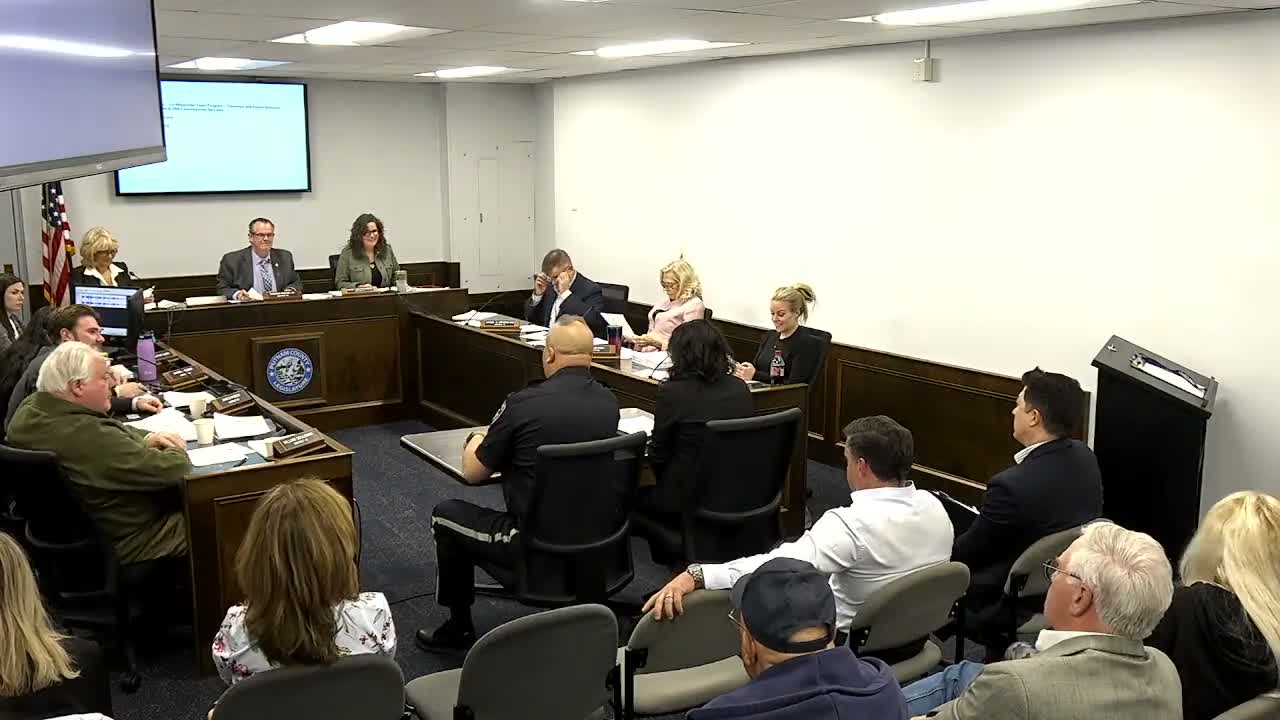
Sheriff Hess on May 13 told the Protective Services Committee he cannot justify assigning a full‑time sworn deputy to the county's co‑responder team (CRT) under the current structure, citing CAD (911) call counts and program governance issues.
"From the period of 02/05/2024 ... Putnam County has experienced approximately 6,479 mental health related calls for service," the sheriff said, adding that CRT responded to about 201 of those calls — roughly 3% — and that the loaded cost of a full‑time deputy assigned to CRT is approximately $250,000 per year. "That brings the cost to the taxpayer of $18,500 to $2,700 to each CRT call," he said, describing the assignment as an inefficient use of sworn patrol time.
The sheriff said CRT operates without a fully developed memorandum of understanding or a unified command framework, and he recommended shifting to models in which behavioral‑health professionals respond as primary responders with law enforcement in backup role when safety requires it.
Sarah Servideo, Putnam County commissioner of social services, disputed the sheriff's characterization of CRT workload and presented a different dataset: "In 2024, our co‑responder team responded to approximately 700 individuals. In 2025, approximately 750," she said, and called for further data reconciliation before structural changes are made.
Legislators pressed both sides for clarity on which calls require sworn law enforcement, how calls are logged, and how CRT follow‑up work is counted. Several legislators and advocacy speakers urged preserving CRT services while exploring alternative coverage models and noted the difficulty of staffing mobile crisis teams, particularly for evening hours.
Separately, during the Social/Educational/Environmental Committee meeting earlier in the evening, Chairwoman Nancy Montgomery introduced a resolution to retain $2.1 million in ARPA funds for community‑based behavioral‑health stabilization services after a previously proposed stabilization‑center site was denied by the planning board. County staff outlined elements that could be financed under an RFP (peer‑operated respite, mobile stabilization outreach, workforce support and capital improvements). Some department leaders queried whether the county could design, bid and contract those services in time to meet federal spending deadlines; when the motion was called, it did not receive a second and therefore failed to move forward.
What happens next: The sheriff said his office will continue to respond to calls requiring law enforcement and is open to alternative models that place behavioral‑health professionals in the primary responder role. Legislators asked county staff to reconcile the differing CRT datasets and to consider intermunicipal or grant approaches that could sustain a mental‑health response model that matches local needs and staffing realities. The committee approved a separate budgetary amendment (26a022) to expend remaining co‑responder grant funds while further policy and funding decisions are worked out.
(Reporting notes: Numerical claims about call counts came from testimony during the meeting; transcript segments show a disagreement between sheriff and DSS on counts and on what constitutes a CRT response.)
"From the period of 02/05/2024 ... Putnam County has experienced approximately 6,479 mental health related calls for service," the sheriff said, adding that CRT responded to about 201 of those calls — roughly 3% — and that the loaded cost of a full‑time deputy assigned to CRT is approximately $250,000 per year. "That brings the cost to the taxpayer of $18,500 to $2,700 to each CRT call," he said, describing the assignment as an inefficient use of sworn patrol time.
The sheriff said CRT operates without a fully developed memorandum of understanding or a unified command framework, and he recommended shifting to models in which behavioral‑health professionals respond as primary responders with law enforcement in backup role when safety requires it.
Sarah Servideo, Putnam County commissioner of social services, disputed the sheriff's characterization of CRT workload and presented a different dataset: "In 2024, our co‑responder team responded to approximately 700 individuals. In 2025, approximately 750," she said, and called for further data reconciliation before structural changes are made.
Legislators pressed both sides for clarity on which calls require sworn law enforcement, how calls are logged, and how CRT follow‑up work is counted. Several legislators and advocacy speakers urged preserving CRT services while exploring alternative coverage models and noted the difficulty of staffing mobile crisis teams, particularly for evening hours.
Separately, during the Social/Educational/Environmental Committee meeting earlier in the evening, Chairwoman Nancy Montgomery introduced a resolution to retain $2.1 million in ARPA funds for community‑based behavioral‑health stabilization services after a previously proposed stabilization‑center site was denied by the planning board. County staff outlined elements that could be financed under an RFP (peer‑operated respite, mobile stabilization outreach, workforce support and capital improvements). Some department leaders queried whether the county could design, bid and contract those services in time to meet federal spending deadlines; when the motion was called, it did not receive a second and therefore failed to move forward.
What happens next: The sheriff said his office will continue to respond to calls requiring law enforcement and is open to alternative models that place behavioral‑health professionals in the primary responder role. Legislators asked county staff to reconcile the differing CRT datasets and to consider intermunicipal or grant approaches that could sustain a mental‑health response model that matches local needs and staffing realities. The committee approved a separate budgetary amendment (26a022) to expend remaining co‑responder grant funds while further policy and funding decisions are worked out.
(Reporting notes: Numerical claims about call counts came from testimony during the meeting; transcript segments show a disagreement between sheriff and DSS on counts and on what constitutes a CRT response.)
View the Full Meeting & All Its Details
This article offers just a summary. Unlock complete video, transcripts, and insights as a Founder Member.
✓
Watch full, unedited meeting videos
✓
Search every word spoken in unlimited transcripts
✓
AI summaries & real-time alerts (all government levels)
✓
Permanent access to expanding government content
30-day money-back guarantee
