Wasco staff: five‑year water rate schedule enters final year; tank grant could allow capacity for about 400 homes
May 13, 2026 | Wasco City, Kern County, California
This article was created by AI summarizing key points discussed. AI makes mistakes, so for full details and context, please refer to the video of the full meeting. Please report any errors so we can fix them. Report an error »
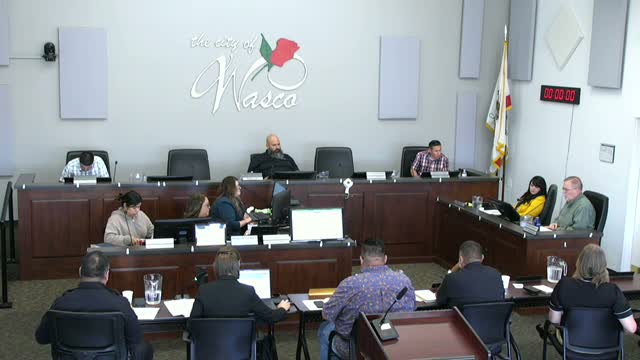
Wasco City staff briefed the council on water-enterprise finances and capacity options, including how a mix of reserves, rate policy and grants shape near-term decisions. Staff reminded the council the current five‑year rate schedule enters its final year July 1, 2026; a rate study under way anticipates phasing out the internal subsidy so modest rate increases thereafter will cover long‑term operating and capital costs.
Budget staff explained the city intentionally used some enterprise reserves during the current five‑year schedule to avoid sharp rate spikes for customers, and that the planned approach is to move to a sustainable, modest year‑over‑year increase rather than large one‑time jumps. “So it won't be until July '28 when these new rates will go into effect,” one staff member clarified while correcting fiscal-year phrasing during the discussion of timing.
On capacity, staff said the city has pursued multiple options. Replacement wells funded from a revolving fund and a recently approved storage tank are expected to help operations and save energy by shifting pumping to lower‑cost hours. Separately, staff reported the city applied for a Community Development Block Grant (CDBG) to fund another water tank; their water engineer’s estimate was that a new tank could provide capacity sufficient for roughly 400 additional homes if the grant is awarded and the project proceeds.
Staff cautioned that some measures — like a brand‑new well — cost significantly more and take longer, so the tank option is a lower‑cost, faster way to add capacity in the near term. Councilmembers asked for detailed revenue and project timing so they can better weigh rate impacts against capacity needs.
What happens next: staff will continue the rate‑study work, finalize revenue projections and follow up on the CDBG grant outcome; any capacity changes that affect development or service levels will be brought back to council for formal action.
Budget staff explained the city intentionally used some enterprise reserves during the current five‑year schedule to avoid sharp rate spikes for customers, and that the planned approach is to move to a sustainable, modest year‑over‑year increase rather than large one‑time jumps. “So it won't be until July '28 when these new rates will go into effect,” one staff member clarified while correcting fiscal-year phrasing during the discussion of timing.
On capacity, staff said the city has pursued multiple options. Replacement wells funded from a revolving fund and a recently approved storage tank are expected to help operations and save energy by shifting pumping to lower‑cost hours. Separately, staff reported the city applied for a Community Development Block Grant (CDBG) to fund another water tank; their water engineer’s estimate was that a new tank could provide capacity sufficient for roughly 400 additional homes if the grant is awarded and the project proceeds.
Staff cautioned that some measures — like a brand‑new well — cost significantly more and take longer, so the tank option is a lower‑cost, faster way to add capacity in the near term. Councilmembers asked for detailed revenue and project timing so they can better weigh rate impacts against capacity needs.
What happens next: staff will continue the rate‑study work, finalize revenue projections and follow up on the CDBG grant outcome; any capacity changes that affect development or service levels will be brought back to council for formal action.
Don't Miss a Word: See the Full Meeting!
Go beyond summaries. Unlock every video, transcript, and key insight with a Founder Membership.
✓
Get instant access to full meeting videos
✓
Search and clip any phrase from complete transcripts
✓
Receive AI-powered summaries & custom alerts
✓
Enjoy lifetime, unrestricted access to government data
30-day money-back guarantee
