RSU 5 advances FY27 spending plan after debate over language positions, special-education hires and reserve funds
May 14, 2026 | RSU 05, School Districts, Maine
This article was created by AI summarizing key points discussed. AI makes mistakes, so for full details and context, please refer to the video of the full meeting. Please report any errors so we can fix them. Report an error »
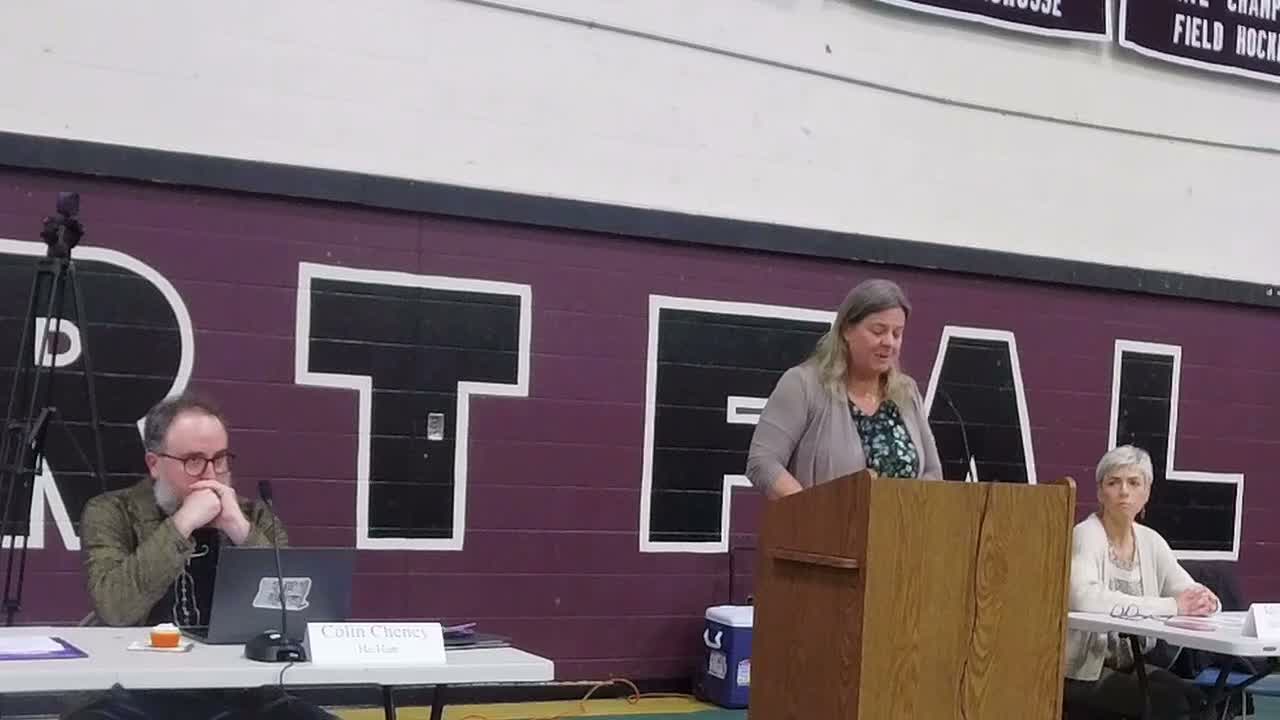
The Regional School Unit 5 annual budget meeting advanced the board’s proposed fiscal year 2026–27 spending plan and sent it to a June 9 referendum after residents debated staffing cuts, special-education hires and how much discretion the school board should have over capital reserves.
Michelle Richeson, chair of the RSU 5 board of directors, opened the meeting by summarizing the district’s priorities and the proposed operating budget (chair’s opening referenced $47,613,420 and a 7.1% overall increase). She said the board plans to apply $885,000 from the fund balance to reduce the local tax impact, which Richeson estimated at 5.46% in Durham, 3.97% in Freeport and 5.81% in Pownall. The meeting followed standard town‑meeting procedure; moderator Gregory I'm ran the floor and said one article required a written ballot.
Why it matters: Residents said they wanted to preserve programs while keeping tax pressure modest. Supporters of additional spending argued restoring a French/world-cultures teacher and an ESOL teacher would meet demonstrated student need; opponents warned about cumulative budget growth and urged restraint.
A citizen amendment to increase Article 1 (regular instruction) by $214,000 — moved by Maura Pillsbury of Freeport to restore a French/world cultures teacher ($107,000) and an ESOL teacher ($107,000) — drew a lengthy public exchange. Pillsbury said more than 80 students and several teachers had signed a petition supporting the French position and emphasized support for immigrant students. After public comment and a hand count, the amendment failed, with the moderator announcing 43 in favor and 71 opposed. Article 1 then passed as written.
The district defended several elements of the proposed budget during question periods. On literacy, Judith Hall (Freeport) cited a district reading-achievement figure shown in board materials (52%) and asked which reading programs were in use. Superintendent Tom Graham said the district has piloted a lower-grade program (described in the meeting as “moss flower”) and is using Hegarty for phonemic awareness; he reported strong early-grade pilot results and said the district expects improvement as cohorts progress.
Special-education costs drew repeated questions. Article 2, recommending $7,510,422 for special education, was explained as being driven by legally required services and by recent student needs that prompted addition of a teacher of the deaf and a speech-language pathologist. The district said those positions were funded from reserves when students first arrived and are now being moved into the operating budget.
Transportation and staffing: Residents asked whether fuel or other pressures drive the transportation line. The district said the increase reflects a multi‑year fleet-replacement plan (to stop leasing buses) and compensation increases negotiated for support staff including bus and van drivers to address recruitment challenges; the district said it currently has no electric buses and cited higher per-unit costs for electrification.
Capital reserves and board discretion became a focal point in a later debate. Article 22 would permit the board to expend up to $1,311,270 from the capital reserve as needed. Andy O’Brien moved to amend the article to cap expendable funds at $100,000 without returning to voters; speakers warned that lowering the cap could create timing problems for emergency repairs and could require additional special warrant meetings. The amendment to reduce the cap to $100,000 failed and Article 22 passed as written.
A required written ballot (Article 14) was held and counted by clerks; the moderator announced the result as 84 yes, 29 no and 1 blank, and said the article passed. The moderator closed the warrant after the remaining articles (including several reserve-authorizations and Region 10 technical high‑school items) passed as written and reminded voters the approved warrant will be on the June 9 referendum ballot.
What’s next: The board’s recommended budget and related warrant articles will be decided by a secret‑ballot referendum on June 9 at local polling stations. The board and administration will continue to answer questions from residents and to report back on how reserve funds are used if Article 22 is triggered.
Sources: Meeting remarks and public comment at the RSU 5 annual budget meeting, May 13, 2026; moderator announcements and clerk counts.
Michelle Richeson, chair of the RSU 5 board of directors, opened the meeting by summarizing the district’s priorities and the proposed operating budget (chair’s opening referenced $47,613,420 and a 7.1% overall increase). She said the board plans to apply $885,000 from the fund balance to reduce the local tax impact, which Richeson estimated at 5.46% in Durham, 3.97% in Freeport and 5.81% in Pownall. The meeting followed standard town‑meeting procedure; moderator Gregory I'm ran the floor and said one article required a written ballot.
Why it matters: Residents said they wanted to preserve programs while keeping tax pressure modest. Supporters of additional spending argued restoring a French/world-cultures teacher and an ESOL teacher would meet demonstrated student need; opponents warned about cumulative budget growth and urged restraint.
A citizen amendment to increase Article 1 (regular instruction) by $214,000 — moved by Maura Pillsbury of Freeport to restore a French/world cultures teacher ($107,000) and an ESOL teacher ($107,000) — drew a lengthy public exchange. Pillsbury said more than 80 students and several teachers had signed a petition supporting the French position and emphasized support for immigrant students. After public comment and a hand count, the amendment failed, with the moderator announcing 43 in favor and 71 opposed. Article 1 then passed as written.
The district defended several elements of the proposed budget during question periods. On literacy, Judith Hall (Freeport) cited a district reading-achievement figure shown in board materials (52%) and asked which reading programs were in use. Superintendent Tom Graham said the district has piloted a lower-grade program (described in the meeting as “moss flower”) and is using Hegarty for phonemic awareness; he reported strong early-grade pilot results and said the district expects improvement as cohorts progress.
Special-education costs drew repeated questions. Article 2, recommending $7,510,422 for special education, was explained as being driven by legally required services and by recent student needs that prompted addition of a teacher of the deaf and a speech-language pathologist. The district said those positions were funded from reserves when students first arrived and are now being moved into the operating budget.
Transportation and staffing: Residents asked whether fuel or other pressures drive the transportation line. The district said the increase reflects a multi‑year fleet-replacement plan (to stop leasing buses) and compensation increases negotiated for support staff including bus and van drivers to address recruitment challenges; the district said it currently has no electric buses and cited higher per-unit costs for electrification.
Capital reserves and board discretion became a focal point in a later debate. Article 22 would permit the board to expend up to $1,311,270 from the capital reserve as needed. Andy O’Brien moved to amend the article to cap expendable funds at $100,000 without returning to voters; speakers warned that lowering the cap could create timing problems for emergency repairs and could require additional special warrant meetings. The amendment to reduce the cap to $100,000 failed and Article 22 passed as written.
A required written ballot (Article 14) was held and counted by clerks; the moderator announced the result as 84 yes, 29 no and 1 blank, and said the article passed. The moderator closed the warrant after the remaining articles (including several reserve-authorizations and Region 10 technical high‑school items) passed as written and reminded voters the approved warrant will be on the June 9 referendum ballot.
What’s next: The board’s recommended budget and related warrant articles will be decided by a secret‑ballot referendum on June 9 at local polling stations. The board and administration will continue to answer questions from residents and to report back on how reserve funds are used if Article 22 is triggered.
Sources: Meeting remarks and public comment at the RSU 5 annual budget meeting, May 13, 2026; moderator announcements and clerk counts.
View the Full Meeting & All Its Details
This article offers just a summary. Unlock complete video, transcripts, and insights as a Founder Member.
✓
Watch full, unedited meeting videos
✓
Search every word spoken in unlimited transcripts
✓
AI summaries & real-time alerts (all government levels)
✓
Permanent access to expanding government content
30-day money-back guarantee
