Ways & Means hears JFO analysis of proposal to raise house-site cap, expanding property tax credits for higher-income households
May 14, 2026 | Ways & Means, HOUSE OF REPRESENTATIVES, Committees, Legislative , Vermont
This article was created by AI summarizing key points discussed. AI makes mistakes, so for full details and context, please refer to the video of the full meeting. Please report any errors so we can fix them. Report an error »
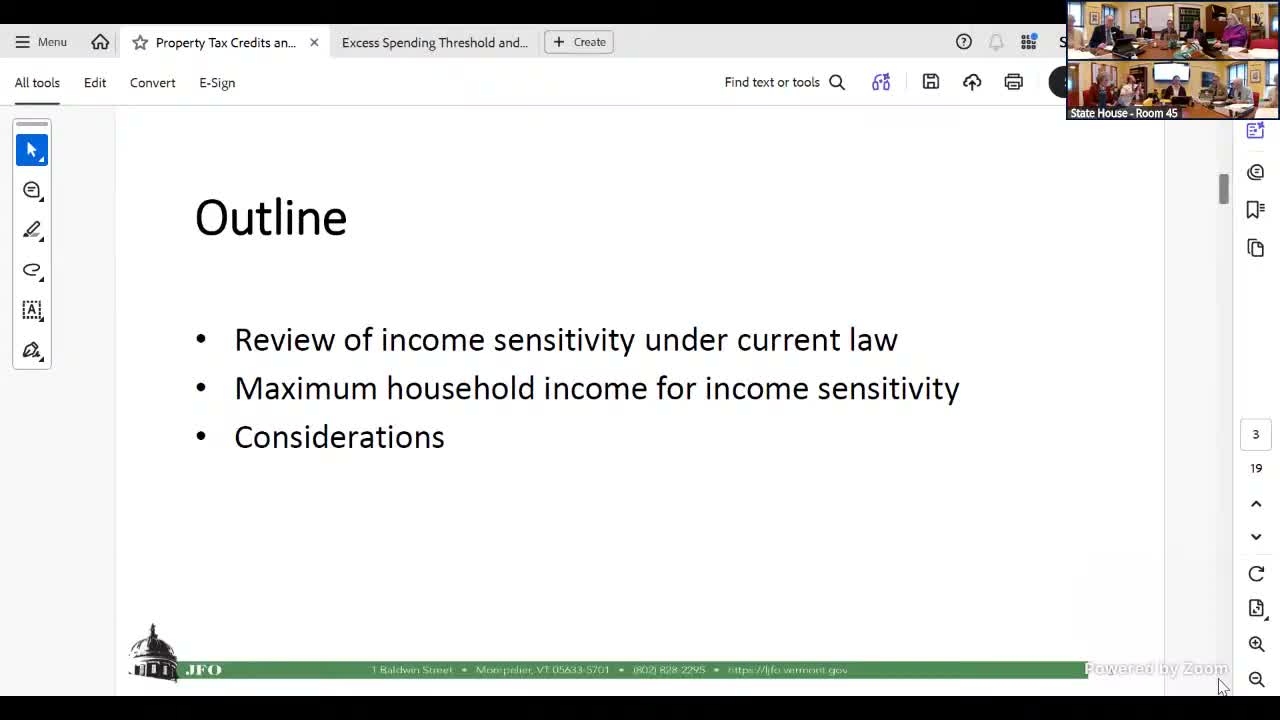
Julia Rector of the Joint Fiscal Office (JFO) told the Ways & Means committee on May 13 that a Tax Department proposal to raise the statutory house-site value cap for higher-income homesteads would expand who qualifies for the state’s property tax credit and raise costs for the education fund.
Rector reviewed the mechanics: the homestead property tax credit is calculated by comparing what a household paid in property taxes to what the household would have paid on income; "that difference is then what is the property tax credit," she said. She explained that statutory parameters — including a $225,000 house-site cap for households above $90,000 and income thresholds such as $90,000 — factor into where the breakeven point (the “maximum household income”) falls.
Why it matters: expanding the house-site cap would increase the number of homesteads that receive larger credits and therefore raise the education fund’s foregone revenue. Rector said the property tax credit is booked as a negative revenue item and estimated that credits applied on fiscal 2027 bills total about $134,000,000. She relayed Tax Department testimony that raising the cap to $250,000 would increase property-tax-credit costs by roughly $6,000,000, though she cautioned her own modeling was not yet finalized: "I believe tax testified to it being around 6,000,000," Rector said.
Timing and distributional trade-offs: Rector emphasized the policy’s delayed effect. Because credits are calculated on prior-year liabilities, any statutory change now would not be reflected on taxpayers’ bills until fiscal 2028. She warned that expanding credits for one group "squeezes the balloon," meaning the additional foregone revenue must be covered by higher property taxes elsewhere or by finding new nonproperty revenues. Rector also outlined an alternative lever: changing the ratio of homestead and income "yields" (the average-bill-change settings) to move the breakeven point, which would also expand credits but could be harder to quantify and would persist into future years.
Committee response: members raised concerns about late-session timing, data gaps and distributional impacts. One committee member noted the $47,000 circuit-breaker threshold "dates back to the nineties" and suggested indexing or revisiting that limit; the same member and others asked how expanding credits would affect housing markets and whether the legislature had sufficient data to evaluate trade-offs. The Chair said they had been "very hesitant to exchange the balloon for all the reasons that Julia outlined."
Context and next steps: Rector reminded members that Act 73 contingently repeals the property tax credit and replaces it with a tiered homestead exemption pegged to inflation, which could make any statutory changes to the credit moot unless Act 73 is amended. The committee scheduled further testimony (including on renter-oriented circuit-breaker provisions) and recessed for a break; staff said they would continue hearings and analysis before any final decision.
The committee did not take formal votes during this discussion; members asked JFO and tax staff for additional modeling and scheduled further testimony.
Rector reviewed the mechanics: the homestead property tax credit is calculated by comparing what a household paid in property taxes to what the household would have paid on income; "that difference is then what is the property tax credit," she said. She explained that statutory parameters — including a $225,000 house-site cap for households above $90,000 and income thresholds such as $90,000 — factor into where the breakeven point (the “maximum household income”) falls.
Why it matters: expanding the house-site cap would increase the number of homesteads that receive larger credits and therefore raise the education fund’s foregone revenue. Rector said the property tax credit is booked as a negative revenue item and estimated that credits applied on fiscal 2027 bills total about $134,000,000. She relayed Tax Department testimony that raising the cap to $250,000 would increase property-tax-credit costs by roughly $6,000,000, though she cautioned her own modeling was not yet finalized: "I believe tax testified to it being around 6,000,000," Rector said.
Timing and distributional trade-offs: Rector emphasized the policy’s delayed effect. Because credits are calculated on prior-year liabilities, any statutory change now would not be reflected on taxpayers’ bills until fiscal 2028. She warned that expanding credits for one group "squeezes the balloon," meaning the additional foregone revenue must be covered by higher property taxes elsewhere or by finding new nonproperty revenues. Rector also outlined an alternative lever: changing the ratio of homestead and income "yields" (the average-bill-change settings) to move the breakeven point, which would also expand credits but could be harder to quantify and would persist into future years.
Committee response: members raised concerns about late-session timing, data gaps and distributional impacts. One committee member noted the $47,000 circuit-breaker threshold "dates back to the nineties" and suggested indexing or revisiting that limit; the same member and others asked how expanding credits would affect housing markets and whether the legislature had sufficient data to evaluate trade-offs. The Chair said they had been "very hesitant to exchange the balloon for all the reasons that Julia outlined."
Context and next steps: Rector reminded members that Act 73 contingently repeals the property tax credit and replaces it with a tiered homestead exemption pegged to inflation, which could make any statutory changes to the credit moot unless Act 73 is amended. The committee scheduled further testimony (including on renter-oriented circuit-breaker provisions) and recessed for a break; staff said they would continue hearings and analysis before any final decision.
The committee did not take formal votes during this discussion; members asked JFO and tax staff for additional modeling and scheduled further testimony.
Don't Miss a Word: See the Full Meeting!
Go beyond summaries. Unlock every video, transcript, and key insight with a Founder Membership.
✓
Get instant access to full meeting videos
✓
Search and clip any phrase from complete transcripts
✓
Receive AI-powered summaries & custom alerts
✓
Enjoy lifetime, unrestricted access to government data
30-day money-back guarantee
