Fargo schools say vaping is disrupting classes; district asks for resources if city tightens retail rules
May 14, 2026 | Fargo , Cass County, North Dakota
This article was created by AI summarizing key points discussed. AI makes mistakes, so for full details and context, please refer to the video of the full meeting. Please report any errors so we can fix them. Report an error »
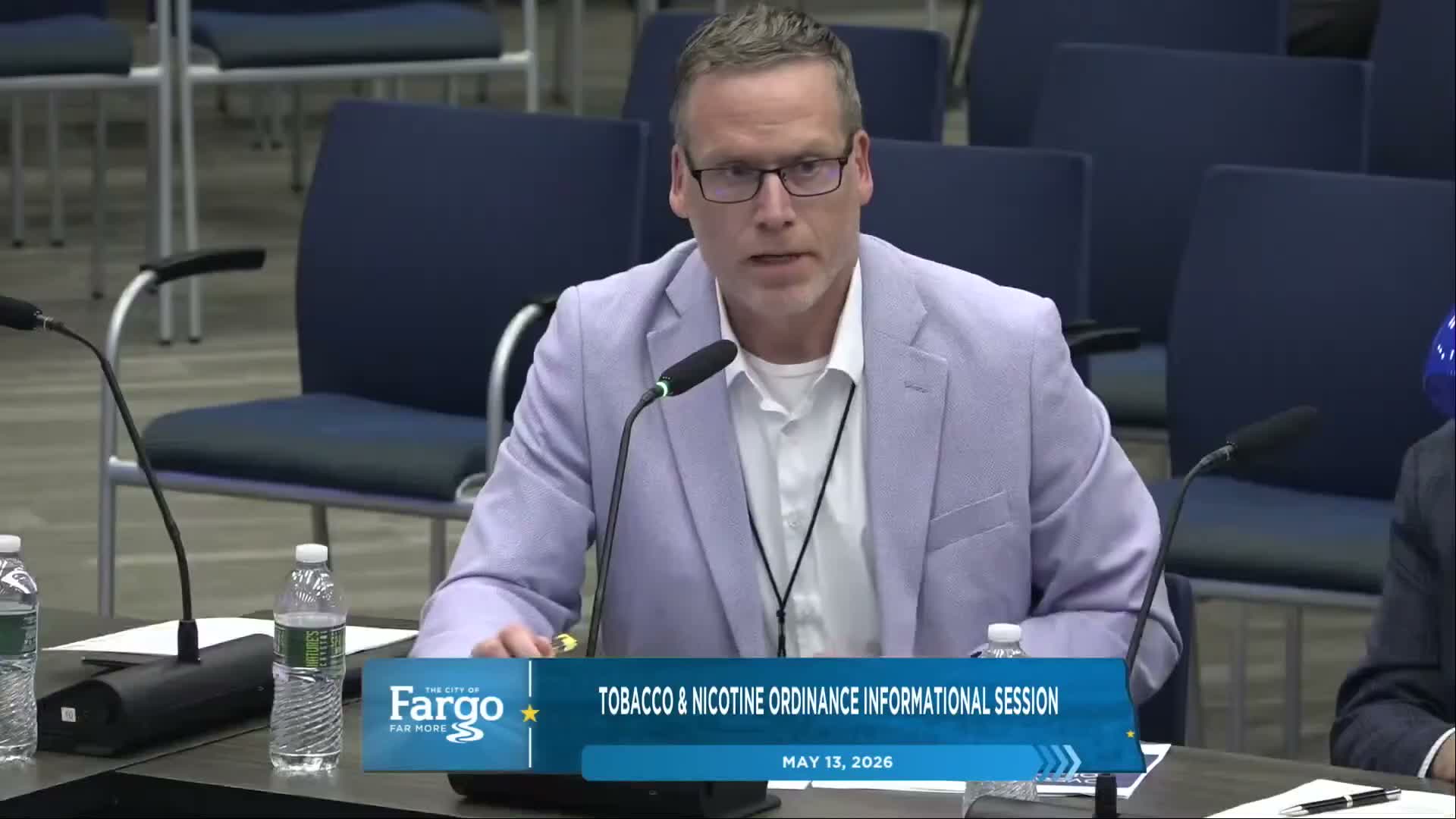
Fargo Public Schools officials told business leaders and city staff at a chamber roundtable that student vaping is imposing growing operational costs and harming classroom time, and asked that city policy responses include dedicated resources.
Corey Steiner, superintendent of Fargo Public Schools, described administrators’ efforts to manage vaping: earlier sensor alerts ranged from 90 to 120 daily in some high schools, triggering time-consuming investigations. “We just added vape detectors in all of our middle schools. That’s a cost of $43,000… but that would have been about another 24, so it was about a $68,000 cost,” Steiner said, describing labor and installation when district staff performed part of the work.
Steiner said the detectors cut sensor activations by roughly half, reduced staff time spent tracking down incidents and helped schools, but he warned the technology will require frequent replacement as devices and products evolve. “Technology is changing instantly. I will guarantee the vape detectors we have in our high schools will not be something that we will be able to have in probably 5 years,” he said.
School leaders asked how the city would channel any license or fine revenue to school-run cessation and prevention programs. Ian McClain, Fargo’s city attorney, said the city could fund programs through an MOU with the school district and that license revenue would normally go to the general fund unless otherwise arranged.
Retailers at the meeting suggested license fees as one way to fund school programs but debated fee levels and structure. Several business representatives favored tiered fees or one-time investments (for ID scanners) rather than high recurring fees. Participants also discussed alternative enforcement options for youth access—education, community service-style sanctions, and prevention programming as complements to retail rules.
Steiner and school representatives asked the city and public-health partners to consider both short-term support for enforcement and ongoing funding for programs that help students who have already begun using nicotine products. The roundtable ended with a commitment to draft fee and MOU options for further stakeholder review.
Corey Steiner, superintendent of Fargo Public Schools, described administrators’ efforts to manage vaping: earlier sensor alerts ranged from 90 to 120 daily in some high schools, triggering time-consuming investigations. “We just added vape detectors in all of our middle schools. That’s a cost of $43,000… but that would have been about another 24, so it was about a $68,000 cost,” Steiner said, describing labor and installation when district staff performed part of the work.
Steiner said the detectors cut sensor activations by roughly half, reduced staff time spent tracking down incidents and helped schools, but he warned the technology will require frequent replacement as devices and products evolve. “Technology is changing instantly. I will guarantee the vape detectors we have in our high schools will not be something that we will be able to have in probably 5 years,” he said.
School leaders asked how the city would channel any license or fine revenue to school-run cessation and prevention programs. Ian McClain, Fargo’s city attorney, said the city could fund programs through an MOU with the school district and that license revenue would normally go to the general fund unless otherwise arranged.
Retailers at the meeting suggested license fees as one way to fund school programs but debated fee levels and structure. Several business representatives favored tiered fees or one-time investments (for ID scanners) rather than high recurring fees. Participants also discussed alternative enforcement options for youth access—education, community service-style sanctions, and prevention programming as complements to retail rules.
Steiner and school representatives asked the city and public-health partners to consider both short-term support for enforcement and ongoing funding for programs that help students who have already begun using nicotine products. The roundtable ended with a commitment to draft fee and MOU options for further stakeholder review.
View the Full Meeting & All Its Details
This article offers just a summary. Unlock complete video, transcripts, and insights as a Founder Member.
✓
Watch full, unedited meeting videos
✓
Search every word spoken in unlimited transcripts
✓
AI summaries & real-time alerts (all government levels)
✓
Permanent access to expanding government content
30-day money-back guarantee
