Committee reviews wide-ranging cannabis bill, flags fee contingency and tenant-use limits
May 14, 2026 | Ways & Means, HOUSE OF REPRESENTATIVES, Committees, Legislative , Vermont
This article was created by AI summarizing key points discussed. AI makes mistakes, so for full details and context, please refer to the video of the full meeting. Please report any errors so we can fix them. Report an error »
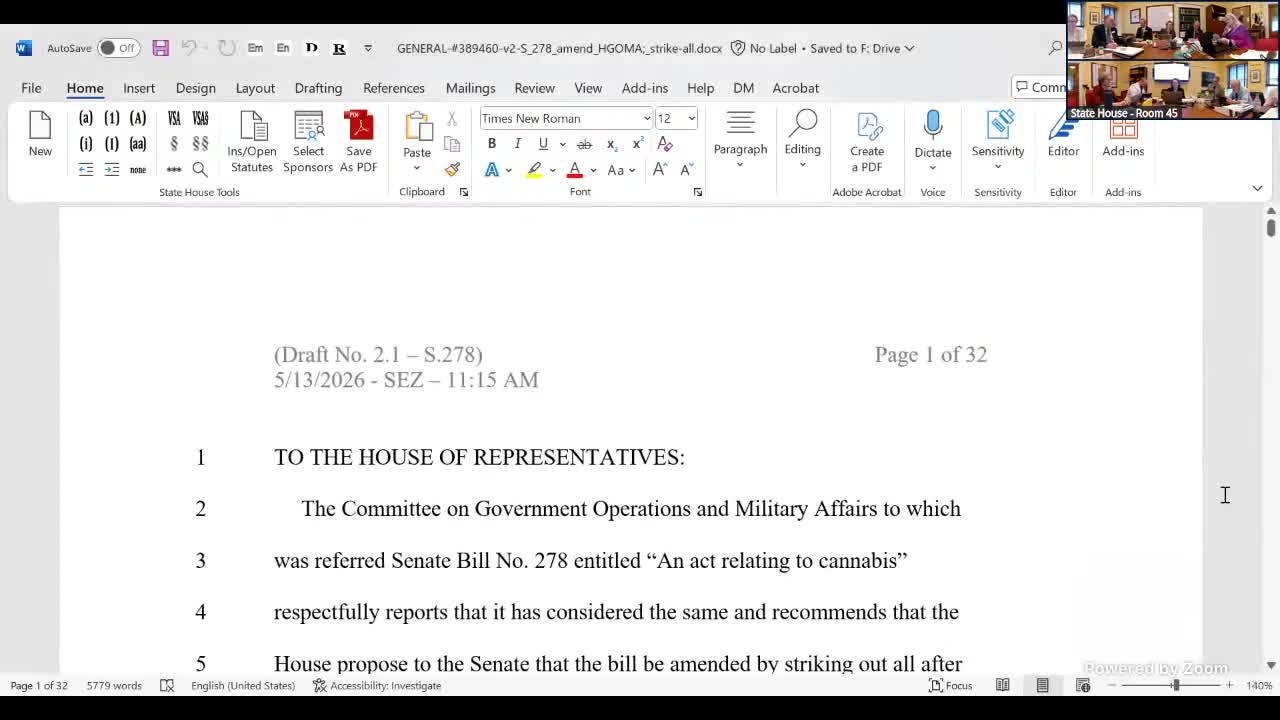
The committee resumed consideration of a comprehensive cannabis bill on May 13, receiving a section-by-section briefing from Sophie Sadani of the Office of Legislative Council and requesting follow-up briefings from tax staff and other witnesses before the bill is taken up again.
Sophie Sadani said the bill raises the allowable THC in a single packaged product from 100 milligrams to 200 milligrams and adjusts retail and criminal possession thresholds to match, allowing retailers to sell up to 2 ounces of cannabis or the equivalent. "It's not to do with the amount of cannabis in a product. It's to do with the size of the packaging," Sadani said, describing the change as analogous to choosing a six-pack versus a 12-pack of alcohol.
The measure also creates a two-year pilot for cannabis event permits, capped at 10 total permits (five public, five private). Sadani said an event permit cannot be issued for a location where alcoholic beverages are sold and that the fee would be $500, with 50% remitted to the municipality and 50% to the cannabis regulation fund. "The board shall include a requirement that permits are issued equitably among cannabis establishment license categories," she said.
The committee heard that one major provision would reduce outdoor cultivator license fees roughly in half but only if the Legislature transfers $105,000 to the cannabis regulation fund before Jan. 1, 2027 to replace anticipated lost revenue. Sadani explained the policy rationale offered by the drafters: outdoor cultivators operate on limited seasonal cycles and face greater weather-related risk, so lower fees are intended to reflect that operational reality. Members pressed for fiscal detail: one asked "Where is the wording for that? Is it on effective dates?" and staff pointed to the bill's effective-dates section.
Members were also told that references to integrated licenses in multiple statutory sections have been removed because integrated licenses have been phased out. A proposed expansion of the cannabis business development fund was deleted after staff reported the fund's balance was low and an appropriation that would have replenished it was removed in a different committee. "This morning, House Government Operations heard that there's not that much money left in that fund," Sadani said.
On tax matters, section 24 would change the definition of modified adjusted gross income to include certain cannabis business deductions for purposes of a property-tax credit; Sadani said this provision would be retroactive to Jan. 1, 2026 and that the tax department had reviewed the language. Several members asked for a detailed tax briefing and for "Kirby" and tax-department staff to appear when the bill is next scheduled so the committee can review fiscal notes and federal preemption concerns.
The bill would also alter landlord–tenant rules: rental agreements could not bar a tenant from possessing or using cannabis products within a dwelling unit, but leases could prohibit the use of lighted cannabis or products intended for inhalation. Sadani cautioned that the section would not override obligations in housing programs that federal law requires to prohibit cannabis possession. "This section shall not apply to any rental agreements that are required by federal law to prohibit the possession or use of cannabis within the rented premises," she said, referencing federal housing restrictions.
Members paused repeatedly to ask for clarifications about timing and funding. The staff review closed with a summary of effective dates: the retroactive tax-change provision to Jan. 1, 2026; the outdoor-cultivator fee cut effective Jan. 1, 2027 contingent on the $105,000 transfer; employee-license changes effective July 1, 2027; and the event-permit pilot repeal scheduled for July 1, 2028 unless the Legislature acts.
Committee members agreed to invite tax department staff and additional witnesses for the next briefing on Friday to resolve outstanding fiscal and federal-law questions. Committee member Jeff, in closing, compared the proposed event permits to long-standing wine- and beer-tasting permits and urged the panel to consider historical permitting precedents when evaluating the pilot. The bill was not voted on during this session; members deferred formal action pending the follow-up briefings.
Next steps: staff will arrange tax and fiscal briefings for Friday and provide the fiscal note and any additional materials requested by members.
Sophie Sadani said the bill raises the allowable THC in a single packaged product from 100 milligrams to 200 milligrams and adjusts retail and criminal possession thresholds to match, allowing retailers to sell up to 2 ounces of cannabis or the equivalent. "It's not to do with the amount of cannabis in a product. It's to do with the size of the packaging," Sadani said, describing the change as analogous to choosing a six-pack versus a 12-pack of alcohol.
The measure also creates a two-year pilot for cannabis event permits, capped at 10 total permits (five public, five private). Sadani said an event permit cannot be issued for a location where alcoholic beverages are sold and that the fee would be $500, with 50% remitted to the municipality and 50% to the cannabis regulation fund. "The board shall include a requirement that permits are issued equitably among cannabis establishment license categories," she said.
The committee heard that one major provision would reduce outdoor cultivator license fees roughly in half but only if the Legislature transfers $105,000 to the cannabis regulation fund before Jan. 1, 2027 to replace anticipated lost revenue. Sadani explained the policy rationale offered by the drafters: outdoor cultivators operate on limited seasonal cycles and face greater weather-related risk, so lower fees are intended to reflect that operational reality. Members pressed for fiscal detail: one asked "Where is the wording for that? Is it on effective dates?" and staff pointed to the bill's effective-dates section.
Members were also told that references to integrated licenses in multiple statutory sections have been removed because integrated licenses have been phased out. A proposed expansion of the cannabis business development fund was deleted after staff reported the fund's balance was low and an appropriation that would have replenished it was removed in a different committee. "This morning, House Government Operations heard that there's not that much money left in that fund," Sadani said.
On tax matters, section 24 would change the definition of modified adjusted gross income to include certain cannabis business deductions for purposes of a property-tax credit; Sadani said this provision would be retroactive to Jan. 1, 2026 and that the tax department had reviewed the language. Several members asked for a detailed tax briefing and for "Kirby" and tax-department staff to appear when the bill is next scheduled so the committee can review fiscal notes and federal preemption concerns.
The bill would also alter landlord–tenant rules: rental agreements could not bar a tenant from possessing or using cannabis products within a dwelling unit, but leases could prohibit the use of lighted cannabis or products intended for inhalation. Sadani cautioned that the section would not override obligations in housing programs that federal law requires to prohibit cannabis possession. "This section shall not apply to any rental agreements that are required by federal law to prohibit the possession or use of cannabis within the rented premises," she said, referencing federal housing restrictions.
Members paused repeatedly to ask for clarifications about timing and funding. The staff review closed with a summary of effective dates: the retroactive tax-change provision to Jan. 1, 2026; the outdoor-cultivator fee cut effective Jan. 1, 2027 contingent on the $105,000 transfer; employee-license changes effective July 1, 2027; and the event-permit pilot repeal scheduled for July 1, 2028 unless the Legislature acts.
Committee members agreed to invite tax department staff and additional witnesses for the next briefing on Friday to resolve outstanding fiscal and federal-law questions. Committee member Jeff, in closing, compared the proposed event permits to long-standing wine- and beer-tasting permits and urged the panel to consider historical permitting precedents when evaluating the pilot. The bill was not voted on during this session; members deferred formal action pending the follow-up briefings.
Next steps: staff will arrange tax and fiscal briefings for Friday and provide the fiscal note and any additional materials requested by members.
Don't Miss a Word: See the Full Meeting!
Go beyond summaries. Unlock every video, transcript, and key insight with a Founder Membership.
✓
Get instant access to full meeting videos
✓
Search and clip any phrase from complete transcripts
✓
Receive AI-powered summaries & custom alerts
✓
Enjoy lifetime, unrestricted access to government data
30-day money-back guarantee
