Weston County GOP committee forwards Baumann, Toomin and Jasinski as clerk nominees after candidate interviews and secret ballot
May 14, 2026 | Weston County, Wyoming
This article was created by AI summarizing key points discussed. AI makes mistakes, so for full details and context, please refer to the video of the full meeting. Please report any errors so we can fix them. Report an error »
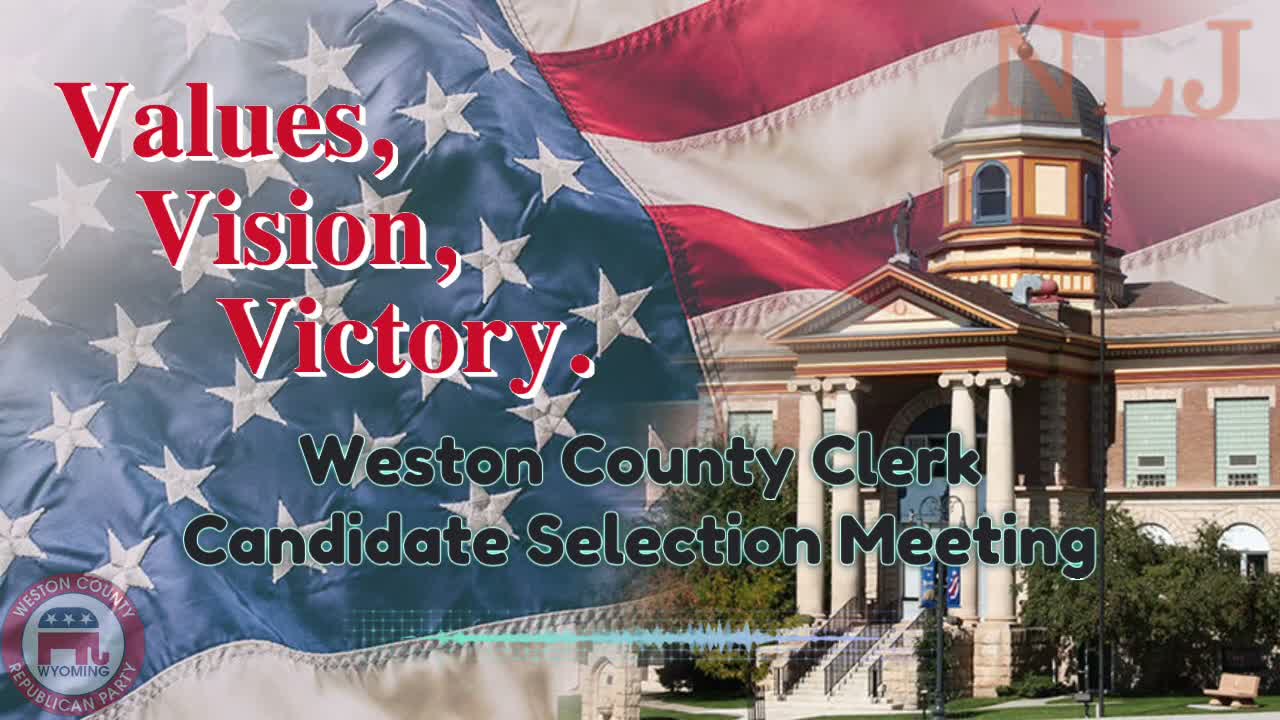
The Weston County Republican Central Committee met in a special session to select three nominees to forward to the county commissioners for the interim county clerk position, interviewing four candidates and voting by written ballot.
Chair Carrie Dross opened the meeting and the committee agreed to floor rules and a five‑minute presentation limit for each candidate followed by questions. Committee members debated whether paper ballots should be signed for transparency or kept secret to reduce peer pressure; the motion to remove the signature requirement failed and the committee kept signed ballots as part of the record.
Three candidates will be forwarded to the commissioners after the vote. The chair announced the final tallies after counting 21 ballots: Patricia (Tricia) Baumann 14 votes, Michael Toomin 20 votes, Amber (the acting clerk) 10 votes and Stanley Jasinski 14 votes. The committee forwarded Baumann, Toomin and Jasinski as its three nominees.
Tricia Baumann, who introduced herself as Tricia, told the committee she would prioritize election integrity and readying the county for the 2026 election. She cited the election code (Title 22) and the clerk duties listed in Title 18-3-402 and said she would not “test the law” or “break the law,” adding that she would seek binding direction from the secretary of state, the attorney general or the Legislative Service Office when statutes are unclear. On hand counting, she said four conditions would be necessary to implement it for 2026: a written directive from the secretary of state, party support and sufficient trained volunteers, no legal cease-and-desist from the attorney general or legislature, and written funding commitment from the county commissioners.
Michael Toomin, who said he has nearly 20 years of experience as an election judge, framed the clerk role as a nonpartisan service job that supports the county’s operations and the upcoming election. “I really believe the clerk’s position is not a political position,” he said, adding that open elections and clear testing procedures should be priorities. Toomin also raised technical concerns about current tabulation systems and said he would favor measures such as air‑gapped test environments and stronger pre‑election testing if machines remain in use.
Amber, the acting clerk, described seven years in the clerk’s office and said she has performed accounts payable, payroll, land records and election tasks. She repeatedly said she would seek help and training from other clerks and the secretary of state and that she would fix procedural problems if they occur; she declined to detail an ongoing criminal investigation she said had arisen from the prior administration, noting she had been asked to testify by investigators and could not discuss evidence.
Stanley Jasinski urged a move toward hand counting, arguing the machines are costly and vulnerable and pointing to statutory provisions governing hand‑count procedures and a buyback clause in the county’s machine contract. He recommended community outreach and using local volunteers if the county transitions to hand counts.
The committee appointed a three‑member teller panel to collect and count ballots and confirmed that ballots would be part of the public record and available for review. After counting, committee leaders announced the three finalists that will be sent to the Weston County commissioners for the final appointment.
The committee closed with a prayer and adjourned. The county commissioners will review the three names and make the final appointment for interim county clerk.
Chair Carrie Dross opened the meeting and the committee agreed to floor rules and a five‑minute presentation limit for each candidate followed by questions. Committee members debated whether paper ballots should be signed for transparency or kept secret to reduce peer pressure; the motion to remove the signature requirement failed and the committee kept signed ballots as part of the record.
Three candidates will be forwarded to the commissioners after the vote. The chair announced the final tallies after counting 21 ballots: Patricia (Tricia) Baumann 14 votes, Michael Toomin 20 votes, Amber (the acting clerk) 10 votes and Stanley Jasinski 14 votes. The committee forwarded Baumann, Toomin and Jasinski as its three nominees.
Tricia Baumann, who introduced herself as Tricia, told the committee she would prioritize election integrity and readying the county for the 2026 election. She cited the election code (Title 22) and the clerk duties listed in Title 18-3-402 and said she would not “test the law” or “break the law,” adding that she would seek binding direction from the secretary of state, the attorney general or the Legislative Service Office when statutes are unclear. On hand counting, she said four conditions would be necessary to implement it for 2026: a written directive from the secretary of state, party support and sufficient trained volunteers, no legal cease-and-desist from the attorney general or legislature, and written funding commitment from the county commissioners.
Michael Toomin, who said he has nearly 20 years of experience as an election judge, framed the clerk role as a nonpartisan service job that supports the county’s operations and the upcoming election. “I really believe the clerk’s position is not a political position,” he said, adding that open elections and clear testing procedures should be priorities. Toomin also raised technical concerns about current tabulation systems and said he would favor measures such as air‑gapped test environments and stronger pre‑election testing if machines remain in use.
Amber, the acting clerk, described seven years in the clerk’s office and said she has performed accounts payable, payroll, land records and election tasks. She repeatedly said she would seek help and training from other clerks and the secretary of state and that she would fix procedural problems if they occur; she declined to detail an ongoing criminal investigation she said had arisen from the prior administration, noting she had been asked to testify by investigators and could not discuss evidence.
Stanley Jasinski urged a move toward hand counting, arguing the machines are costly and vulnerable and pointing to statutory provisions governing hand‑count procedures and a buyback clause in the county’s machine contract. He recommended community outreach and using local volunteers if the county transitions to hand counts.
The committee appointed a three‑member teller panel to collect and count ballots and confirmed that ballots would be part of the public record and available for review. After counting, committee leaders announced the three finalists that will be sent to the Weston County commissioners for the final appointment.
The committee closed with a prayer and adjourned. The county commissioners will review the three names and make the final appointment for interim county clerk.
Don't Miss a Word: See the Full Meeting!
Go beyond summaries. Unlock every video, transcript, and key insight with a Founder Membership.
✓
Get instant access to full meeting videos
✓
Search and clip any phrase from complete transcripts
✓
Receive AI-powered summaries & custom alerts
✓
Enjoy lifetime, unrestricted access to government data
30-day money-back guarantee
