Michigan House Insurance Committee hears bills to allow private share insurance for state-chartered credit unions
May 14, 2026 | 2025-2026 House Legislature MI, Michigan
This article was created by AI summarizing key points discussed. AI makes mistakes, so for full details and context, please refer to the video of the full meeting. Please report any errors so we can fix them. Report an error »
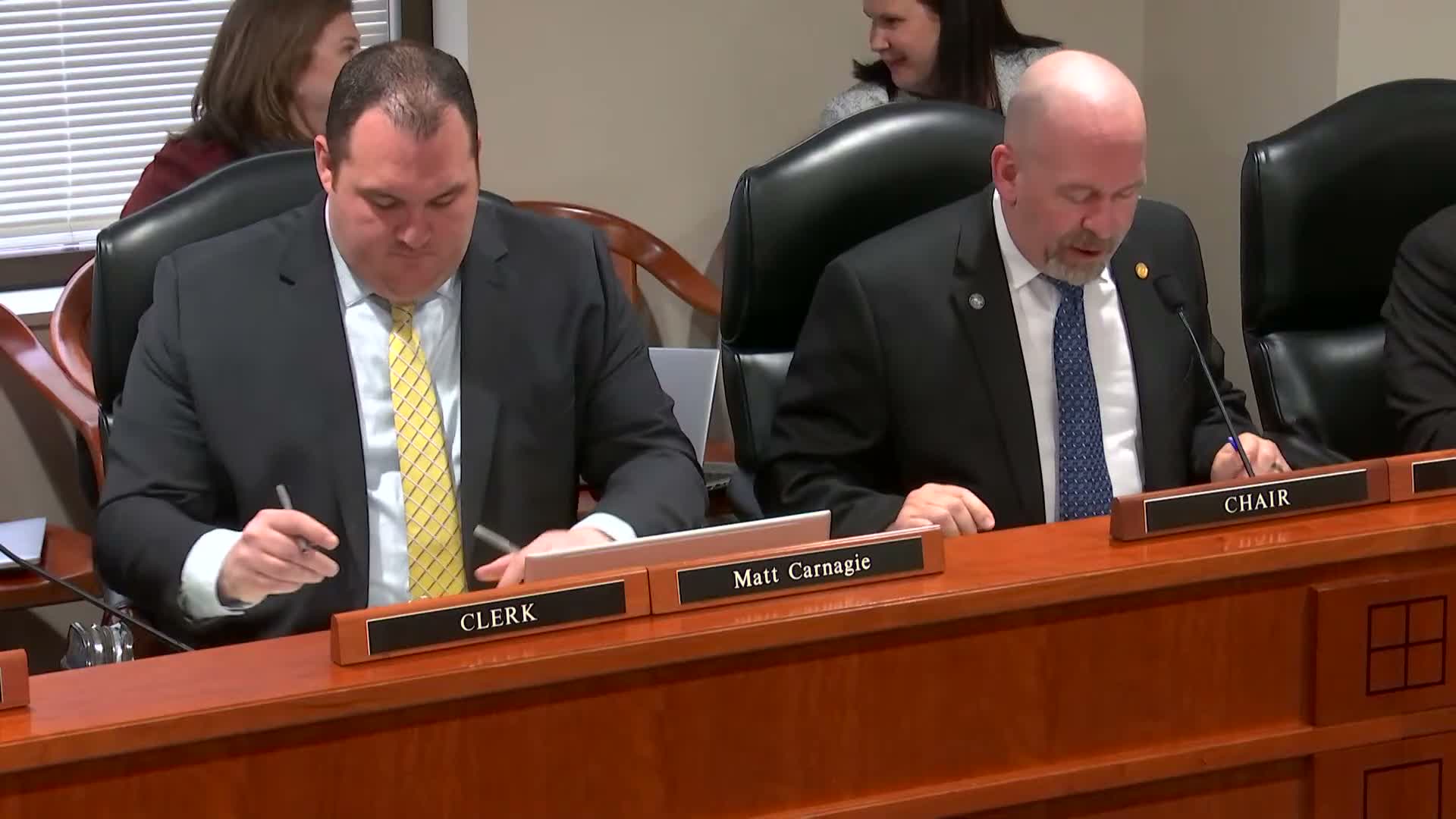
Chair Harris opened the House Insurance Committee hearing and introduced a package of five bills (HB 5779–5783) that would update Michigan's Credit Union Act to permit state-chartered credit unions to use qualified private share insurance.
The bills, Harris said, would not eliminate consumer protections or regulatory oversight but would allow private share insurers to provide baseline coverage in situations where federal insurance (through the National Credit Union Administration) is not used. "This legislation does not eliminate consumer protections or regulatory oversight," Harris said, arguing the statutory framework should allow flexibility while preserving safety.
Vice Chair Brenda Carter, a co-sponsor of the package and sponsor of HB 5783, told the committee the bills are intended to enable lawful, clear and properly structured communications between credit unions, regulators and qualified private insurers. "If we're going to allow qualified private insurance organizations to play a role in this process, then communications must be clear, lawful, and properly structured," Carter said, asking for support for the package.
Kieran Marion, executive vice president of advocacy for the Michigan Credit Union League, testified in favor of the bills and asked the committee to hear all five together. Marion provided a short bill-by-bill rundown, describing sponsor focuses that include authorization at formation or conversion, technical charter reference updates, accommodations for out-of-state credit unions with private insurance, and a licensing/regulatory process to be developed by the state regulator. Marion said the League represents 172 state and federally chartered credit unions serving almost 6,000,000 Michiganders and emphasized that drafting the package took about 18 months.
Representing private insurers, Kurt Loes, chief operations officer of American Share Insurance (ASI), described ASI as a mutual share insurance guarantee fund founded in 1974 that insures deposits across 10 states. Loes told the committee ASI provides deposit protection up to $250,000 per account and said ASI's balance sheet and reserve practices are conservative; he said ASI insures more than $20,000,000,000 in deposits for roughly 1,300,000 members and stated, "In the 52 years since our founding, no member has ever lost money in an ASI insured account."
Loes explained ASI's oversight and examination practices: ASI is regulated in Ohio and participates in joint examinations with state credit-union regulators; financial statements are audited annually and an independent actuary attests to reserve sufficiency. He said ASI maintains committed lines of credit with large financial institutions, follows conservative investment strategies and reports equity and reserve ratios that, as he characterized them, compare favorably to federal programs.
During questioning, a committee member asked how many private deposit insurers operate nationally. Loes said ASI is currently the only provider offering a private-deposit-insurance baseline in the way described to the committee. When asked whether the program would replace the NCUA for state-chartered credit unions that opt in, Loes said yes: "This program would be a replacement to the federal insurance program. NCUA would no longer be the insurer of record for those state-chartered credit unions, and, in this case, ASI would be."
Committee members also pressed on differences among states and exam frequency; Loes said each state operates somewhat differently but that most require regulator exams every 12 to 18 months and that ASI conducts most exams jointly with state regulators.
The committee did not take a final vote on HB 5779–5783 at the hearing; its recorded formal action during the session was a separate motion to re-refer House Bill 5214 to the House Committee on Finance, which passed on a 9–0 tally. The committee adjourned with no further business scheduled at that session.
The bills, Harris said, would not eliminate consumer protections or regulatory oversight but would allow private share insurers to provide baseline coverage in situations where federal insurance (through the National Credit Union Administration) is not used. "This legislation does not eliminate consumer protections or regulatory oversight," Harris said, arguing the statutory framework should allow flexibility while preserving safety.
Vice Chair Brenda Carter, a co-sponsor of the package and sponsor of HB 5783, told the committee the bills are intended to enable lawful, clear and properly structured communications between credit unions, regulators and qualified private insurers. "If we're going to allow qualified private insurance organizations to play a role in this process, then communications must be clear, lawful, and properly structured," Carter said, asking for support for the package.
Kieran Marion, executive vice president of advocacy for the Michigan Credit Union League, testified in favor of the bills and asked the committee to hear all five together. Marion provided a short bill-by-bill rundown, describing sponsor focuses that include authorization at formation or conversion, technical charter reference updates, accommodations for out-of-state credit unions with private insurance, and a licensing/regulatory process to be developed by the state regulator. Marion said the League represents 172 state and federally chartered credit unions serving almost 6,000,000 Michiganders and emphasized that drafting the package took about 18 months.
Representing private insurers, Kurt Loes, chief operations officer of American Share Insurance (ASI), described ASI as a mutual share insurance guarantee fund founded in 1974 that insures deposits across 10 states. Loes told the committee ASI provides deposit protection up to $250,000 per account and said ASI's balance sheet and reserve practices are conservative; he said ASI insures more than $20,000,000,000 in deposits for roughly 1,300,000 members and stated, "In the 52 years since our founding, no member has ever lost money in an ASI insured account."
Loes explained ASI's oversight and examination practices: ASI is regulated in Ohio and participates in joint examinations with state credit-union regulators; financial statements are audited annually and an independent actuary attests to reserve sufficiency. He said ASI maintains committed lines of credit with large financial institutions, follows conservative investment strategies and reports equity and reserve ratios that, as he characterized them, compare favorably to federal programs.
During questioning, a committee member asked how many private deposit insurers operate nationally. Loes said ASI is currently the only provider offering a private-deposit-insurance baseline in the way described to the committee. When asked whether the program would replace the NCUA for state-chartered credit unions that opt in, Loes said yes: "This program would be a replacement to the federal insurance program. NCUA would no longer be the insurer of record for those state-chartered credit unions, and, in this case, ASI would be."
Committee members also pressed on differences among states and exam frequency; Loes said each state operates somewhat differently but that most require regulator exams every 12 to 18 months and that ASI conducts most exams jointly with state regulators.
The committee did not take a final vote on HB 5779–5783 at the hearing; its recorded formal action during the session was a separate motion to re-refer House Bill 5214 to the House Committee on Finance, which passed on a 9–0 tally. The committee adjourned with no further business scheduled at that session.
View the Full Meeting & All Its Details
This article offers just a summary. Unlock complete video, transcripts, and insights as a Founder Member.
✓
Watch full, unedited meeting videos
✓
Search every word spoken in unlimited transcripts
✓
AI summaries & real-time alerts (all government levels)
✓
Permanent access to expanding government content
30-day money-back guarantee
