Joint Sustainability Committee unanimously urges Council to require transparency, independent analysis before Austin Energy pursues gas peakers
May 13, 2026 | Austin, Travis County, Texas
This article was created by AI summarizing key points discussed. AI makes mistakes, so for full details and context, please refer to the video of the full meeting. Please report any errors so we can fix them. Report an error »
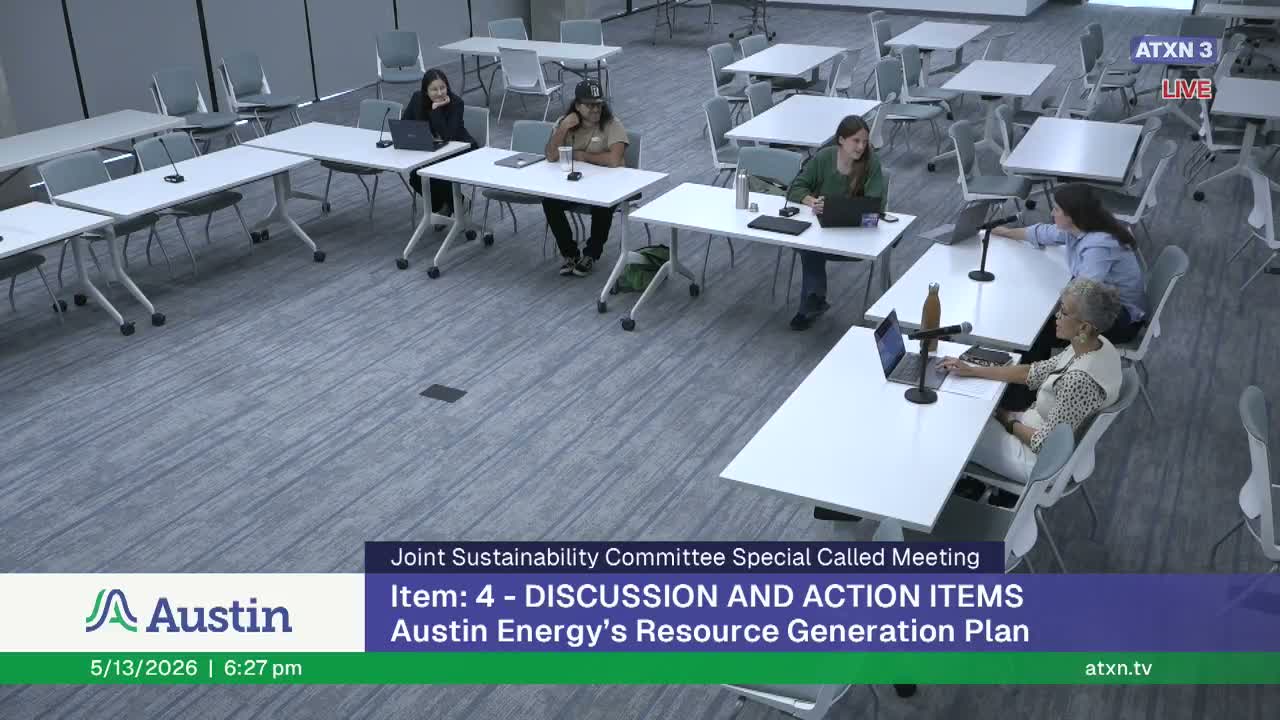
The Joint Sustainability Committee on May 21 unanimously adopted a resolution urging the Austin City Council to require transparency, competitive purchasing and independent economic analysis before Austin Energy moves forward with plans tied to natural‑gas peaking capacity.
Committee Chair (speaker S1) told members the item scheduled for Council on May 21 would ask authorization to “spend money” without stating a dollar amount or naming vendors. “They’re requesting authorization to spend money, but there is no amount listed and there is no, there’s no companies listed because they have not actually gone through the competitive purchasing process,” the Chair said, describing what the committee called a “blank check” request for roughly 400 megawatts of peakers that could cost on the order of $1 billion based on current market estimates.
Why it matters: members said the purchase would lock the city into a capital-intensive fossil‑fuel asset with long lifetimes, expose ratepayers to potential stranded-asset risk and could undermine Austin’s climate goals. The resolution asks Council to direct the city manager to use the established competitive purchasing process; fully disclose costs and financial-risk analyses to the public; conduct a well‑promoted public engagement process comparing gas peakers with zero‑emission alternatives; and commission an independent economic analysis that factors in greenhouse‑gas emissions and local air‑quality impacts.
Committee debate centered on three practical concerns: whether the Council request was for a down payment or full purchase, whether Austin Energy intended to discuss key commercial details in executive session, and whether other options (batteries, demand management, transmission upgrades) had been adequately modeled. Speaker S8 said the utility appeared prepared to handle “the vast majority of meaningful conversation” in executive session and that lack of public information was a central concern. Several members asked for clearer fiscal-impact figures, scenario modeling of volatile fuel prices and a comparison of levelized costs for peakers versus storage and renewables.
The resolution was amended on the floor to add explicit language requiring disclosure of the financial risks of potential stranded assets and to strengthen air‑quality findings. The committee inserted a whereas clause referencing the American Lung Association’s 2026 State of the Air report, which it said assigned Travis County an F for ozone, a D for short‑term particle pollution and a failing grade for annual particle pollution. The committee also added language noting methane’s high near‑term global‑warming potential (86 times CO2 over a 20‑year horizon when emitted directly), citing concerns about leakage in Texas natural‑gas production.
Process and outcome: Speaker S2 moved to adopt the recommendation and Speaker S3 seconded. After final edits and the Chair’s readaloud of the amended language, the committee voted unanimously to approve the resolution and asked staff and advocates to elevate the recommendation to Council members ahead of the May 21 meeting.
What happens next: the committee’s resolution is advisory; Council will make the final decision on the Austin Energy item scheduled for May 21. The committee asked the city manager to provide publicly the analysis that shows why carbon‑free alternatives were not available and to fully explain how any requested action would affect Austin Energy’s ability to meet its carbon targets.
Notes: The Chair and multiple committee members recommended adding scenario modeling and asked that the independent economic analysis include the financial impacts of added greenhouse‑gas emissions and local air pollution.
Committee Chair (speaker S1) told members the item scheduled for Council on May 21 would ask authorization to “spend money” without stating a dollar amount or naming vendors. “They’re requesting authorization to spend money, but there is no amount listed and there is no, there’s no companies listed because they have not actually gone through the competitive purchasing process,” the Chair said, describing what the committee called a “blank check” request for roughly 400 megawatts of peakers that could cost on the order of $1 billion based on current market estimates.
Why it matters: members said the purchase would lock the city into a capital-intensive fossil‑fuel asset with long lifetimes, expose ratepayers to potential stranded-asset risk and could undermine Austin’s climate goals. The resolution asks Council to direct the city manager to use the established competitive purchasing process; fully disclose costs and financial-risk analyses to the public; conduct a well‑promoted public engagement process comparing gas peakers with zero‑emission alternatives; and commission an independent economic analysis that factors in greenhouse‑gas emissions and local air‑quality impacts.
Committee debate centered on three practical concerns: whether the Council request was for a down payment or full purchase, whether Austin Energy intended to discuss key commercial details in executive session, and whether other options (batteries, demand management, transmission upgrades) had been adequately modeled. Speaker S8 said the utility appeared prepared to handle “the vast majority of meaningful conversation” in executive session and that lack of public information was a central concern. Several members asked for clearer fiscal-impact figures, scenario modeling of volatile fuel prices and a comparison of levelized costs for peakers versus storage and renewables.
The resolution was amended on the floor to add explicit language requiring disclosure of the financial risks of potential stranded assets and to strengthen air‑quality findings. The committee inserted a whereas clause referencing the American Lung Association’s 2026 State of the Air report, which it said assigned Travis County an F for ozone, a D for short‑term particle pollution and a failing grade for annual particle pollution. The committee also added language noting methane’s high near‑term global‑warming potential (86 times CO2 over a 20‑year horizon when emitted directly), citing concerns about leakage in Texas natural‑gas production.
Process and outcome: Speaker S2 moved to adopt the recommendation and Speaker S3 seconded. After final edits and the Chair’s readaloud of the amended language, the committee voted unanimously to approve the resolution and asked staff and advocates to elevate the recommendation to Council members ahead of the May 21 meeting.
What happens next: the committee’s resolution is advisory; Council will make the final decision on the Austin Energy item scheduled for May 21. The committee asked the city manager to provide publicly the analysis that shows why carbon‑free alternatives were not available and to fully explain how any requested action would affect Austin Energy’s ability to meet its carbon targets.
Notes: The Chair and multiple committee members recommended adding scenario modeling and asked that the independent economic analysis include the financial impacts of added greenhouse‑gas emissions and local air pollution.
View the Full Meeting & All Its Details
This article offers just a summary. Unlock complete video, transcripts, and insights as a Founder Member.
✓
Watch full, unedited meeting videos
✓
Search every word spoken in unlimited transcripts
✓
AI summaries & real-time alerts (all government levels)
✓
Permanent access to expanding government content
30-day money-back guarantee
