Rhinebeck board authorizes letter of intent to pursue New York pro‑housing certification
May 13, 2026 | Rhinebeck, Dutchess County, New York
This article was created by AI summarizing key points discussed. AI makes mistakes, so for full details and context, please refer to the video of the full meeting. Please report any errors so we can fix them. Report an error »
Donna Warner, co‑chair of the Comprehensive Plan Implementation Committee’s Affordable Housing Work Group, told the village board that New York’s Pro‑Housing Certification offers two pathways to certification: demonstrable housing growth (about 1% of units) or adoption of a model “pro housing” resolution prepared by the state program. Warner said the program now prioritizes or requires certification to apply for certain discretionary funding and that the current package of programs totals roughly $650 million to $750 million for certified communities.
"The certification is designed specifically for municipalities who are taking meaningful steps, towards housing growth," Warner said, describing how certification links municipal zoning and permitting changes to eligibility for state housing and infrastructure programs. She said the CPIC unanimously recommended that the Village of Rhinebeck pursue the certification and that the committee could bring a resolution for the board’s public hearing and vote.
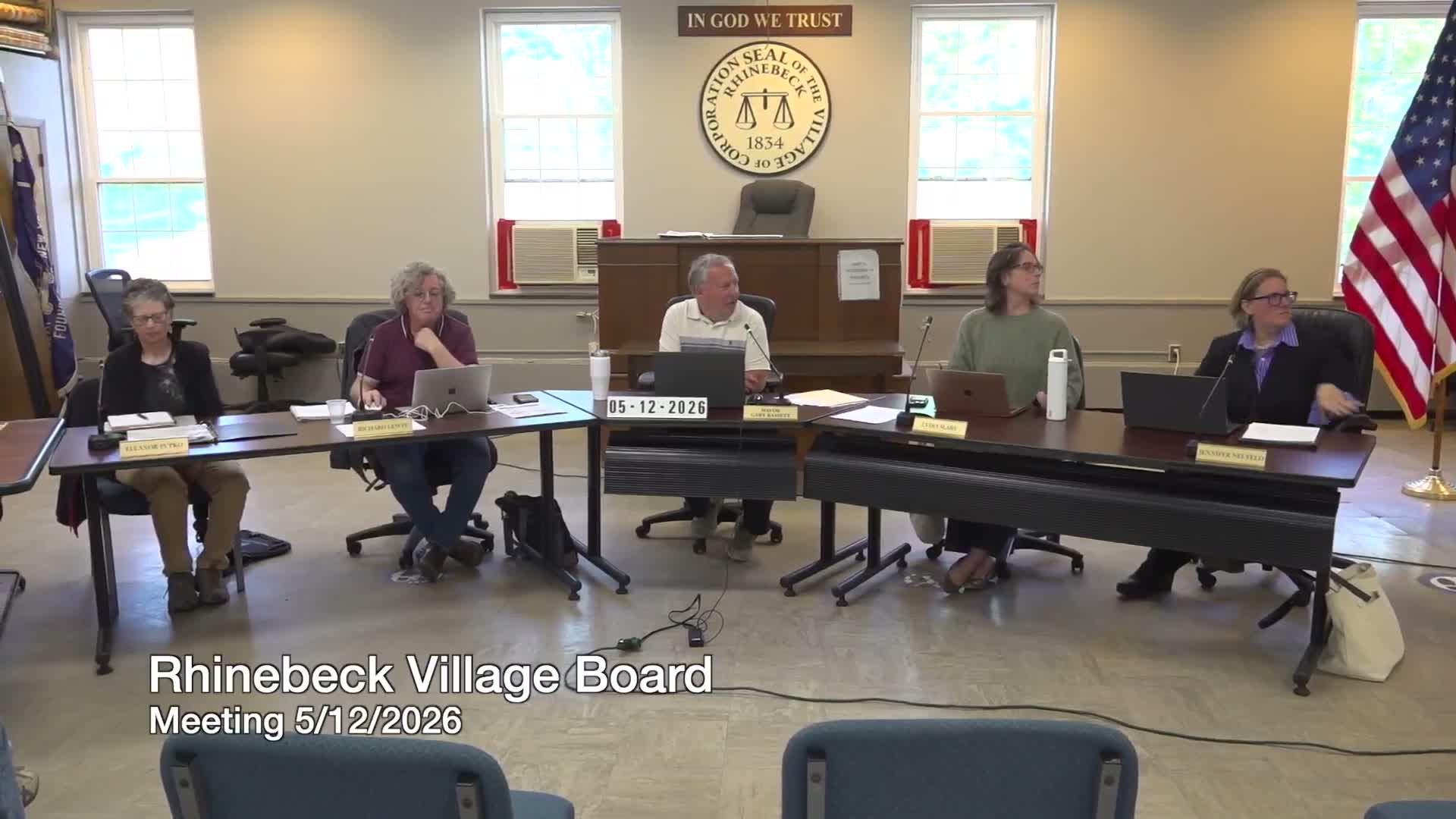
Chair moved to authorize the mayor to submit a pro‑housing letter of intent, schedule a public hearing on the model resolution and appoint a liaison to support the application process. Board members discussed which pathway the village would pursue and whether edits were needed to the draft letter; the board agreed the resolution could be adopted and application materials submitted pending minor edits. Members recorded their support by voice vote and the motion passed with ayes recorded (tally not specified in the transcript).
The board discussed potential next steps: filing the application with New York State Homes and Community Renewal, documenting current zoning/permitting data, and scheduling a public hearing on the pro‑housing resolution before a formal vote. Warner emphasized the role of municipal adoption in unlocking state infrastructure funds—citing sewer expansion as a likely eligible use.
The board’s approval authorizes municipal staff to proceed with the letter of intent and to set a public hearing to consider the model pro‑housing resolution; the transcript records a voice vote in favor but does not include a formal roll‑call tally. The board did not yet adopt the pro‑housing resolution itself; that remains a separate, upcoming public hearing and vote.
"The certification is designed specifically for municipalities who are taking meaningful steps, towards housing growth," Warner said, describing how certification links municipal zoning and permitting changes to eligibility for state housing and infrastructure programs. She said the CPIC unanimously recommended that the Village of Rhinebeck pursue the certification and that the committee could bring a resolution for the board’s public hearing and vote.
Chair moved to authorize the mayor to submit a pro‑housing letter of intent, schedule a public hearing on the model resolution and appoint a liaison to support the application process. Board members discussed which pathway the village would pursue and whether edits were needed to the draft letter; the board agreed the resolution could be adopted and application materials submitted pending minor edits. Members recorded their support by voice vote and the motion passed with ayes recorded (tally not specified in the transcript).
The board discussed potential next steps: filing the application with New York State Homes and Community Renewal, documenting current zoning/permitting data, and scheduling a public hearing on the pro‑housing resolution before a formal vote. Warner emphasized the role of municipal adoption in unlocking state infrastructure funds—citing sewer expansion as a likely eligible use.
The board’s approval authorizes municipal staff to proceed with the letter of intent and to set a public hearing to consider the model pro‑housing resolution; the transcript records a voice vote in favor but does not include a formal roll‑call tally. The board did not yet adopt the pro‑housing resolution itself; that remains a separate, upcoming public hearing and vote.
View the Full Meeting & All Its Details
This article offers just a summary. Unlock complete video, transcripts, and insights as a Founder Member.
✓
Watch full, unedited meeting videos
✓
Search every word spoken in unlimited transcripts
✓
AI summaries & real-time alerts (all government levels)
✓
Permanent access to expanding government content
30-day money-back guarantee
