Will County planning commission recommends denying 6,099-acre Earthrise solar special-use permit after wetlands and corrosion concerns
May 13, 2026 | Will County, Illinois
This article was created by AI summarizing key points discussed. AI makes mistakes, so for full details and context, please refer to the video of the full meeting. Please report any errors so we can fix them. Report an error »
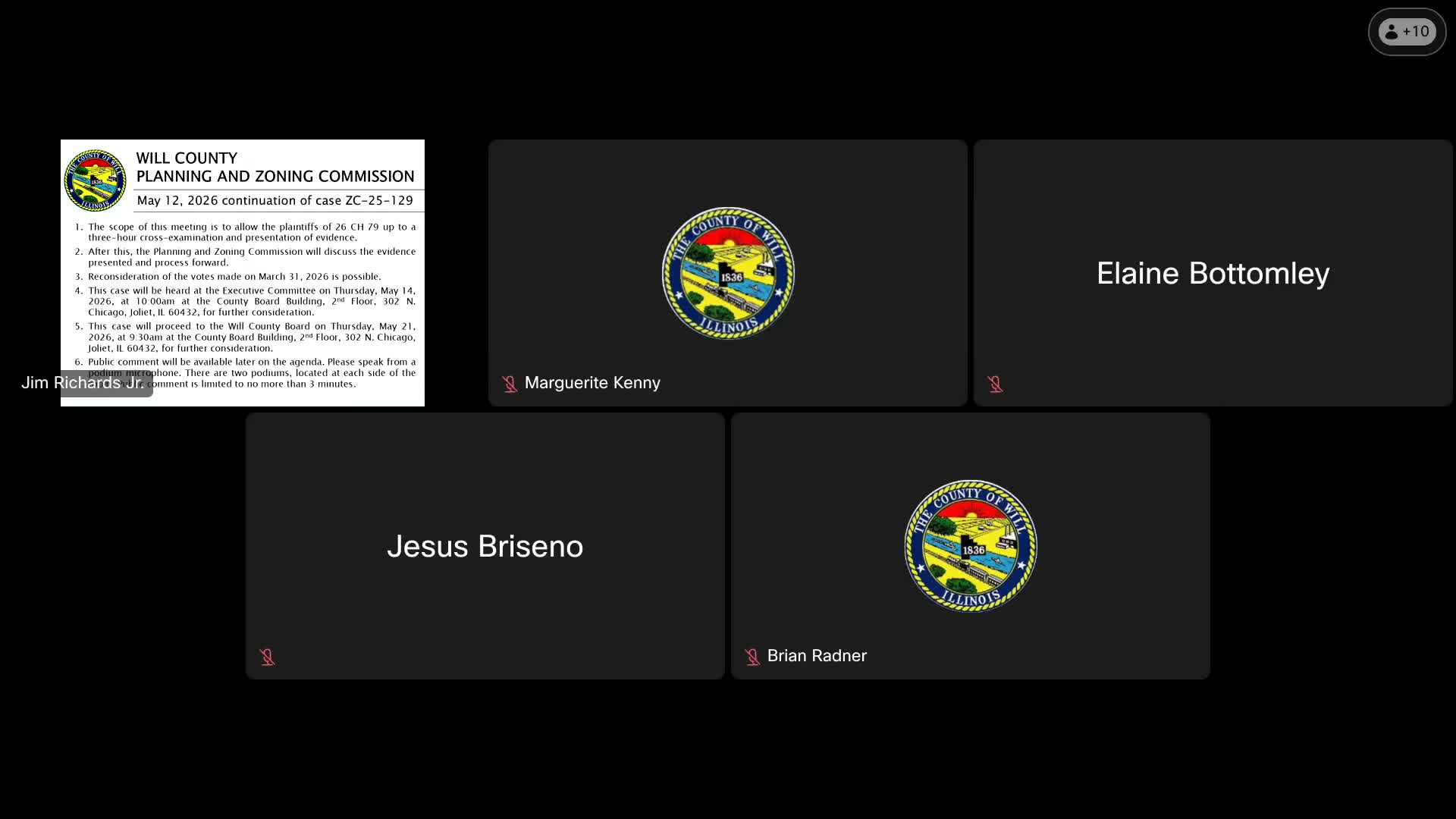
The Will County Planning and Zoning Commission on May 12 recommended that the county board deny a proposed special-use permit for a 6,099-acre, 96-parcel commercial solar facility proposed by Lincoln Solar Energy LLC / Earthrise.
The hearing, held on court remand to allow cross-examination and the presentation of additional evidence, included extended direct and cross-examination of the developers lead witness and two days of focused technical testimony about wetlands and soil conditions. Ben Jacoby, attorney for the applicant, told the commission the only issue on remand was the special-use permit and that the applicant had supplemented the record with a May 8 memorandum and an updated site plan. "The variances are not at issue tonight," Jacoby said, adding the applicant had filed supplemental wetland delineations and site-plan refinements.
Plaintiffs counsel Steven Becker objected to introduction of some supplemental materials and repeatedly questioned the developer about the decision to submit a single special-use application covering noncontiguous parcels. Becker also pressed the company on the projects interaction with wetlands and hydric soils, the Illinois Land Evaluation and Site Assessment (LISA) score and the potential for galvanized-steel pile corrosion to leach zinc into soil and groundwater.
The developers witness, identified in the hearing as the lead project developer, said the November 2025 application used the U.S. Fish and Wildlife Service National Wetland Inventory (NWI) as the primary delineation and that field delineations had since been completed. On the record, the developer said it would "avoid the permanent impacts to all wetlands identified in this supplement." The developer also acknowledged the 03/05/2026 site plan is conceptual and that final panel locations would be set during the site-development-permit stage.
Plaintiffs presented three witnesses who argued the project poses environmental and public-safety risks. Melissa Tabteager, a caisson drilling professional, testified that "anything put into ground that is wet is going to eventually leach out," describing hydric soils and arguing that driven galvanized posts in wet ground could corrode more quickly and increase local leaching risk. Neighbors offered photos and video of frequent, local flooding around parcels adjacent to the proposed footprint.
Company witnesses and counsel countered that decades of galvanized-steel use in infrastructure provide no documented evidence of groundwater contamination from standard driven piles at the densities proposed, that expert testimony (presented earlier in the administrative record) had concluded local leaching would be minimal and that the developer had now provided supplemental field delineations to overlay the conceptual plan and avoid delineated wetlands.
Commissioners pressed both sides on what the special-use vote would authorize versus what would be reviewed later in site-development permits. The developer said final site work, including more detailed field delineations and a conservation plan with the soil and water conservation district, would refine panel layouts and wetland protection measures.
Before taking the final recommendation vote, the commission approved amendments to staff-recommended conditions (including language allowing the applicant to use an above-ground cabling system between panels as presented at the hearing, classifying gravel fire lanes as pervious for county code purposes and adding road-use agreement language consistent with county ordinance). The amendment passed on roll call.
On the substantive recommendation on the special-use permit (ZC-25129 / SUP-25-056), the commission recorded a roll-call vote that failed to approve the permit, producing a recommendation of denial to the county board. The motion to approve with the six conditions as amended did not receive a majority; the recorded votes showed one commissioner voting yes and four voting no, and the commissions action now goes to the county board for a final decision.
What happens next: the commissions recommendation is advisory to the county board; the board will consider the application and the administratively compiled record (including the supplemental materials) in a future meeting. The applicant has referenced potential federal tax incentives and project timelines but made no final commitment in the hearing; developer counsel said decisions about tax-credit applications would be made at an appropriate future time.
Reporting notes: the hearing record includes the developments site data (applicant-stated nameplate capacity of 600 megawatts at the point of interconnection), the project footprint (6,099 acres across 96 parcels), and natural-resource materials cited in the hearing (a Will South Cook Soil and Water Conservation District Natural Resource Information report and ECOCAT/IDNR references). Plaintiffs and some commissioners raised questions about farmed-wetland delineation seasonality and whether supplemental field work completed since the November 2025 application satisfied ordinance requirements; the developer and staff maintain the supplemental delineation report overlays the March 2026 site plan and that wetlands will be avoided in the final design.
The Planning & Zoning Commission adjourned the special hearing and scheduled its next regular meeting for May 19.
The hearing, held on court remand to allow cross-examination and the presentation of additional evidence, included extended direct and cross-examination of the developers lead witness and two days of focused technical testimony about wetlands and soil conditions. Ben Jacoby, attorney for the applicant, told the commission the only issue on remand was the special-use permit and that the applicant had supplemented the record with a May 8 memorandum and an updated site plan. "The variances are not at issue tonight," Jacoby said, adding the applicant had filed supplemental wetland delineations and site-plan refinements.
Plaintiffs counsel Steven Becker objected to introduction of some supplemental materials and repeatedly questioned the developer about the decision to submit a single special-use application covering noncontiguous parcels. Becker also pressed the company on the projects interaction with wetlands and hydric soils, the Illinois Land Evaluation and Site Assessment (LISA) score and the potential for galvanized-steel pile corrosion to leach zinc into soil and groundwater.
The developers witness, identified in the hearing as the lead project developer, said the November 2025 application used the U.S. Fish and Wildlife Service National Wetland Inventory (NWI) as the primary delineation and that field delineations had since been completed. On the record, the developer said it would "avoid the permanent impacts to all wetlands identified in this supplement." The developer also acknowledged the 03/05/2026 site plan is conceptual and that final panel locations would be set during the site-development-permit stage.
Plaintiffs presented three witnesses who argued the project poses environmental and public-safety risks. Melissa Tabteager, a caisson drilling professional, testified that "anything put into ground that is wet is going to eventually leach out," describing hydric soils and arguing that driven galvanized posts in wet ground could corrode more quickly and increase local leaching risk. Neighbors offered photos and video of frequent, local flooding around parcels adjacent to the proposed footprint.
Company witnesses and counsel countered that decades of galvanized-steel use in infrastructure provide no documented evidence of groundwater contamination from standard driven piles at the densities proposed, that expert testimony (presented earlier in the administrative record) had concluded local leaching would be minimal and that the developer had now provided supplemental field delineations to overlay the conceptual plan and avoid delineated wetlands.
Commissioners pressed both sides on what the special-use vote would authorize versus what would be reviewed later in site-development permits. The developer said final site work, including more detailed field delineations and a conservation plan with the soil and water conservation district, would refine panel layouts and wetland protection measures.
Before taking the final recommendation vote, the commission approved amendments to staff-recommended conditions (including language allowing the applicant to use an above-ground cabling system between panels as presented at the hearing, classifying gravel fire lanes as pervious for county code purposes and adding road-use agreement language consistent with county ordinance). The amendment passed on roll call.
On the substantive recommendation on the special-use permit (ZC-25129 / SUP-25-056), the commission recorded a roll-call vote that failed to approve the permit, producing a recommendation of denial to the county board. The motion to approve with the six conditions as amended did not receive a majority; the recorded votes showed one commissioner voting yes and four voting no, and the commissions action now goes to the county board for a final decision.
What happens next: the commissions recommendation is advisory to the county board; the board will consider the application and the administratively compiled record (including the supplemental materials) in a future meeting. The applicant has referenced potential federal tax incentives and project timelines but made no final commitment in the hearing; developer counsel said decisions about tax-credit applications would be made at an appropriate future time.
Reporting notes: the hearing record includes the developments site data (applicant-stated nameplate capacity of 600 megawatts at the point of interconnection), the project footprint (6,099 acres across 96 parcels), and natural-resource materials cited in the hearing (a Will South Cook Soil and Water Conservation District Natural Resource Information report and ECOCAT/IDNR references). Plaintiffs and some commissioners raised questions about farmed-wetland delineation seasonality and whether supplemental field work completed since the November 2025 application satisfied ordinance requirements; the developer and staff maintain the supplemental delineation report overlays the March 2026 site plan and that wetlands will be avoided in the final design.
The Planning & Zoning Commission adjourned the special hearing and scheduled its next regular meeting for May 19.
View the Full Meeting & All Its Details
This article offers just a summary. Unlock complete video, transcripts, and insights as a Founder Member.
✓
Watch full, unedited meeting videos
✓
Search every word spoken in unlimited transcripts
✓
AI summaries & real-time alerts (all government levels)
✓
Permanent access to expanding government content
30-day money-back guarantee
