Lowell advances federally mandated Centerville sewer separation; commission issues standard order of conditions
May 13, 2026 | Lowell City, Middlesex County, Massachusetts
This article was created by AI summarizing key points discussed. AI makes mistakes, so for full details and context, please refer to the video of the full meeting. Please report any errors so we can fix them. Report an error »
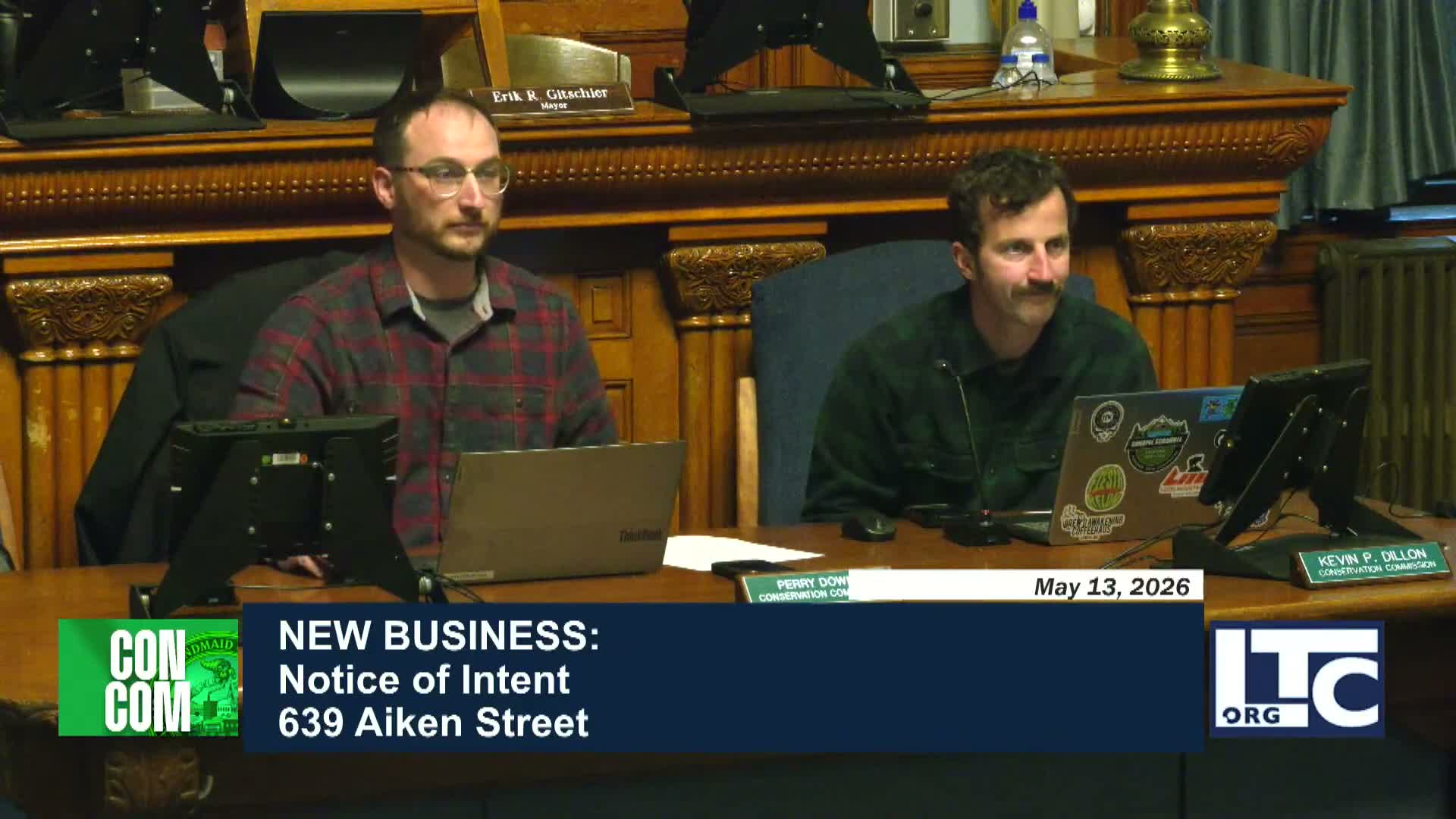
Evan Walsh, executive director of the Lowell Regional Wastewater Utility, told the Lowell Conservation Commission on May 13 that the city is seeking approval of a Notice of Intent for Phase 2A of the Centerville sewer separation project, with work near 639 Aiken Street (MassDEP file 2060852). Walsh described the overall program as part of a federally mandated sewer‑separation effort that will require multiple phases across the city and said the Phase 2 trunk line in Centerville will connect to earlier work.
Walsh provided scope and mitigation details: the full program includes roughly 12,000 linear feet of drainage, the Centerville main trunk line for this phase is about 3,000 feet, and pipe sections will reach up to 5 feet by 6 feet. Work will temporarily affect riverfront, land under water, bordering land subject to flooding, and buffer/offset zones under WPA jurisdiction. Mitigation will include steel sheeting, sandbagging, excavation from the upland side of the river, compost log placements to control sediment, and riprap at the outfall to dissipate energy and limit erosion.
Walsh also reviewed three MassDEP comments on the filing: a change from an ordinary high water line to mean annual high water increased calculated impacts by about 100 square feet in underwater/riverfront areas but was addressed in a revised table; a revised table clarified fill under the BLSF and resulted in an approximately 90–100 cubic yard reduction in fill within the flood zone; and the outfall velocity concern is addressed with an outfall design and riprap to minimize erosion. Walsh said the utility plans to bid the work in the fall, award a contract in early 2027, and expects roughly two to three years of construction for this phase; all phases of the program must be completed by 2032 under the federal schedule.
The commission opened the public hearing for the NOI, recorded that no members of the public were present to comment, and closed the hearing. A motion to issue the City a standard order of conditions was made, seconded and approved by the commission.
Commissioners asked clarifying questions about timing and impact; Walsh and his companion from CDM Smith (identified as Sean Lavoie present to assist) described the project sequencing and erosion mitigation. The utility emphasized design measures intended to minimize riverbank disturbance and sediment discharge during construction.
Walsh provided scope and mitigation details: the full program includes roughly 12,000 linear feet of drainage, the Centerville main trunk line for this phase is about 3,000 feet, and pipe sections will reach up to 5 feet by 6 feet. Work will temporarily affect riverfront, land under water, bordering land subject to flooding, and buffer/offset zones under WPA jurisdiction. Mitigation will include steel sheeting, sandbagging, excavation from the upland side of the river, compost log placements to control sediment, and riprap at the outfall to dissipate energy and limit erosion.
Walsh also reviewed three MassDEP comments on the filing: a change from an ordinary high water line to mean annual high water increased calculated impacts by about 100 square feet in underwater/riverfront areas but was addressed in a revised table; a revised table clarified fill under the BLSF and resulted in an approximately 90–100 cubic yard reduction in fill within the flood zone; and the outfall velocity concern is addressed with an outfall design and riprap to minimize erosion. Walsh said the utility plans to bid the work in the fall, award a contract in early 2027, and expects roughly two to three years of construction for this phase; all phases of the program must be completed by 2032 under the federal schedule.
The commission opened the public hearing for the NOI, recorded that no members of the public were present to comment, and closed the hearing. A motion to issue the City a standard order of conditions was made, seconded and approved by the commission.
Commissioners asked clarifying questions about timing and impact; Walsh and his companion from CDM Smith (identified as Sean Lavoie present to assist) described the project sequencing and erosion mitigation. The utility emphasized design measures intended to minimize riverbank disturbance and sediment discharge during construction.
View the Full Meeting & All Its Details
This article offers just a summary. Unlock complete video, transcripts, and insights as a Founder Member.
✓
Watch full, unedited meeting videos
✓
Search every word spoken in unlimited transcripts
✓
AI summaries & real-time alerts (all government levels)
✓
Permanent access to expanding government content
30-day money-back guarantee
