Conference committee adopts House File 3900 language to send school‑trust amendment to voters
May 13, 2026 | 2026 Legislature MN, Minnesota
This article was created by AI summarizing key points discussed. AI makes mistakes, so for full details and context, please refer to the video of the full meeting. Please report any errors so we can fix them. Report an error »
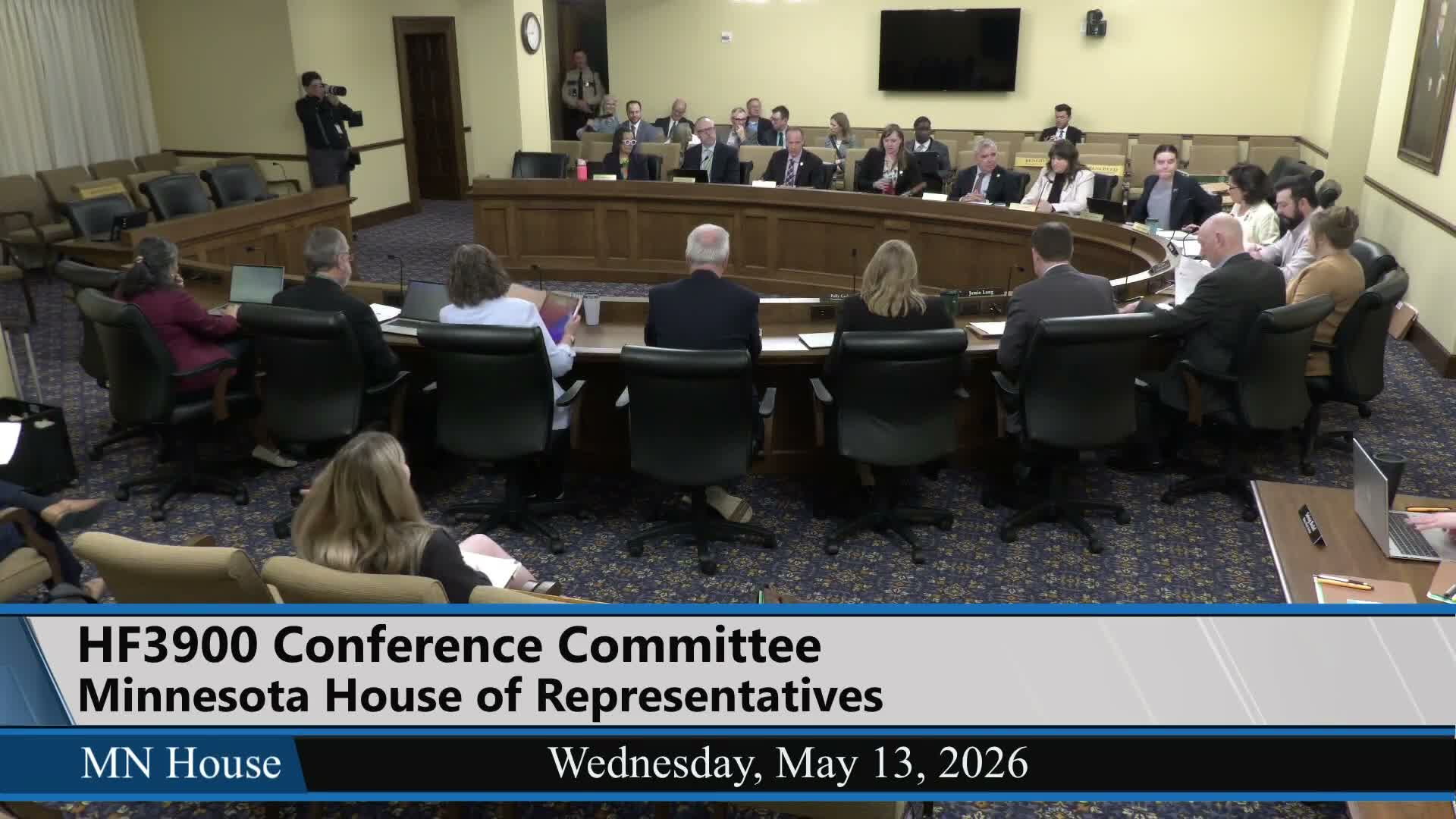
Representative Spencer Igoe, chair of the conference committee and chief author of House File 3,900, opened the meeting and led a nonpartisan staff walkthrough of the bill’s language, which would amend the Minnesota Constitution to change how the Permanent School Trust Fund’s distributions are calculated.
House research described the core change: instead of distributing the interest and dividends earned annually, the amendment would set a fixed annual distribution equal to 4.5 percent of the fund’s value, measured as the average over the previous three fiscal years. The proposal assigns the Commissioner of Management and Budget the responsibility to determine and transfer the distributable amount, and directs that the Department of Education administer the portion allocated to school districts. The ballot question language would be submitted to voters as a yes/no question and would require a simple majority of those voting to pass.
Committee members debated whether statutory authority to set the 4.5 percent could be altered by a future legislature and whether the amendment should require a supermajority to change distribution policy. Senator Rob Farnsworth asked counsel whether a later legislature could raise the distribution above 4.5 percent, for example to 8–10 percent, and whether anything in the language would prevent that. Counsel replied that, under the proposals, the 4.5 percent is established by statute and there is no explicit constitutional cap in the House language; the Senate version would add constitutional language requiring a two‑thirds vote of each house to change distribution policy. Counsel also said that the constitutional phrase requiring preservation of the fund’s purchasing power is “fairly strong,” but that remedies and who would have standing to sue were not entirely clear.
Representative Jamie Long said he had no personal intention of adjusting the 4.5 percent next year and voiced a general opposition to embedding supermajority requirements in law: “I don't have an intention, personally, of, adjusting the 4.5% next year,” he said, adding that the existing system of checks and balances among the two houses and the governor already constrains dramatic changes.
Senator Farnsworth countered that changing from interest‑and‑dividends to a percentage of fund value could make the fund more vulnerable to politicization and that a two‑thirds requirement would protect against simple‑majority changes: “The 2 thirds would guard against that political aspect of this fund,” he said. Several members, including Senator Mary Kunish and Representative Shelly Joaquin, said they feared a supermajority requirement could also have downsides—making it harder to lower a distribution if the fund’s value declined and risking the fund being used as a political pawn.
Representative (Timo) Driscoll recounted the School Trust Lands Commission’s bipartisan design and historical safeguards, noting that prior practices that charged trust lands for unrelated expenses had been corrected by the legislature to preserve funds for students. Chair Igoe emphasized the measure’s stated aim to preserve the purchasing power of the trust for Minnesota students.
Senator Mary Kunish moved to adopt the language of House File 3,900 (second engrossment) as the conference committee report. The chair called a roll‑call vote; the motion passed 7–1. The committee recorded ayes from Representative Spencer Igoe, Representative Jamie Long, Representative Timo Driscoll, Representative Shelly Joaquin, Senator Mary Kunish, Senator Steve Swadzinski and Senator Amanda Hemmingson Yeager, with Senator Rob Farnsworth voting no. The chair said members would receive an email to accept the conference committee report and the committee adjourned.
What happens next: the adopted conference committee report will be delivered through the legislature’s acceptance process and the constitutional amendment language approved by the conference committee would go before Minnesota voters as a ballot question if the legislature and procedural steps allow it to proceed.
House research described the core change: instead of distributing the interest and dividends earned annually, the amendment would set a fixed annual distribution equal to 4.5 percent of the fund’s value, measured as the average over the previous three fiscal years. The proposal assigns the Commissioner of Management and Budget the responsibility to determine and transfer the distributable amount, and directs that the Department of Education administer the portion allocated to school districts. The ballot question language would be submitted to voters as a yes/no question and would require a simple majority of those voting to pass.
Committee members debated whether statutory authority to set the 4.5 percent could be altered by a future legislature and whether the amendment should require a supermajority to change distribution policy. Senator Rob Farnsworth asked counsel whether a later legislature could raise the distribution above 4.5 percent, for example to 8–10 percent, and whether anything in the language would prevent that. Counsel replied that, under the proposals, the 4.5 percent is established by statute and there is no explicit constitutional cap in the House language; the Senate version would add constitutional language requiring a two‑thirds vote of each house to change distribution policy. Counsel also said that the constitutional phrase requiring preservation of the fund’s purchasing power is “fairly strong,” but that remedies and who would have standing to sue were not entirely clear.
Representative Jamie Long said he had no personal intention of adjusting the 4.5 percent next year and voiced a general opposition to embedding supermajority requirements in law: “I don't have an intention, personally, of, adjusting the 4.5% next year,” he said, adding that the existing system of checks and balances among the two houses and the governor already constrains dramatic changes.
Senator Farnsworth countered that changing from interest‑and‑dividends to a percentage of fund value could make the fund more vulnerable to politicization and that a two‑thirds requirement would protect against simple‑majority changes: “The 2 thirds would guard against that political aspect of this fund,” he said. Several members, including Senator Mary Kunish and Representative Shelly Joaquin, said they feared a supermajority requirement could also have downsides—making it harder to lower a distribution if the fund’s value declined and risking the fund being used as a political pawn.
Representative (Timo) Driscoll recounted the School Trust Lands Commission’s bipartisan design and historical safeguards, noting that prior practices that charged trust lands for unrelated expenses had been corrected by the legislature to preserve funds for students. Chair Igoe emphasized the measure’s stated aim to preserve the purchasing power of the trust for Minnesota students.
Senator Mary Kunish moved to adopt the language of House File 3,900 (second engrossment) as the conference committee report. The chair called a roll‑call vote; the motion passed 7–1. The committee recorded ayes from Representative Spencer Igoe, Representative Jamie Long, Representative Timo Driscoll, Representative Shelly Joaquin, Senator Mary Kunish, Senator Steve Swadzinski and Senator Amanda Hemmingson Yeager, with Senator Rob Farnsworth voting no. The chair said members would receive an email to accept the conference committee report and the committee adjourned.
What happens next: the adopted conference committee report will be delivered through the legislature’s acceptance process and the constitutional amendment language approved by the conference committee would go before Minnesota voters as a ballot question if the legislature and procedural steps allow it to proceed.
View the Full Meeting & All Its Details
This article offers just a summary. Unlock complete video, transcripts, and insights as a Founder Member.
✓
Watch full, unedited meeting videos
✓
Search every word spoken in unlimited transcripts
✓
AI summaries & real-time alerts (all government levels)
✓
Permanent access to expanding government content
30-day money-back guarantee
