Fire officials tell Ann Arbor planning commission that 150-foot rule, apparatus and staffing shape infill design
May 13, 2026 | Ann Arbor Public Schools, School Boards, Michigan
This article was created by AI summarizing key points discussed. AI makes mistakes, so for full details and context, please refer to the video of the full meeting. Please report any errors so we can fix them. Report an error »
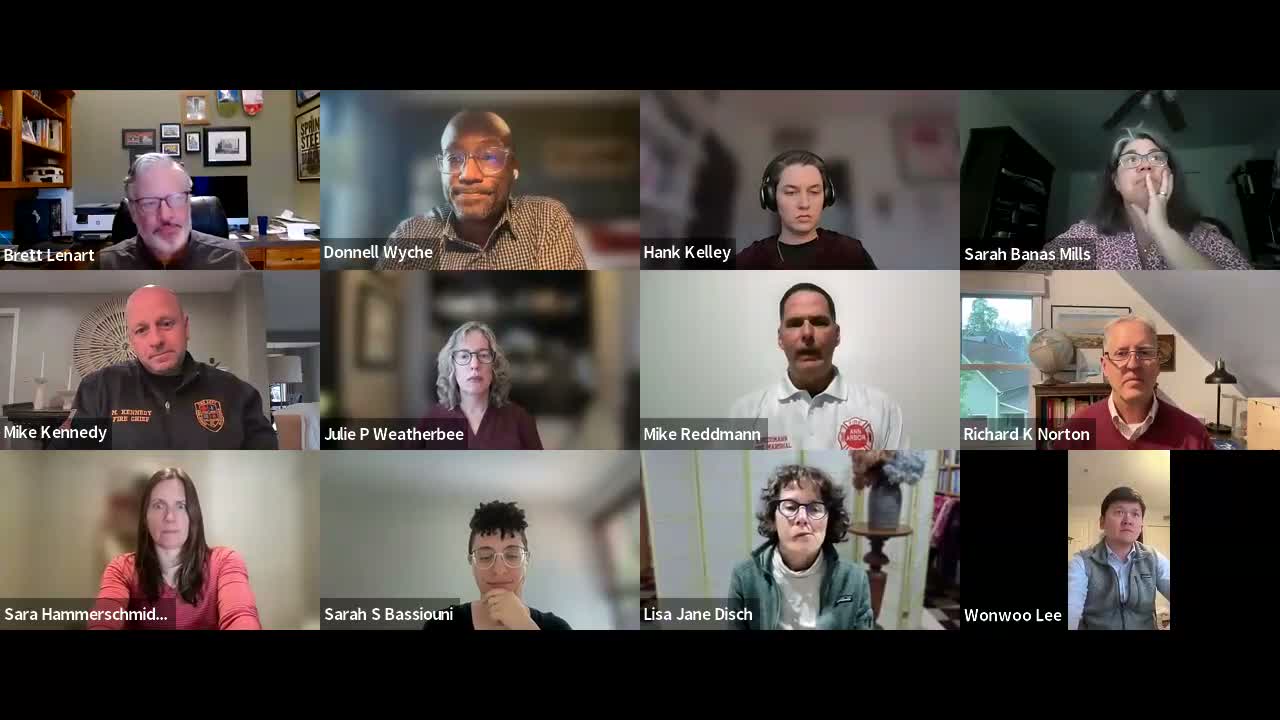
Chair Donnell White opened the May work session of the Ann Arbor City Planning Commission and said there would be no formal votes as the commission sought information from city fire officials about how code requirements affect infill development.
The most consequential takeaway for commissioners was a set of technical limits in the adopted codes that can force changes to site plans: Fire Marshal Marshall Redmond told the commission that the city follows the 2021 International Fire Code (IFC) and that the code includes a 150-foot travel-distance limit for fire apparatus, which often requires turnarounds or additional paved surface when a building is set far back on a parcel. "There's a fire code that says we can't travel over a 150 feet, without having a turnaround," Redmond said, adding that the travel distance is measured along the actual travel path around a building.
Why it matters: commissioners said their priority is enabling more housing while minimizing impervious surface and neighborhood impacts. Several planners pointed to the 805 Oxford review as an example where code-driven access requirements led designers to move a building in ways that increased paving and impacts on neighboring properties.
Chief Kennedy, who described his role overseeing operations while the marshal handles technical plan compliance, framed the issue as partly outside the city's direct control. He said Ann Arbor legally adopted the 2021 Michigan Building Code and the 2021 International Fire Code earlier this year and noted Michigan's statutes and code-adoption timing can limit local latitude. "2021 Michigan building code and 2021 international fire code were adopted this year," Chief Kennedy said.
Commissioners explored exceptions and alternatives. Redmond emphasized that code books include written exceptions and commentary that sometimes permit different approaches when the intent of a provision is met. He also said some occupancies are governed by the Michigan Residential Code (MRC) rather than the Building Code; the MRC contains different application rules, and certain hose-lay or travel-distance provisions do not apply to one- and two-family dwellings on a single parcel.
Practical trade-offs surfaced repeatedly. Commissioners and staff discussed pervious-pavement trials (the Viridian project off Platte Road was cited) and whether newer materials can meet fire- and engineering standards in Michigan's winter climate. Redmond and Chief Kennedy said some pervious systems have performed well but warned about plowing and maintenance in snow.
Apparatus and staffing: the commission also heard that equipment and personnel choices can mitigate, but not eliminate, constraints. Chief Kennedy described efforts to buy more compact pumpers (a "Boston-spec" pumper) and a tiller truck to improve downtown turning radius and access; he called those purchases part of a multi-year effort to adapt to tighter urban streets. But he said equipment is only one piece of the puzzle: staffing levels matter most. "It's $1,600,000 a year if we were to add an additional fire crew," Chief Kennedy said while urging that state advocacy to allow local code flexibility would be the most powerful long-term lever.
Other clarifications: commissioners asked whether the University of Michigan's projects must follow the same city review; Chief Kennedy said the university inspects and enforces many projects internally and the city retains operational response but limited enforcement authority on university parcels. Fire inspection frequency for commercial occupancies, Redmond said, is generally annual or biennial depending on occupancy type; by contrast, some residential inspections fall to the housing department.
Next steps: staff agreed to invite Solid Waste staff to a future work session because solid-waste collection rules and contracted providers have, in some cases, required design changes that interact with fire and access requirements. No formal decisions or code changes were made at the session; commissioners left with clearer technical constraints to weigh as they pursue city goals to enable more housing.
The commission adjourned after offering a second opportunity for public comment; no participants raised hands and no votes were taken.
The most consequential takeaway for commissioners was a set of technical limits in the adopted codes that can force changes to site plans: Fire Marshal Marshall Redmond told the commission that the city follows the 2021 International Fire Code (IFC) and that the code includes a 150-foot travel-distance limit for fire apparatus, which often requires turnarounds or additional paved surface when a building is set far back on a parcel. "There's a fire code that says we can't travel over a 150 feet, without having a turnaround," Redmond said, adding that the travel distance is measured along the actual travel path around a building.
Why it matters: commissioners said their priority is enabling more housing while minimizing impervious surface and neighborhood impacts. Several planners pointed to the 805 Oxford review as an example where code-driven access requirements led designers to move a building in ways that increased paving and impacts on neighboring properties.
Chief Kennedy, who described his role overseeing operations while the marshal handles technical plan compliance, framed the issue as partly outside the city's direct control. He said Ann Arbor legally adopted the 2021 Michigan Building Code and the 2021 International Fire Code earlier this year and noted Michigan's statutes and code-adoption timing can limit local latitude. "2021 Michigan building code and 2021 international fire code were adopted this year," Chief Kennedy said.
Commissioners explored exceptions and alternatives. Redmond emphasized that code books include written exceptions and commentary that sometimes permit different approaches when the intent of a provision is met. He also said some occupancies are governed by the Michigan Residential Code (MRC) rather than the Building Code; the MRC contains different application rules, and certain hose-lay or travel-distance provisions do not apply to one- and two-family dwellings on a single parcel.
Practical trade-offs surfaced repeatedly. Commissioners and staff discussed pervious-pavement trials (the Viridian project off Platte Road was cited) and whether newer materials can meet fire- and engineering standards in Michigan's winter climate. Redmond and Chief Kennedy said some pervious systems have performed well but warned about plowing and maintenance in snow.
Apparatus and staffing: the commission also heard that equipment and personnel choices can mitigate, but not eliminate, constraints. Chief Kennedy described efforts to buy more compact pumpers (a "Boston-spec" pumper) and a tiller truck to improve downtown turning radius and access; he called those purchases part of a multi-year effort to adapt to tighter urban streets. But he said equipment is only one piece of the puzzle: staffing levels matter most. "It's $1,600,000 a year if we were to add an additional fire crew," Chief Kennedy said while urging that state advocacy to allow local code flexibility would be the most powerful long-term lever.
Other clarifications: commissioners asked whether the University of Michigan's projects must follow the same city review; Chief Kennedy said the university inspects and enforces many projects internally and the city retains operational response but limited enforcement authority on university parcels. Fire inspection frequency for commercial occupancies, Redmond said, is generally annual or biennial depending on occupancy type; by contrast, some residential inspections fall to the housing department.
Next steps: staff agreed to invite Solid Waste staff to a future work session because solid-waste collection rules and contracted providers have, in some cases, required design changes that interact with fire and access requirements. No formal decisions or code changes were made at the session; commissioners left with clearer technical constraints to weigh as they pursue city goals to enable more housing.
The commission adjourned after offering a second opportunity for public comment; no participants raised hands and no votes were taken.
View the Full Meeting & All Its Details
This article offers just a summary. Unlock complete video, transcripts, and insights as a Founder Member.
✓
Watch full, unedited meeting videos
✓
Search every word spoken in unlimited transcripts
✓
AI summaries & real-time alerts (all government levels)
✓
Permanent access to expanding government content
30-day money-back guarantee
