Planning Commission reviews major zoning modernization topics: setbacks, stepbacks, use consolidation
May 13, 2026 | Albemarle County, Virginia
This article was created by AI summarizing key points discussed. AI makes mistakes, so for full details and context, please refer to the video of the full meeting. Please report any errors so we can fix them. Report an error »
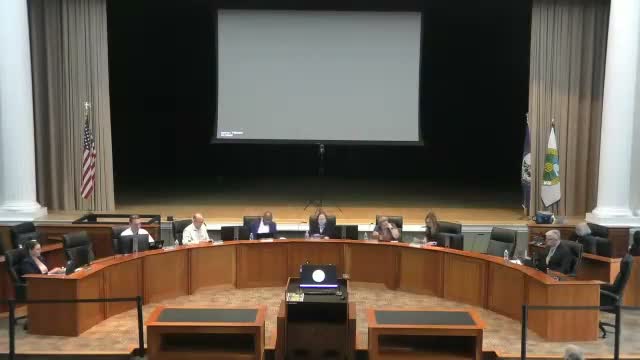
Senior Planner Leah Bromfield presented a phase‑2 work session on zoning modernization that focused on Article 4 (district regulations) and Article 6 (use permissions). The staff presentation outlined outreach, accessibility goals for the new use-table format and a series of discussion topics on which staff sought commission feedback.
On accessory structures, staff proposed standardizing setbacks to 5 feet across infill and non-infill contexts to simplify the code and align with the building-code preference for 10-foot separation between structures. Commissioners asked about easements and shared-driveway impacts; staff said the 5-foot setback is from the property boundary and easement rules would remain an additional constraint.
Staff proposed increasing the height/foot threshold that triggers an additional stepback from 40 feet to 50 feet (effectively moving the trigger from the third/fourth story to the fourth story). Staff said since 2019 the county has received 27 waiver requests on stepbacks (25 approved) and argued raising the threshold would reduce repetitive waiver requests; commissioners tended to support the change.
A key discussion concerned terminology for permitted uses. Staff sought a replacement for the planner‑jargon term 'by right' because members of the public often misunderstand it. Commissioners debated options — 'permitted,' 'allowable,' 'administratively approved,' 'staff review' — with several members favoring a term that signals review is still required (for example, 'administratively approved' or 'staff review').
Staff also presented a consolidation of many narrowly defined uses into broader categories (for example, combining many retail subtypes into 'general retail sales and service' and grouping heavy manufacturing separately). Commissioners endorsed simplification in principle but identified several items meriting separate treatment or future phase‑3 discussion, including: retail nurseries/greenhouses, feed stores, golf courses (flagged because of high water and chemical inputs), and sawmills (already treated separately because of noise and processing impacts).
Other substantive topics included: home-occupation reorganizing (merging class A/B and major/minor designations into two major/minor tiers with clarified performance standards including vehicle-trip thresholds), clarifying temporary-event language (minor vs major temporary events and permanent vs temporary farmers' markets), and treatment of outdoor performance areas (staff proposed removing a narrowly defined 'outdoor drama theater' from the rural-area list pending the rural-area plan discussion). On data centers, staff and the code author explained that a 40,000-square-foot threshold was chosen after survey of local building footprints and was judged to capture the scale where impacts differ.
Commissioners asked for additional detail and follow-up analysis on several items (notably water/fertilizer impacts for golf, definitions of campground types, distinctions between minor and major outdoor/athletic uses, and clearer public-facing phrasing for the use-table categories). Staff said many refinements will be addressed in phase 3 and in linked performance-standard sections; the commission set a June work session to continue overlay-district and related discussions.
Next steps: staff will return with revised draft language and further materials. Commissioners suggested staff publish clearer guidance and checklists explaining criteria for what constitutes a 'major' versus 'minor' change where that distinction matters (for example, development-area expansion vs minor text edits).
On accessory structures, staff proposed standardizing setbacks to 5 feet across infill and non-infill contexts to simplify the code and align with the building-code preference for 10-foot separation between structures. Commissioners asked about easements and shared-driveway impacts; staff said the 5-foot setback is from the property boundary and easement rules would remain an additional constraint.
Staff proposed increasing the height/foot threshold that triggers an additional stepback from 40 feet to 50 feet (effectively moving the trigger from the third/fourth story to the fourth story). Staff said since 2019 the county has received 27 waiver requests on stepbacks (25 approved) and argued raising the threshold would reduce repetitive waiver requests; commissioners tended to support the change.
A key discussion concerned terminology for permitted uses. Staff sought a replacement for the planner‑jargon term 'by right' because members of the public often misunderstand it. Commissioners debated options — 'permitted,' 'allowable,' 'administratively approved,' 'staff review' — with several members favoring a term that signals review is still required (for example, 'administratively approved' or 'staff review').
Staff also presented a consolidation of many narrowly defined uses into broader categories (for example, combining many retail subtypes into 'general retail sales and service' and grouping heavy manufacturing separately). Commissioners endorsed simplification in principle but identified several items meriting separate treatment or future phase‑3 discussion, including: retail nurseries/greenhouses, feed stores, golf courses (flagged because of high water and chemical inputs), and sawmills (already treated separately because of noise and processing impacts).
Other substantive topics included: home-occupation reorganizing (merging class A/B and major/minor designations into two major/minor tiers with clarified performance standards including vehicle-trip thresholds), clarifying temporary-event language (minor vs major temporary events and permanent vs temporary farmers' markets), and treatment of outdoor performance areas (staff proposed removing a narrowly defined 'outdoor drama theater' from the rural-area list pending the rural-area plan discussion). On data centers, staff and the code author explained that a 40,000-square-foot threshold was chosen after survey of local building footprints and was judged to capture the scale where impacts differ.
Commissioners asked for additional detail and follow-up analysis on several items (notably water/fertilizer impacts for golf, definitions of campground types, distinctions between minor and major outdoor/athletic uses, and clearer public-facing phrasing for the use-table categories). Staff said many refinements will be addressed in phase 3 and in linked performance-standard sections; the commission set a June work session to continue overlay-district and related discussions.
Next steps: staff will return with revised draft language and further materials. Commissioners suggested staff publish clearer guidance and checklists explaining criteria for what constitutes a 'major' versus 'minor' change where that distinction matters (for example, development-area expansion vs minor text edits).
Don't Miss a Word: See the Full Meeting!
Go beyond summaries. Unlock every video, transcript, and key insight with a Founder Membership.
✓
Get instant access to full meeting videos
✓
Search and clip any phrase from complete transcripts
✓
Receive AI-powered summaries & custom alerts
✓
Enjoy lifetime, unrestricted access to government data
30-day money-back guarantee
