Committee reviews 2027 IT, building management and GIS budgets and approves public GIS data sharing
May 13, 2026 | Kane County, Illinois
This article was created by AI summarizing key points discussed. AI makes mistakes, so for full details and context, please refer to the video of the full meeting. Please report any errors so we can fix them. Report an error »
Kane County staff on May 13 presented high-level proposals for the 2027 budgets of Information Technologies, Building Management and GIS and discussed cost-reduction measures, capital-planning priorities and a new plan to publish GIS datasets publicly.
Charles Lasky of the IT department said staff are working to meet a 5% reduction in expenses requested by the finance committee while accommodating a nonunion pay increase; measures include eliminating some vacant positions, reducing contractual services, shifting costs to special-revenue funds and deferring capital until the board sets priorities. Lasky said revenue from fees and services is up about 4 percent and highlighted cost pressures from rising hardware and licensing prices.
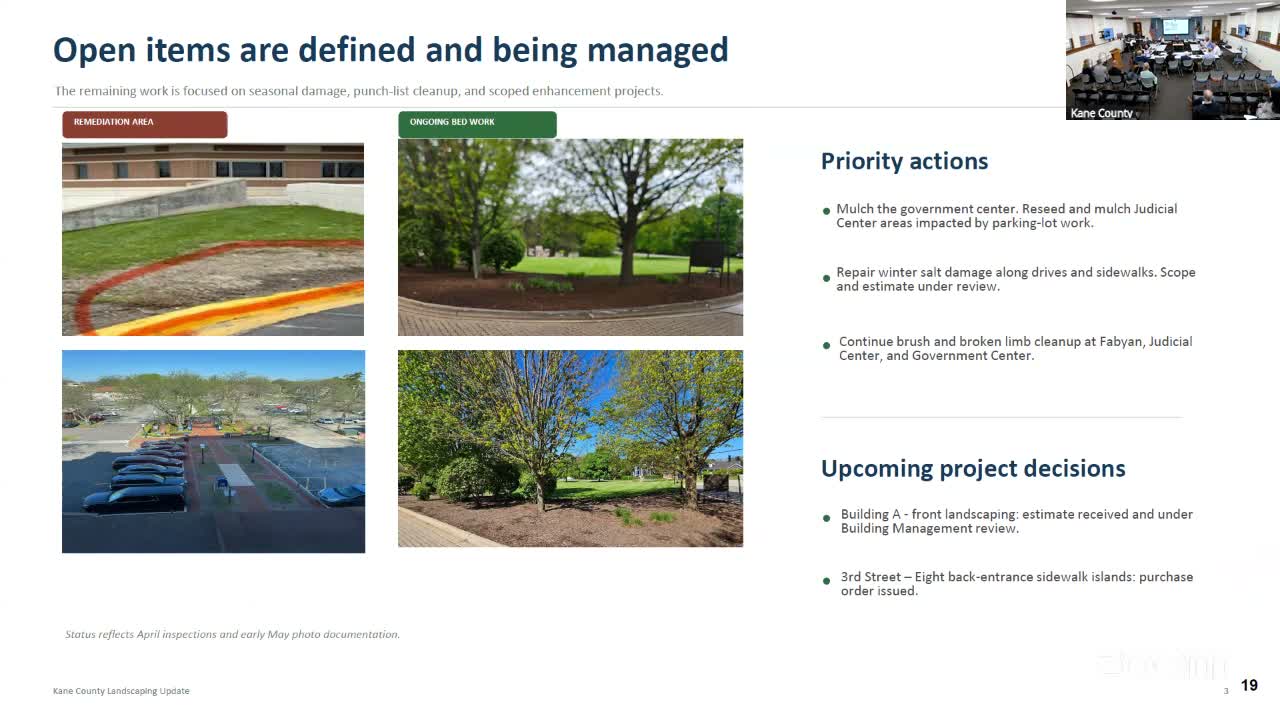
Kevin Harris (building management) said the department met the 5% target largely by reducing overtime (from about $200,000 to $133,000) and eliminating a vacancy; he emphasized building maintenance, space-utilization analysis and energy-cost planning, and noted a net decrease of $391,529 in combined lines. Harris also briefed the committee on landscaping progress, mulching schedules and an ongoing pond-treatment program.
Kurt Lebo (GIS) proposed publicly sharing roughly 500 GIS datasets—topography, LIDAR, road centerlines, aerial imagery, parcels, fiber and municipal boundaries—so users can consume the data directly through web services. Lebo said state review and review by the state’s attorney were completed, the proposal has no initial cost to the county, and the fee-study adjustments provide a 5% revenue increase that would sustain GIS operations without using fund balance.
Committee members asked how artificial intelligence might affect staffing and operations; IT and building-management staff said AI use is at an early stage, has potential for drafting and reporting efficiencies, but raises data-protection issues (juvenile or protected court records) and legal/workforce constraints being debated in state-level legislation.
The committee voted to approve the GIS public-data sharing resolution on a roll-call vote and recommended continued interdepartmental coordination on capital requests, AI policy and fee allocations. The presentations were informational; budget details and capital requests will return to the committee as staff refine transactions and respond to board direction.
Charles Lasky of the IT department said staff are working to meet a 5% reduction in expenses requested by the finance committee while accommodating a nonunion pay increase; measures include eliminating some vacant positions, reducing contractual services, shifting costs to special-revenue funds and deferring capital until the board sets priorities. Lasky said revenue from fees and services is up about 4 percent and highlighted cost pressures from rising hardware and licensing prices.
Kevin Harris (building management) said the department met the 5% target largely by reducing overtime (from about $200,000 to $133,000) and eliminating a vacancy; he emphasized building maintenance, space-utilization analysis and energy-cost planning, and noted a net decrease of $391,529 in combined lines. Harris also briefed the committee on landscaping progress, mulching schedules and an ongoing pond-treatment program.
Kurt Lebo (GIS) proposed publicly sharing roughly 500 GIS datasets—topography, LIDAR, road centerlines, aerial imagery, parcels, fiber and municipal boundaries—so users can consume the data directly through web services. Lebo said state review and review by the state’s attorney were completed, the proposal has no initial cost to the county, and the fee-study adjustments provide a 5% revenue increase that would sustain GIS operations without using fund balance.
Committee members asked how artificial intelligence might affect staffing and operations; IT and building-management staff said AI use is at an early stage, has potential for drafting and reporting efficiencies, but raises data-protection issues (juvenile or protected court records) and legal/workforce constraints being debated in state-level legislation.
The committee voted to approve the GIS public-data sharing resolution on a roll-call vote and recommended continued interdepartmental coordination on capital requests, AI policy and fee allocations. The presentations were informational; budget details and capital requests will return to the committee as staff refine transactions and respond to board direction.
View the Full Meeting & All Its Details
This article offers just a summary. Unlock complete video, transcripts, and insights as a Founder Member.
✓
Watch full, unedited meeting videos
✓
Search every word spoken in unlimited transcripts
✓
AI summaries & real-time alerts (all government levels)
✓
Permanent access to expanding government content
30-day money-back guarantee
