District-funded air-quality tests show short-term NO2 and PM2.5 spikes; consultant recommends longer monitoring
May 13, 2026 | Westfield-Washington Schools, School Boards, Indiana
This article was created by AI summarizing key points discussed. AI makes mistakes, so for full details and context, please refer to the video of the full meeting. Please report any errors so we can fix them. Report an error »
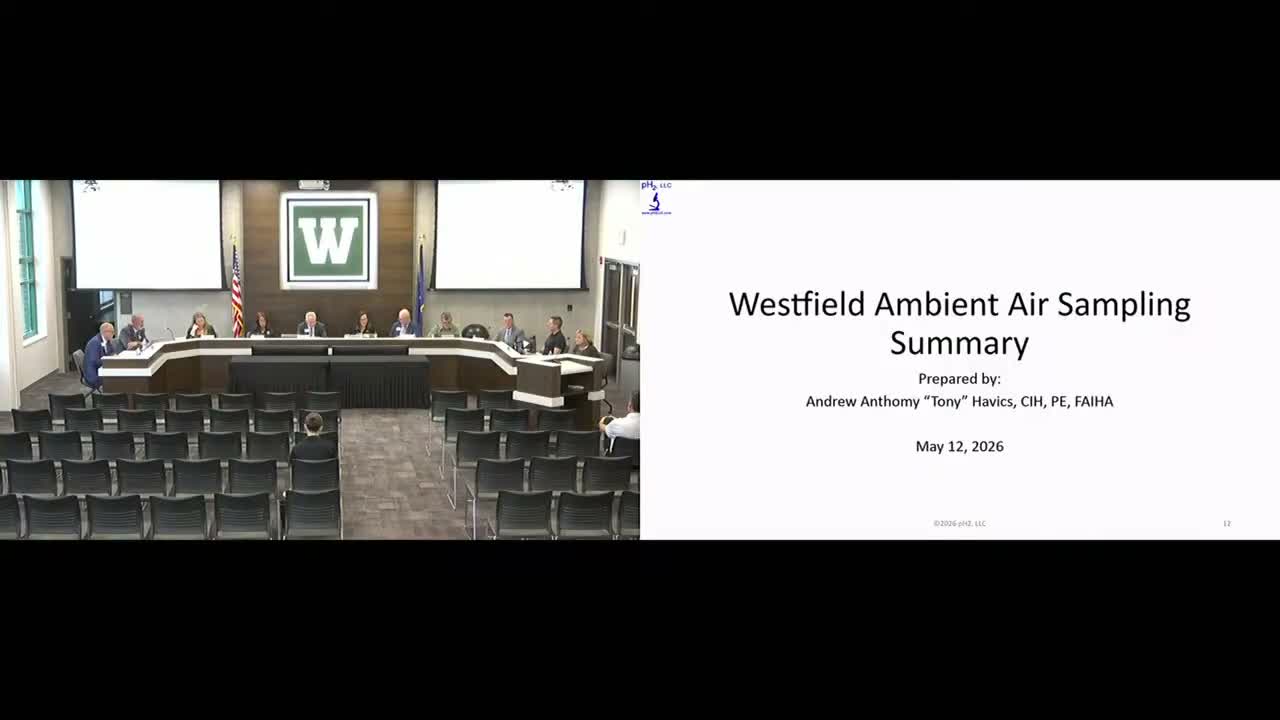
Tony Havocs, an environmental consultant with PH2 LLC, told the Westfield Washington School Board on May 12 that a one-week outdoor monitoring study at Cool Creek (intermediate) and Oak Trace Elementary found no acute hazards but did record short-term spikes in nitrogen dioxide (NO2) and fine particulate matter (PM2.5).
Havocs said carbon monoxide and sulfur dioxide were below detection limits and average ozone values were under the EPA 8-hour benchmark. He cautioned that the weeklong sample (March 25–April 3) is a small slice of the year and that unusually high winds and some nearby activities (for example, a pressure washer observed near a sampler) likely affected particulates: “These instrumentations are…good in indicators, but they’re not perfect,” he said.
Havocs flagged NO2 and PM2.5 as the areas of concern in the short-term sample, noting one-hour peaks near 0.1 ppm for NO2 and several minute-scale readings above typical annual values. He said those brief exceedances primarily present reversible irritation risks for sensitive groups (people with asthma, COPD, older adults and children under 2) rather than an acute public-health emergency. “If my kids were going to that school… I wouldn’t have any problem with them going to that school,” Havocs said, adding that typical student outdoor periods (30–60 minutes, such as recess) are unlikely to trigger hospital visits.
Administration and the consultant emphasized measurement limits and interpretation. Havocs explained that short monitors and lower-cost sensors tend to overestimate mass-based particulate metrics unless site-calibrated and that sampling height and nearby sources change numbers. He recommended longer-term deployment of cheaper networked sensors (EPA-endorsed lower-cost meters) or periodic calibrated sampling to capture seasonal trends and reduce the influence of transient events.
Superintendent Dr. Atha said the district will release the consultant’s executive summary and full report to parents and staff and noted the district is evaluating whether to install longer-term sensors at a subset of sites. Board members asked about next steps for families of students with severe asthma; administrators said school health staff will continue existing accommodations and consult medical guidance if longer monitoring shows consistent exceedances.
Havocs concluded that, given the short sampling period and environmental conditions during the week sampled, the two sites were broadly comparable and not materially different in overall air quality index terms. He recommended follow-up monitoring if the board wants a fuller, seasonal picture rather than a weeklong snapshot.
Havocs said carbon monoxide and sulfur dioxide were below detection limits and average ozone values were under the EPA 8-hour benchmark. He cautioned that the weeklong sample (March 25–April 3) is a small slice of the year and that unusually high winds and some nearby activities (for example, a pressure washer observed near a sampler) likely affected particulates: “These instrumentations are…good in indicators, but they’re not perfect,” he said.
Havocs flagged NO2 and PM2.5 as the areas of concern in the short-term sample, noting one-hour peaks near 0.1 ppm for NO2 and several minute-scale readings above typical annual values. He said those brief exceedances primarily present reversible irritation risks for sensitive groups (people with asthma, COPD, older adults and children under 2) rather than an acute public-health emergency. “If my kids were going to that school… I wouldn’t have any problem with them going to that school,” Havocs said, adding that typical student outdoor periods (30–60 minutes, such as recess) are unlikely to trigger hospital visits.
Administration and the consultant emphasized measurement limits and interpretation. Havocs explained that short monitors and lower-cost sensors tend to overestimate mass-based particulate metrics unless site-calibrated and that sampling height and nearby sources change numbers. He recommended longer-term deployment of cheaper networked sensors (EPA-endorsed lower-cost meters) or periodic calibrated sampling to capture seasonal trends and reduce the influence of transient events.
Superintendent Dr. Atha said the district will release the consultant’s executive summary and full report to parents and staff and noted the district is evaluating whether to install longer-term sensors at a subset of sites. Board members asked about next steps for families of students with severe asthma; administrators said school health staff will continue existing accommodations and consult medical guidance if longer monitoring shows consistent exceedances.
Havocs concluded that, given the short sampling period and environmental conditions during the week sampled, the two sites were broadly comparable and not materially different in overall air quality index terms. He recommended follow-up monitoring if the board wants a fuller, seasonal picture rather than a weeklong snapshot.
Don't Miss a Word: See the Full Meeting!
Go beyond summaries. Unlock every video, transcript, and key insight with a Founder Membership.
✓
Get instant access to full meeting videos
✓
Search and clip any phrase from complete transcripts
✓
Receive AI-powered summaries & custom alerts
✓
Enjoy lifetime, unrestricted access to government data
30-day money-back guarantee
