NASS May forecast: U.S. winter wheat harvested area and production plunge; prices expected to rise
May 13, 2026 | National Agricultural Statistics Service (NASS), Department of Agriculture (USDA), Executive, Federal
This article was created by AI summarizing key points discussed. AI makes mistakes, so for full details and context, please refer to the video of the full meeting. Please report any errors so we can fix them. Report an error »
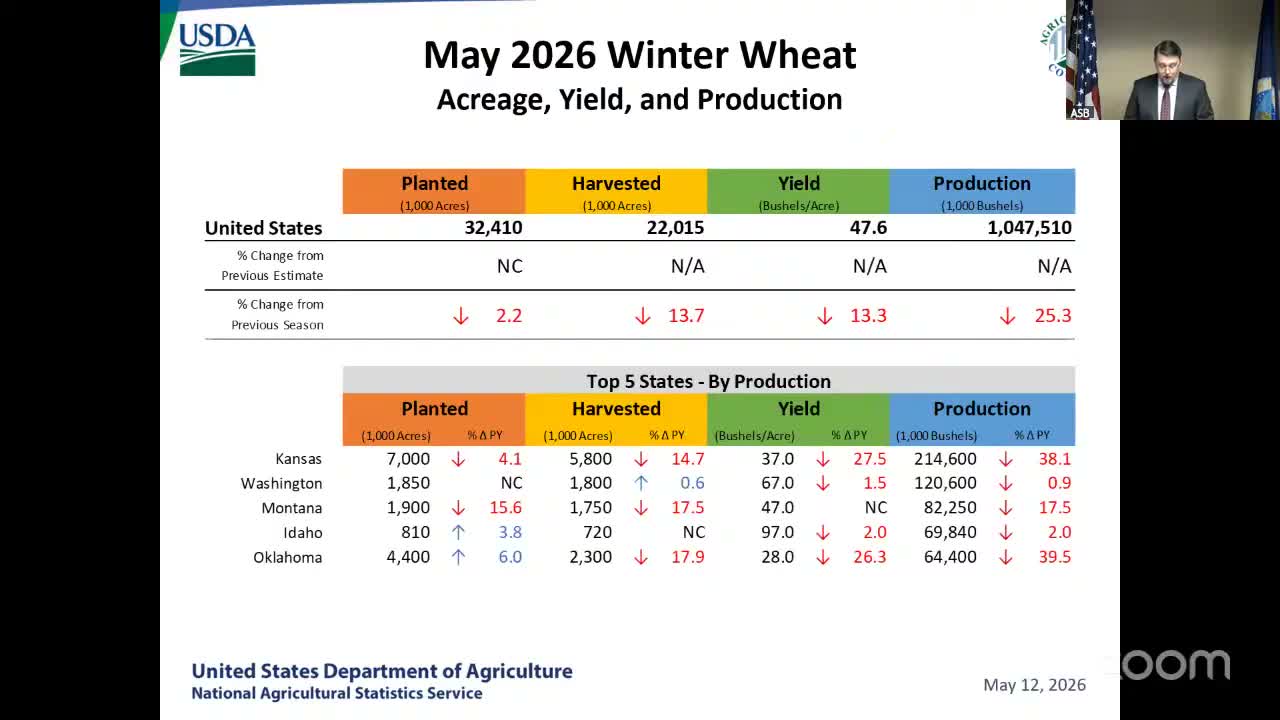
Anthony Grilleman, acting chief of the National Agricultural Statistics Service (NASS) Crops Branch, said at the agency’s May briefing that NASS’s first seasonal forecast for winter wheat shows sharp declines in area, yield and production.
NASS estimated U.S. planted winter wheat acres at 32,400,000 (unchanged from March and down 2.2% year over year) and forecast harvested acres at just over 22,000,000 (down 13.7% y/y). “If realized, this will be a record low harvested area for The US,” Grilleman said. As of May 1, NASS forecast yield at 47.6 bushels per acre, down 13.3% from last year, and production at nearly 1,050,000,000 bushels, down 25.3% from 2025.
Why it matters: the May forecast is NASS’s first formal seasonal estimate for winter wheat and feeds USDA’s supply-and-use balance that influences domestic and global prices. NASS staff noted the May survey window and the objective-yield field program are early in the season: the ag-yield operator survey had a 7,350-sample frame with data collection Apr. 29–May 7, and the May objective-yield sampling was limited to parts of Kansas, Oklahoma and Texas with additional samples to be enumerated in June and July.
The briefing showed weaker crop-condition ratings (31% good-to-excellent on May 3, 28% on May 10) and an increased gap this year between planted and harvested acreage compared with recent seasons, indicating more abandonment than typical. Grilleman also broke production by class: hard red winter at about 515 million bushels (down 36% y/y), soft red ~301 million bushels (down about 14.7%), and white winter ~232 million bushels (down roughly 5%).
NASS said the May production forecast falls well below pre-report industry expectations and cautioned that May is an initial forecast: sampling for the NASS objective-yield program expands in June and July and future months will update these estimates. NASS will host a 1:30 p.m. Eastern “Stat Chat” to discuss the numbers and released a schedule of upcoming county and commodity reports.
The briefing material and the May numbers will be used in USDA’s WASDE balance sheet updates, which NASS and the World Agricultural Outlook Board said are likely to tighten supplies and provide upward pressure on season-average prices.
NASS estimated U.S. planted winter wheat acres at 32,400,000 (unchanged from March and down 2.2% year over year) and forecast harvested acres at just over 22,000,000 (down 13.7% y/y). “If realized, this will be a record low harvested area for The US,” Grilleman said. As of May 1, NASS forecast yield at 47.6 bushels per acre, down 13.3% from last year, and production at nearly 1,050,000,000 bushels, down 25.3% from 2025.
Why it matters: the May forecast is NASS’s first formal seasonal estimate for winter wheat and feeds USDA’s supply-and-use balance that influences domestic and global prices. NASS staff noted the May survey window and the objective-yield field program are early in the season: the ag-yield operator survey had a 7,350-sample frame with data collection Apr. 29–May 7, and the May objective-yield sampling was limited to parts of Kansas, Oklahoma and Texas with additional samples to be enumerated in June and July.
The briefing showed weaker crop-condition ratings (31% good-to-excellent on May 3, 28% on May 10) and an increased gap this year between planted and harvested acreage compared with recent seasons, indicating more abandonment than typical. Grilleman also broke production by class: hard red winter at about 515 million bushels (down 36% y/y), soft red ~301 million bushels (down about 14.7%), and white winter ~232 million bushels (down roughly 5%).
NASS said the May production forecast falls well below pre-report industry expectations and cautioned that May is an initial forecast: sampling for the NASS objective-yield program expands in June and July and future months will update these estimates. NASS will host a 1:30 p.m. Eastern “Stat Chat” to discuss the numbers and released a schedule of upcoming county and commodity reports.
The briefing material and the May numbers will be used in USDA’s WASDE balance sheet updates, which NASS and the World Agricultural Outlook Board said are likely to tighten supplies and provide upward pressure on season-average prices.
View the Full Meeting & All Its Details
This article offers just a summary. Unlock complete video, transcripts, and insights as a Founder Member.
✓
Watch full, unedited meeting videos
✓
Search every word spoken in unlimited transcripts
✓
AI summaries & real-time alerts (all government levels)
✓
Permanent access to expanding government content
30-day money-back guarantee
