Poudre School District holds first reading of consolidation policy after months of community engagement
May 13, 2026 | Poudre School District R-1, School Districts , Colorado
This article was created by AI summarizing key points discussed. AI makes mistakes, so for full details and context, please refer to the video of the full meeting. Please report any errors so we can fix them. Report an error »
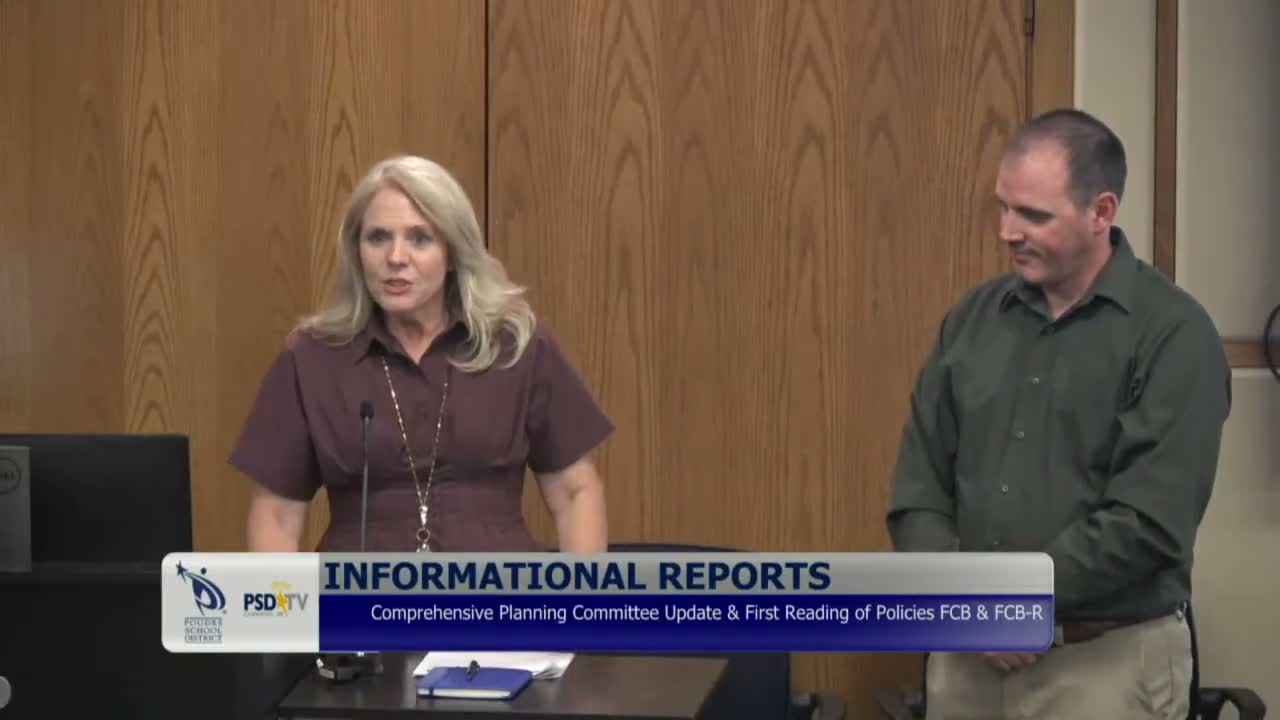
The Poudre School District board on May 12 took the first formal step toward codifying how it would study and potentially recommend school closures, consolidations and relocations, hearing a lengthy update from the comprehensive planning committee and a wide-ranging board discussion.
The comprehensive planning committee co-chairs, Brett Hanson and Dr. Tracy Guile, told trustees the committee’s work so far has focused on front‑loading community engagement and producing a set of criteria to guide any future recommendations. Hanson said the district received 7,519 responses to its public criteria survey and that the top-ranked identification metric from that outreach was building condition and quality. “We had 7,519 responses to the survey,” Hanson said, citing the engagement numbers that the committee used to shape its draft policy.
The committee proposed FCB (the board policy) and FCBR (the implementing regulation) as a package: identification criteria (building condition and quality, building utilization, current and projected enrollment), and a second layer of implementation criteria and equity-focused administrative guidelines to mitigate harms and preserve programming. Dr. Guile described the committee’s consensus threshold: “Our consensus threshold is 90% or greater,” and said the administrative guidelines are designed to put “meat on” the equity commitments in the policy.
Board members applauded the depth of outreach — including listening sessions, targeted engagement with Title I and multilingual families, and a publicly available dashboard scheduled for release the next day — but several raised objections to parts of the draft. Some trustees urged inserting numeric triggers (for example, explicit utilization or enrollment thresholds) so the policy would produce clearer signals and reduce perceived arbitrariness. Others warned that fixed thresholds could unfairly penalize communities and strip staff flexibility to weigh equity-related factors.
Committee co‑chairs and staff framed the draft as a middle path: a data-driven process plus equity guidelines rather than a purely formulaic trigger. The committee emphasized that criteria were meant to work together rather than act as independent automatic shutdown rules. Dr. Guile and Hanson said the committee had deliberately chosen not to embed hard numeric cutoffs at this stage because districts they studied either reported that strict thresholds produced unintended, inequitable results or would have instantly designated a large share of PSD schools as candidates.
Trustees and staff agreed on a near-term cadence: a public data dashboard with the facility and enrollment metrics would go live on the district website the following day, and the board scheduled a second reading and vote on the policy and regulation for its May 26 meeting. If adopted, staff said any recommendation produced under the policy would not be implemented for the 2026–27 school year and that, under the committee timeline, the earliest implementation would be for the 2027–28 school year.
What’s next: the board will revisit FCB and FCBR on May 26 with suggested edits, clarified language around what constitutes an initiation or study, and greater precision about sequencing. The comprehensive planning committee will continue phase‑three work preparing recommendation scenarios if the board directs staff to proceed.
The comprehensive planning committee co-chairs, Brett Hanson and Dr. Tracy Guile, told trustees the committee’s work so far has focused on front‑loading community engagement and producing a set of criteria to guide any future recommendations. Hanson said the district received 7,519 responses to its public criteria survey and that the top-ranked identification metric from that outreach was building condition and quality. “We had 7,519 responses to the survey,” Hanson said, citing the engagement numbers that the committee used to shape its draft policy.
The committee proposed FCB (the board policy) and FCBR (the implementing regulation) as a package: identification criteria (building condition and quality, building utilization, current and projected enrollment), and a second layer of implementation criteria and equity-focused administrative guidelines to mitigate harms and preserve programming. Dr. Guile described the committee’s consensus threshold: “Our consensus threshold is 90% or greater,” and said the administrative guidelines are designed to put “meat on” the equity commitments in the policy.
Board members applauded the depth of outreach — including listening sessions, targeted engagement with Title I and multilingual families, and a publicly available dashboard scheduled for release the next day — but several raised objections to parts of the draft. Some trustees urged inserting numeric triggers (for example, explicit utilization or enrollment thresholds) so the policy would produce clearer signals and reduce perceived arbitrariness. Others warned that fixed thresholds could unfairly penalize communities and strip staff flexibility to weigh equity-related factors.
Committee co‑chairs and staff framed the draft as a middle path: a data-driven process plus equity guidelines rather than a purely formulaic trigger. The committee emphasized that criteria were meant to work together rather than act as independent automatic shutdown rules. Dr. Guile and Hanson said the committee had deliberately chosen not to embed hard numeric cutoffs at this stage because districts they studied either reported that strict thresholds produced unintended, inequitable results or would have instantly designated a large share of PSD schools as candidates.
Trustees and staff agreed on a near-term cadence: a public data dashboard with the facility and enrollment metrics would go live on the district website the following day, and the board scheduled a second reading and vote on the policy and regulation for its May 26 meeting. If adopted, staff said any recommendation produced under the policy would not be implemented for the 2026–27 school year and that, under the committee timeline, the earliest implementation would be for the 2027–28 school year.
What’s next: the board will revisit FCB and FCBR on May 26 with suggested edits, clarified language around what constitutes an initiation or study, and greater precision about sequencing. The comprehensive planning committee will continue phase‑three work preparing recommendation scenarios if the board directs staff to proceed.
View the Full Meeting & All Its Details
This article offers just a summary. Unlock complete video, transcripts, and insights as a Founder Member.
✓
Watch full, unedited meeting videos
✓
Search every word spoken in unlimited transcripts
✓
AI summaries & real-time alerts (all government levels)
✓
Permanent access to expanding government content
30-day money-back guarantee
