Sen. Scott Beck proposes statewide ‘attendance zones’ and advisory boards; Education Committee declines immediate endorsement
May 13, 2026 | Education, SENATE, Committees, Legislative , Vermont
This article was created by AI summarizing key points discussed. AI makes mistakes, so for full details and context, please refer to the video of the full meeting. Please report any errors so we can fix them. Report an error »
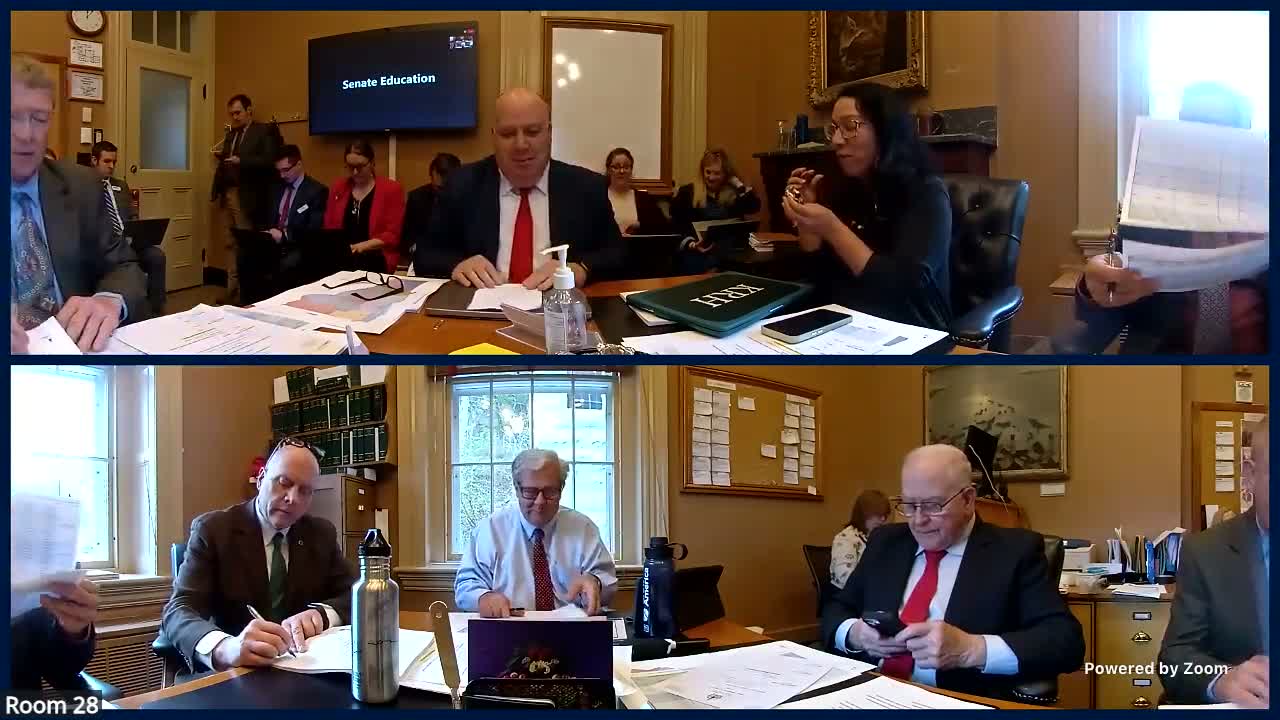
Sen. Scott Beck (Caledonia District) told the Senate Education Committee at a special meeting on May 13 that he is proposing a statewide reorganization that would turn Vermont’s 119 school districts into attendance zones, assign those zones to 11 larger area school districts, create local education advisory boards and change the state’s cost-containment approach to rely on the excess-spending threshold rather than the current foundation formula.
Beck said the draft language remains his proposal, has not been reviewed by the Agency of Education or the administration, and is intended to be a decision-ready amendment rather than a contingent, study-only plan. “This is a plan with no contingencies, no check backs,” Beck said, urging committee members to consider the policy tradeoffs now rather than defer action.
At the center of Beck’s proposal are three structural changes: first, every existing school district would become an attendance zone with a local education advisory board charged with advising the assigned area school district board about local schools, deciding whether to tuition or operate certain grades, and weighing in on proposed grade closures; second, those attendance zones would be grouped into 11 larger school districts designed so eligible students can reach a career-and-technical-education (CTE) center without crossing a district line; third, the plan would replace the Act 73 foundation approach for cost control with adjustments to the excess-spending threshold.
Under the draft, district mergers would take effect in fiscal year 2030 (effective 07/01/2029). The proposal reduces the excess-spending threshold to 111% in FY30, then phases the threshold down by 1 percentage point per year until reaching 105% (which Beck said is the statewide weighted average pupil spending); he also included a floor preventing a district from spending less than 90% of that base.
Beck said the map and the 11 area districts were drawn to ensure at least one CTE center exists within each area and to minimize out-of-district travel for students who rely on CTE programs. He also proposed an option allowing individual CTE students to exercise choice if a center in an adjacent area better serves their needs.
Ezra Holban of the legislative fiscal office explained a technical funding change committee members flagged: the amendment would replace small-school and sparse-school weights with support grants (as envisioned in Act 73), which reduces long-term weighted average daily membership figures but offsets that reduction by delivering offsetting grant revenue to lower a district’s reported spending. "The reason is this would replace small school weights and sparse school weights with the support grants envisioned in Act 73," Holban said, describing how the grants would act as offsetting revenue.
Beck also addressed school-construction funding. He proposed exempting capital construction spending from the excess-spending threshold and relying on the existing Act 60 school construction aid program to cover a larger share of local bond costs. Beck cited example homestead shares—"If Addison spends another dollar ... the resident homestead taxpayers in Addison are going to pay 46.2% of that dollar"—to illustrate how state aid already subsidizes local construction bonds.
Committee members raised multiple concerns. Several asked why Agency of Education staff were not present to respond; one member said the AOE had not been in the room and urged that agency staff be involved before the committee recommends the amendment to Finance. Another member asked for a fiscal comparison that applies the foundation formula instead of the proposal’s model; committee members were told that a complete foundation-formula comparison had not been prepared for this meeting.
Throughout the discussion members emphasized the policy stakes: possible changes to local control, the allocation of capital-construction responsibility, and the timing and scale of fiscal impact once mergers are implemented. A number of senators said they were not ready to recommend supplanting the committee’s existing draft language and asked that the proposal receive more review from AOE and from the Joint Fiscal Office.
The committee did not take a formal vote. Members debated whether to give a quick straw poll or recommendation to Senate Finance—several said Finance was asking for the Education Committee’s guidance—but the meeting concluded without the committee endorsing Beck’s amendment. "I don't know where this amendment's gonna, you know, come in," Beck said; the committee’s next step was to offer guidance to Senate Finance only after additional review and analysis.
The Education Committee adjourned after roughly 45 minutes of discussion without taking formal action on the amendment.
Beck said the draft language remains his proposal, has not been reviewed by the Agency of Education or the administration, and is intended to be a decision-ready amendment rather than a contingent, study-only plan. “This is a plan with no contingencies, no check backs,” Beck said, urging committee members to consider the policy tradeoffs now rather than defer action.
At the center of Beck’s proposal are three structural changes: first, every existing school district would become an attendance zone with a local education advisory board charged with advising the assigned area school district board about local schools, deciding whether to tuition or operate certain grades, and weighing in on proposed grade closures; second, those attendance zones would be grouped into 11 larger school districts designed so eligible students can reach a career-and-technical-education (CTE) center without crossing a district line; third, the plan would replace the Act 73 foundation approach for cost control with adjustments to the excess-spending threshold.
Under the draft, district mergers would take effect in fiscal year 2030 (effective 07/01/2029). The proposal reduces the excess-spending threshold to 111% in FY30, then phases the threshold down by 1 percentage point per year until reaching 105% (which Beck said is the statewide weighted average pupil spending); he also included a floor preventing a district from spending less than 90% of that base.
Beck said the map and the 11 area districts were drawn to ensure at least one CTE center exists within each area and to minimize out-of-district travel for students who rely on CTE programs. He also proposed an option allowing individual CTE students to exercise choice if a center in an adjacent area better serves their needs.
Ezra Holban of the legislative fiscal office explained a technical funding change committee members flagged: the amendment would replace small-school and sparse-school weights with support grants (as envisioned in Act 73), which reduces long-term weighted average daily membership figures but offsets that reduction by delivering offsetting grant revenue to lower a district’s reported spending. "The reason is this would replace small school weights and sparse school weights with the support grants envisioned in Act 73," Holban said, describing how the grants would act as offsetting revenue.
Beck also addressed school-construction funding. He proposed exempting capital construction spending from the excess-spending threshold and relying on the existing Act 60 school construction aid program to cover a larger share of local bond costs. Beck cited example homestead shares—"If Addison spends another dollar ... the resident homestead taxpayers in Addison are going to pay 46.2% of that dollar"—to illustrate how state aid already subsidizes local construction bonds.
Committee members raised multiple concerns. Several asked why Agency of Education staff were not present to respond; one member said the AOE had not been in the room and urged that agency staff be involved before the committee recommends the amendment to Finance. Another member asked for a fiscal comparison that applies the foundation formula instead of the proposal’s model; committee members were told that a complete foundation-formula comparison had not been prepared for this meeting.
Throughout the discussion members emphasized the policy stakes: possible changes to local control, the allocation of capital-construction responsibility, and the timing and scale of fiscal impact once mergers are implemented. A number of senators said they were not ready to recommend supplanting the committee’s existing draft language and asked that the proposal receive more review from AOE and from the Joint Fiscal Office.
The committee did not take a formal vote. Members debated whether to give a quick straw poll or recommendation to Senate Finance—several said Finance was asking for the Education Committee’s guidance—but the meeting concluded without the committee endorsing Beck’s amendment. "I don't know where this amendment's gonna, you know, come in," Beck said; the committee’s next step was to offer guidance to Senate Finance only after additional review and analysis.
The Education Committee adjourned after roughly 45 minutes of discussion without taking formal action on the amendment.
View the Full Meeting & All Its Details
This article offers just a summary. Unlock complete video, transcripts, and insights as a Founder Member.
✓
Watch full, unedited meeting videos
✓
Search every word spoken in unlimited transcripts
✓
AI summaries & real-time alerts (all government levels)
✓
Permanent access to expanding government content
30-day money-back guarantee
