Howard County Council hears public concerns over proposed 3¢ property tax shift
May 20, 2024 | Howard County, Maryland
This article was created by AI summarizing key points discussed. AI makes mistakes, so for full details and context, please refer to the video of the full meeting. Please report any errors so we can fix them. Report an error »
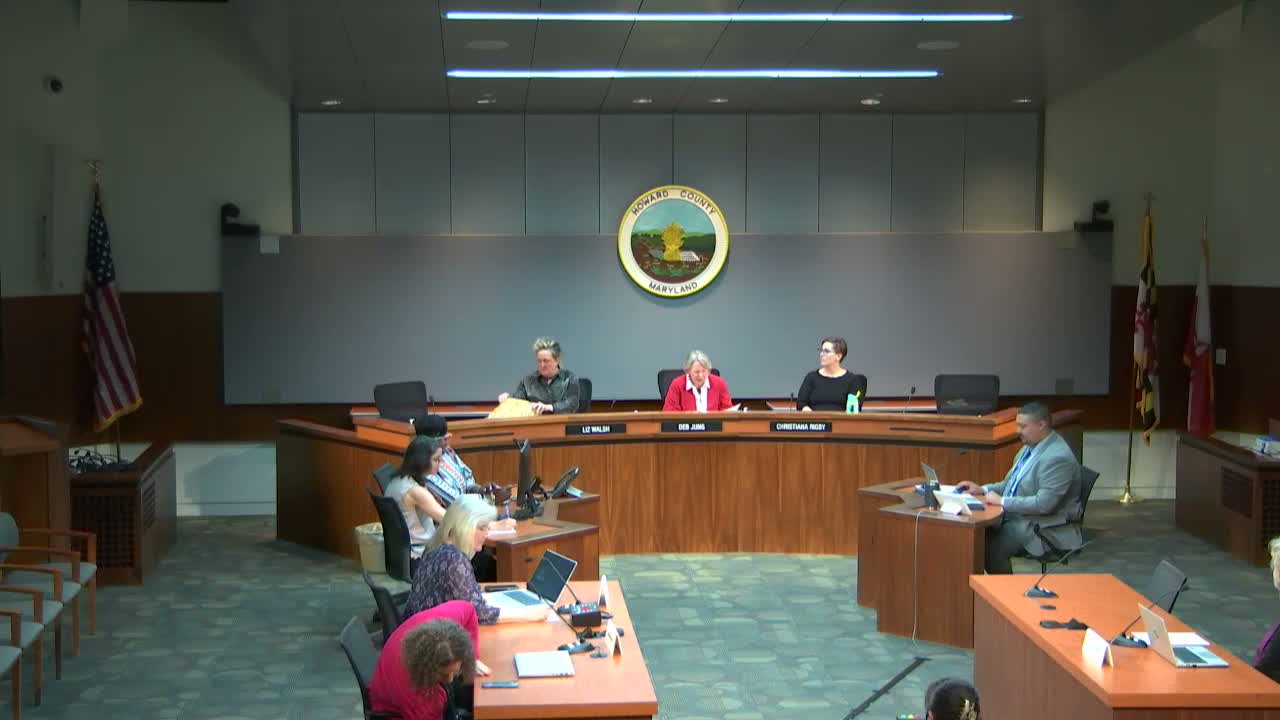
Howard County Council Chair Deb Young opened a public hearing and said the council would receive testimony on a proposed real property tax rate change for the taxable year beginning July 1, 2024. The administration’s proposal would shift 3 cents from the fire tax to the county property tax — raising the county rate from $1.014 to $1.044 per $100 of assessed value, according to the notice — and the council is scheduled to set the rate at a meeting on May 22, 2024, at 12 p.m. in the Banneker Room of the George Howard Building in Ellicott City.
Budget administrator Holly Sun told council members the 3¢ swap is intended to be cost-neutral for property owners because the decrease in the fire tax offsets the increase in the county rate. "It's really a tax rate shift we're proposing," Sun said, and the change is meant to "maximize the capacity in the general fund," money Sun said supports the school system and other critical services.
Why it matters: Council members and residents said the proposal must be viewed against recent assessment increases that raise tax revenues even if the nominal rate is constant. Several speakers pressed for historical modeling and a clearer accounting of where revenue increases from rising assessments have gone.
Resident Dan Waters, of Ellicott City, said he had examined assessment records and saw increases near 9.8% for some neighboring properties between July 2023 and January 2024. "If that is an increase in accordance and that reflects the property values increase and then we're adding additional property tax, why not use the money to allow the citizens and constituents to keep their own money," Waters said. He described the shift as "opportunistic" if the county did not first account for higher revenues driven by market-appreciation of property values.
Council member Mister Youngman and budget staff answered that assessment and tax-bill dynamics are more complex. Youngman said assessments are phased in (reassessments are performed on roughly one-third of properties each year) and owner-occupied properties benefit from a homestead tax credit that limits the annual dollar increase on a homeowner's bill to about 5% in many cases. "Assessments can go up. If market values are up 30%, assessments are gonna go up 30%. And the state sets those assessments," Youngman said, adding that the homestead credit and phase-in rules minimize abrupt year-to-year bill shocks for many owners.
Youngman also said county revenues remain under pressure from inflationary costs — for example, higher vehicle, labor and fuel costs — and from state-driven education funding requirements. Several council members and the budget office cited increasing county contributions to the Howard County Public School System: FY23 included about $40,000,000 above maintenance of effort and FY24 about $47,000,000 above maintenance of effort, figures discussed at the hearing.
Sun and other council members acknowledged requests from the council to provide earlier and current revenue models. Sun said changes since earlier modeling include higher ambulance fees and a Medicaid reimbursement change that added roughly $5,000,000 annually; she said she would check agency records and try to provide comparative models requested in work sessions.
A separate procedural question raised by council members concerned the verb tense in the public notice, which stated "the County Council of Howard County proposes to increase real property tax rates." Several members said the county executive proposed the change. County counsel responded that the notice language follows wording required by state statute and that the administration submitted the resolution through the council's legislative process.
What happens next: The council will consider written comments that remain part of the record and will consider the rate-setting resolution at the scheduled meeting on May 22, 2024, at 12 p.m. in the Banneker Room. Council members asked budget staff to supply the comparative modeling and revenue detail requested by members before formal action.
Reporter’s note: At the hearing budget staff and council members used the phrase "3 for 3" to describe the 3¢ transfer from the fire tax to the county rate; the administration and council characterized the change as intended to be cost-neutral for property owners because the fire-tax reduction offsets the property-rate increase.
Budget administrator Holly Sun told council members the 3¢ swap is intended to be cost-neutral for property owners because the decrease in the fire tax offsets the increase in the county rate. "It's really a tax rate shift we're proposing," Sun said, and the change is meant to "maximize the capacity in the general fund," money Sun said supports the school system and other critical services.
Why it matters: Council members and residents said the proposal must be viewed against recent assessment increases that raise tax revenues even if the nominal rate is constant. Several speakers pressed for historical modeling and a clearer accounting of where revenue increases from rising assessments have gone.
Resident Dan Waters, of Ellicott City, said he had examined assessment records and saw increases near 9.8% for some neighboring properties between July 2023 and January 2024. "If that is an increase in accordance and that reflects the property values increase and then we're adding additional property tax, why not use the money to allow the citizens and constituents to keep their own money," Waters said. He described the shift as "opportunistic" if the county did not first account for higher revenues driven by market-appreciation of property values.
Council member Mister Youngman and budget staff answered that assessment and tax-bill dynamics are more complex. Youngman said assessments are phased in (reassessments are performed on roughly one-third of properties each year) and owner-occupied properties benefit from a homestead tax credit that limits the annual dollar increase on a homeowner's bill to about 5% in many cases. "Assessments can go up. If market values are up 30%, assessments are gonna go up 30%. And the state sets those assessments," Youngman said, adding that the homestead credit and phase-in rules minimize abrupt year-to-year bill shocks for many owners.
Youngman also said county revenues remain under pressure from inflationary costs — for example, higher vehicle, labor and fuel costs — and from state-driven education funding requirements. Several council members and the budget office cited increasing county contributions to the Howard County Public School System: FY23 included about $40,000,000 above maintenance of effort and FY24 about $47,000,000 above maintenance of effort, figures discussed at the hearing.
Sun and other council members acknowledged requests from the council to provide earlier and current revenue models. Sun said changes since earlier modeling include higher ambulance fees and a Medicaid reimbursement change that added roughly $5,000,000 annually; she said she would check agency records and try to provide comparative models requested in work sessions.
A separate procedural question raised by council members concerned the verb tense in the public notice, which stated "the County Council of Howard County proposes to increase real property tax rates." Several members said the county executive proposed the change. County counsel responded that the notice language follows wording required by state statute and that the administration submitted the resolution through the council's legislative process.
What happens next: The council will consider written comments that remain part of the record and will consider the rate-setting resolution at the scheduled meeting on May 22, 2024, at 12 p.m. in the Banneker Room. Council members asked budget staff to supply the comparative modeling and revenue detail requested by members before formal action.
Reporter’s note: At the hearing budget staff and council members used the phrase "3 for 3" to describe the 3¢ transfer from the fire tax to the county rate; the administration and council characterized the change as intended to be cost-neutral for property owners because the fire-tax reduction offsets the property-rate increase.
View the Full Meeting & All Its Details
This article offers just a summary. Unlock complete video, transcripts, and insights as a Founder Member.
✓
Watch full, unedited meeting videos
✓
Search every word spoken in unlimited transcripts
✓
AI summaries & real-time alerts (all government levels)
✓
Permanent access to expanding government content
30-day money-back guarantee
