Chariho adopts K–12 social studies curriculum; amendment to emphasize "founding principles" fails
May 13, 2026 | Chariho, School Districts, Rhode Island
This article was created by AI summarizing key points discussed. AI makes mistakes, so for full details and context, please refer to the video of the full meeting. Please report any errors so we can fix them. Report an error »
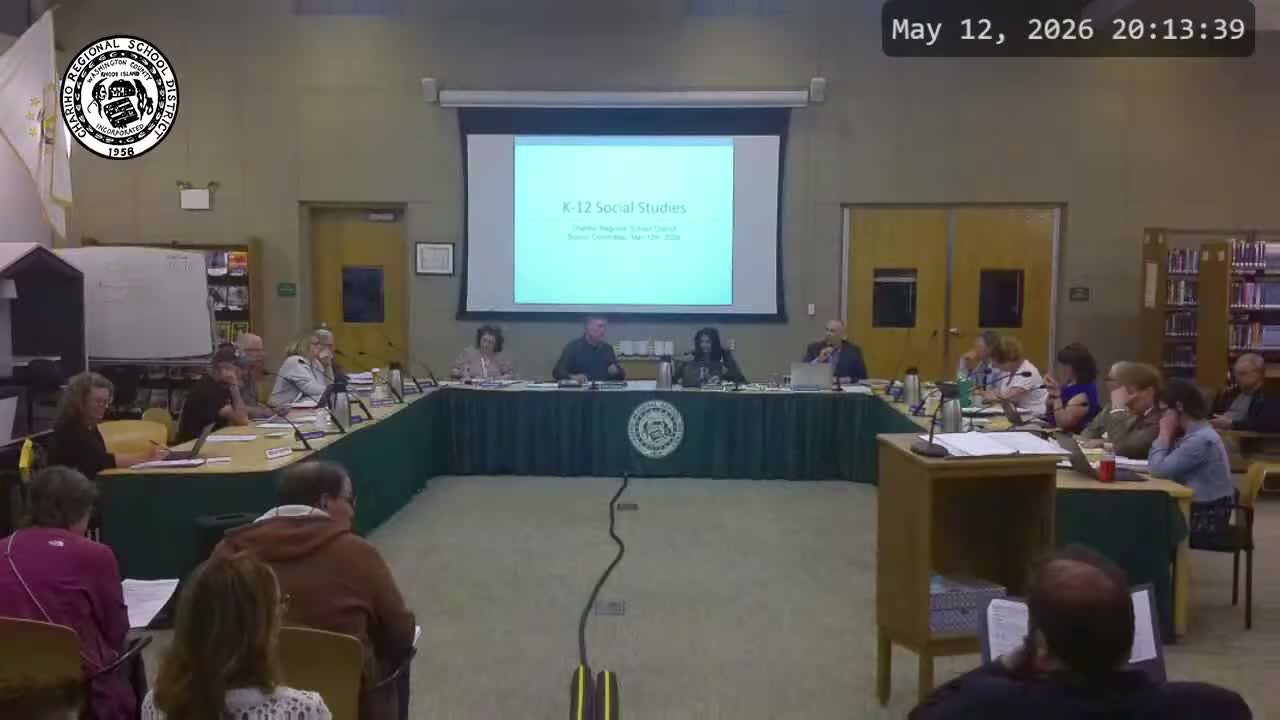
The Chariho School Committee voted May 20 to adopt a new K–12 social studies curriculum aligned to Rhode Island Department of Education anchor standards, a plan administrators said will pilot in the 2026–27 school year.
Assistant Superintendent Dr. Michael Camiller (introduced at the meeting) told the committee that RIDE adopted new social-studies standards and that the district’s version moves away from rote memorization toward interdisciplinary, inquiry-based work and greater emphasis on writing and civic engagement. He said grade-level shifts were most significant in grades 5–8, with grade 4 seeing added Rhode Island history and grade 8 focused on civics as a graduation project requirement.
Committee members asked for clarity about resources, parental access to assignments and the legal obligation to adopt RIDE anchor standards. Camiller and staff said resources for the middle grades were budgeted and that next year would function as a pilot period to allow for pacing and materials adjustments. A parent raised concerns about using Canvas for assignment access; administrators said Canvas would be retired next year and that teachers should be contacted directly about assignment details.
At the meeting a committee member (S24) moved an amendment to the adoption motion to request that the curriculum more explicitly incorporate instruction transmitting “America’s founding principles, a deep reverence for our resultant freedoms, and a love for this country.” The amendment drew debate and failed on a 4–6 vote. The substantive motion to adopt the K–12 social studies curriculum then passed; the committee recorded the adoption and described next steps for pilot implementation and review.
The district said Vision 2029 and the curriculum are connected: priorities include strong instruction, timely student supports and family communication. Staff emphasized teacher-led implementation strategies such as learning walks, a multi-tiered system of supports (MTSS) and continued stakeholder feedback during the pilot year. The committee indicated it will monitor resources and pacing and accept feedback through the curriculum-adoption process.
Next steps: the curriculum will be piloted in 2026–27 with continued committee oversight; staff will return with implementation details and any proposed resource needs.
Assistant Superintendent Dr. Michael Camiller (introduced at the meeting) told the committee that RIDE adopted new social-studies standards and that the district’s version moves away from rote memorization toward interdisciplinary, inquiry-based work and greater emphasis on writing and civic engagement. He said grade-level shifts were most significant in grades 5–8, with grade 4 seeing added Rhode Island history and grade 8 focused on civics as a graduation project requirement.
Committee members asked for clarity about resources, parental access to assignments and the legal obligation to adopt RIDE anchor standards. Camiller and staff said resources for the middle grades were budgeted and that next year would function as a pilot period to allow for pacing and materials adjustments. A parent raised concerns about using Canvas for assignment access; administrators said Canvas would be retired next year and that teachers should be contacted directly about assignment details.
At the meeting a committee member (S24) moved an amendment to the adoption motion to request that the curriculum more explicitly incorporate instruction transmitting “America’s founding principles, a deep reverence for our resultant freedoms, and a love for this country.” The amendment drew debate and failed on a 4–6 vote. The substantive motion to adopt the K–12 social studies curriculum then passed; the committee recorded the adoption and described next steps for pilot implementation and review.
The district said Vision 2029 and the curriculum are connected: priorities include strong instruction, timely student supports and family communication. Staff emphasized teacher-led implementation strategies such as learning walks, a multi-tiered system of supports (MTSS) and continued stakeholder feedback during the pilot year. The committee indicated it will monitor resources and pacing and accept feedback through the curriculum-adoption process.
Next steps: the curriculum will be piloted in 2026–27 with continued committee oversight; staff will return with implementation details and any proposed resource needs.
Don't Miss a Word: See the Full Meeting!
Go beyond summaries. Unlock every video, transcript, and key insight with a Founder Membership.
✓
Get instant access to full meeting videos
✓
Search and clip any phrase from complete transcripts
✓
Receive AI-powered summaries & custom alerts
✓
Enjoy lifetime, unrestricted access to government data
30-day money-back guarantee
