Council holds public hearing on proposed 0.1% local income tax for correctional facilities, including possible juvenile facility
May 13, 2026 | Tippecanoe County, Indiana
This article was created by AI summarizing key points discussed. AI makes mistakes, so for full details and context, please refer to the video of the full meeting. Please report any errors so we can fix them. Report an error »
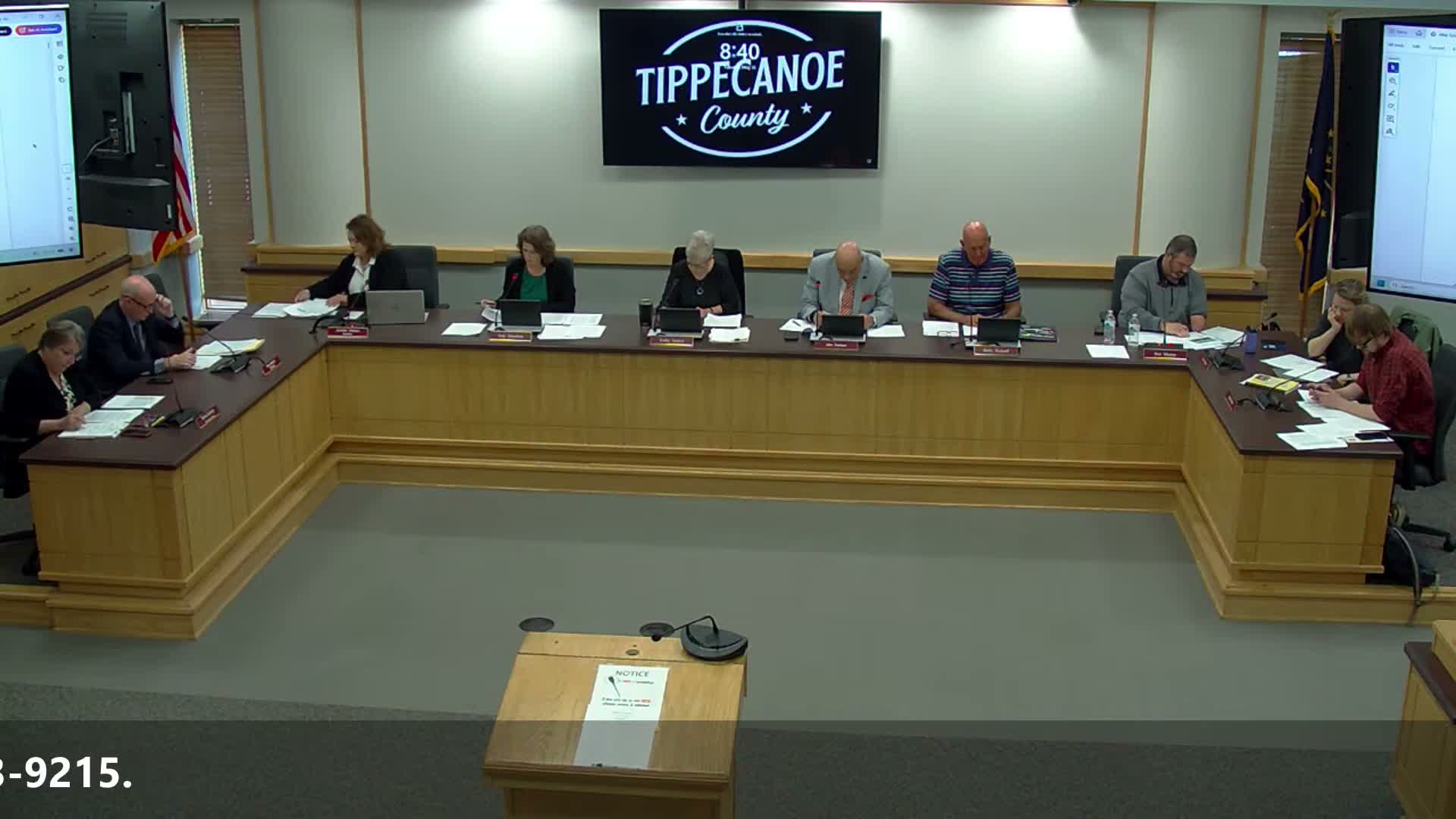
County council members heard a detailed presentation and public comment on a proposed 0.1 percentage-point increase in the local income tax (LIT) for correctional facilities that would raise the county share from roughly 1.14% to about 1.24% if approved.
Commissioner Ben Carson introduced the proposal as an option to create a capital funding stream for correctional and juvenile detention infrastructure and said the measure is intended for long-range planning rather than immediate action. "We're not making any determinations today — the idea is we present it, we hear about it, we get public feedback, and we provide several months of opportunities for feedback to educate us and allow us to make an informed decision," Carson said.
Auditor Jennifer provided the fiscal context, describing how the county currently uses public-safety LIT for salaries and operations and how a correctional-facilities LIT would be used primarily for capital projects. She said the proposal would increase the county LIT by 0.1 percentage point, from 1.14% to approximately 1.24%, and estimated that 0.1% would generate about $6.3 million in additional county receipts in 2027. Jennifer also explained the statutory ceilings: up to 0.2% for facilities/operations without bonding and up to 0.3% if bonded under Indiana code.
Speakers emphasized taxpayer impact and workforce effects. Carson and Jennifer used a simple example of personal impact: "0.1% is about $50 a year" for someone with $50,000 adjusted gross income and about $100 a year for $100,000 AGI, to illustrate the scale of the proposal.
Judge Faith Graham, who identified herself as juvenile court judge for Tippecanoe County, told the council that legal changes and capacity shortages are driving detention costs higher. She reviewed a series of statutory and practice changes since 2005 and said a 2023 law reclassification of certain juveniles as "juvenile arrestees" — and prohibitions on housing those arrestees with adult inmates except after specific hearings — has sharply increased county costs and bed demand. "I have already spent 58% of my entire budget so far this year," Graham said, and she warned that juvenile-arrestee placements are often more expensive and last longer than prior juvenile stays.
Local youth-services leaders also urged planning and funding for local capacity. Rebecca Humphrey, the county's youth services executive director, said securing local beds keeps children connected to family and school and reduces the time staff spend arranging placements; she cited reductions in juvenile arrests since implementation of the juvenile detention alternatives initiative (JDAI) but said recent trends and legal changes have reversed some gains.
Sheriff Bob Goldsmith described the operational impacts of distant placements: lengthy transports take deputies off patrol, create overtime and mileage costs, and separate youths from family supports and school programs. "When we're doing a lot of transports, miles rack up real quick," Goldsmith said, urging local capacity to reduce those drains on staff and budget.
Council members pressed staff for compensation comparisons and budget trade-offs. Auditor Jennifer noted public-safety costs have grown to about 44% of the general fund in the current budget and suggested shifting some eligible costs into the correctional LIT fund could relieve general-fund pressure. Ben Carson said county pay scales are roughly 10% below similar counties and that retention has become an operational concern.
No formal vote was held; the council directed staff to continue outreach and scheduled additional months of public input and two ordinance readings if the council chooses to advance the proposal. Staff outlined timing nuances: an adoption by Aug. 31 would take effect Oct. 1, 2026, while adoption between Sept. 1 and Oct. 31 would set an effective date of Jan. 1, 2027.
What comes next: the council will accept written comments, hold additional briefings and public hearings, and consider two formal readings before any adoption vote. The council emphasized it will continue to weigh trade-offs, including potential shifts of expenditures between LIT silos and the impact on older residents and taxpayers.
Commissioner Ben Carson introduced the proposal as an option to create a capital funding stream for correctional and juvenile detention infrastructure and said the measure is intended for long-range planning rather than immediate action. "We're not making any determinations today — the idea is we present it, we hear about it, we get public feedback, and we provide several months of opportunities for feedback to educate us and allow us to make an informed decision," Carson said.
Auditor Jennifer provided the fiscal context, describing how the county currently uses public-safety LIT for salaries and operations and how a correctional-facilities LIT would be used primarily for capital projects. She said the proposal would increase the county LIT by 0.1 percentage point, from 1.14% to approximately 1.24%, and estimated that 0.1% would generate about $6.3 million in additional county receipts in 2027. Jennifer also explained the statutory ceilings: up to 0.2% for facilities/operations without bonding and up to 0.3% if bonded under Indiana code.
Speakers emphasized taxpayer impact and workforce effects. Carson and Jennifer used a simple example of personal impact: "0.1% is about $50 a year" for someone with $50,000 adjusted gross income and about $100 a year for $100,000 AGI, to illustrate the scale of the proposal.
Judge Faith Graham, who identified herself as juvenile court judge for Tippecanoe County, told the council that legal changes and capacity shortages are driving detention costs higher. She reviewed a series of statutory and practice changes since 2005 and said a 2023 law reclassification of certain juveniles as "juvenile arrestees" — and prohibitions on housing those arrestees with adult inmates except after specific hearings — has sharply increased county costs and bed demand. "I have already spent 58% of my entire budget so far this year," Graham said, and she warned that juvenile-arrestee placements are often more expensive and last longer than prior juvenile stays.
Local youth-services leaders also urged planning and funding for local capacity. Rebecca Humphrey, the county's youth services executive director, said securing local beds keeps children connected to family and school and reduces the time staff spend arranging placements; she cited reductions in juvenile arrests since implementation of the juvenile detention alternatives initiative (JDAI) but said recent trends and legal changes have reversed some gains.
Sheriff Bob Goldsmith described the operational impacts of distant placements: lengthy transports take deputies off patrol, create overtime and mileage costs, and separate youths from family supports and school programs. "When we're doing a lot of transports, miles rack up real quick," Goldsmith said, urging local capacity to reduce those drains on staff and budget.
Council members pressed staff for compensation comparisons and budget trade-offs. Auditor Jennifer noted public-safety costs have grown to about 44% of the general fund in the current budget and suggested shifting some eligible costs into the correctional LIT fund could relieve general-fund pressure. Ben Carson said county pay scales are roughly 10% below similar counties and that retention has become an operational concern.
No formal vote was held; the council directed staff to continue outreach and scheduled additional months of public input and two ordinance readings if the council chooses to advance the proposal. Staff outlined timing nuances: an adoption by Aug. 31 would take effect Oct. 1, 2026, while adoption between Sept. 1 and Oct. 31 would set an effective date of Jan. 1, 2027.
What comes next: the council will accept written comments, hold additional briefings and public hearings, and consider two formal readings before any adoption vote. The council emphasized it will continue to weigh trade-offs, including potential shifts of expenditures between LIT silos and the impact on older residents and taxpayers.
View the Full Meeting & All Its Details
This article offers just a summary. Unlock complete video, transcripts, and insights as a Founder Member.
✓
Watch full, unedited meeting videos
✓
Search every word spoken in unlimited transcripts
✓
AI summaries & real-time alerts (all government levels)
✓
Permanent access to expanding government content
30-day money-back guarantee
