Montville board weighs $110 million capital plan, considers referendum and town survey
May 13, 2026 | Montville Township School District, School Districts, New Jersey
This article was created by AI summarizing key points discussed. AI makes mistakes, so for full details and context, please refer to the video of the full meeting. Please report any errors so we can fix them. Report an error »
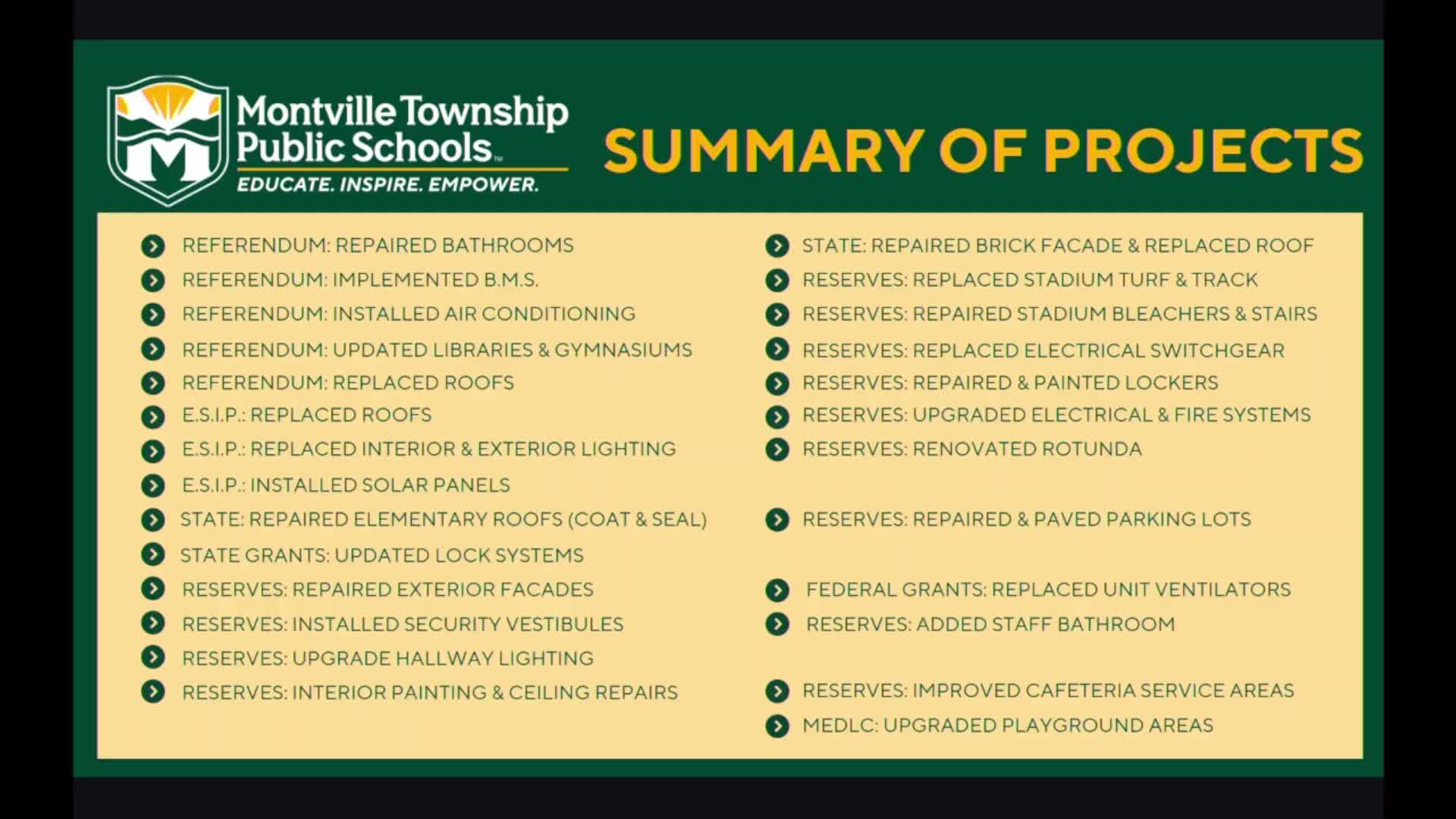
Montville Township Board of Education officials on May 1 laid out a multi‑part capital proposal totaling roughly $110 million that district leaders say is needed to keep aging facilities functioning and to add program space.
The presentation, delivered as part of a facilities update, described about $57 million in capital improvements already completed over the past decade (roofs, LED conversions, solar panels, security vestibules, turf and track replacements), much of it funded from the district’s reserves. Administrators identified roughly $24 million of outstanding elementary repairs and another approximately $31 million of high‑school and Lazar campus repairs; program enhancements such as auditorium improvements were estimated at about $20.5 million, and additional expansion work brought the total package to an estimated $110 million.
Why it matters: administrators warned reserves are reaching a point where continuing to fund large projects from savings is unsustainable. ‘‘We’ll hit a point in June 2027 where we can’t add any more into the reserves,’’ the presenter said, noting that without replenishment the district would be unable to take on new capital work.
School leaders outlined funding scenarios and aid expectations. Eligible elementary work would receive an estimated 38% state aid, meaning the town would pay roughly 62% of those costs; auditorium and expansion items were modeled at a lower estimated state contribution (about 15%). Board members and administrators discussed energy‑savings incentive program (ESIP) limits, noting that lighting and solar produce the largest self‑funding savings but that unit‑ventilator and window replacements typically do not yield sufficient energy savings to fully finance the projects through ESIP mechanisms.
Board members pressed on taxpayer impact and timing. For an illustrative $31.6 million subset of repairs, administrators estimated an average annual impact of about $170 for the average assessed home; that impact would run for the life of the bond issuance but decline when an earlier 2017 issuance drops off. The board discussed bonding as a way to reduce immediate reserve drawdown (for example, the $31M repairs could translate to roughly $18.6M in bonding costs to the district’s share), and acknowledged that construction inflation has increased costs since prior planning.
Next steps and public engagement: administrators proposed a two‑part public approach if the board opts to proceed: produce Department of Education submittal documents (schematics and drawings) by July to support a January 2027 referendum window, or alternatively target a September 2027 question; and launch a townwide survey (open roughly mid‑June to mid‑July) asking residents to prioritize ‘‘must‑have’’ repairs versus ‘‘wish‑list’’ items. The board’s finance and facilities subcommittee indicated consensus to prioritize immediate repairs across all seven schools and to use the survey to test support for program enhancements.
The board agreed to bring more refined scope and cost estimates back at upcoming meetings and to present a proposed survey to the finance and facilities committee at the June 9 meeting. No referendum decision was taken at tonight’s meeting.
The presentation, delivered as part of a facilities update, described about $57 million in capital improvements already completed over the past decade (roofs, LED conversions, solar panels, security vestibules, turf and track replacements), much of it funded from the district’s reserves. Administrators identified roughly $24 million of outstanding elementary repairs and another approximately $31 million of high‑school and Lazar campus repairs; program enhancements such as auditorium improvements were estimated at about $20.5 million, and additional expansion work brought the total package to an estimated $110 million.
Why it matters: administrators warned reserves are reaching a point where continuing to fund large projects from savings is unsustainable. ‘‘We’ll hit a point in June 2027 where we can’t add any more into the reserves,’’ the presenter said, noting that without replenishment the district would be unable to take on new capital work.
School leaders outlined funding scenarios and aid expectations. Eligible elementary work would receive an estimated 38% state aid, meaning the town would pay roughly 62% of those costs; auditorium and expansion items were modeled at a lower estimated state contribution (about 15%). Board members and administrators discussed energy‑savings incentive program (ESIP) limits, noting that lighting and solar produce the largest self‑funding savings but that unit‑ventilator and window replacements typically do not yield sufficient energy savings to fully finance the projects through ESIP mechanisms.
Board members pressed on taxpayer impact and timing. For an illustrative $31.6 million subset of repairs, administrators estimated an average annual impact of about $170 for the average assessed home; that impact would run for the life of the bond issuance but decline when an earlier 2017 issuance drops off. The board discussed bonding as a way to reduce immediate reserve drawdown (for example, the $31M repairs could translate to roughly $18.6M in bonding costs to the district’s share), and acknowledged that construction inflation has increased costs since prior planning.
Next steps and public engagement: administrators proposed a two‑part public approach if the board opts to proceed: produce Department of Education submittal documents (schematics and drawings) by July to support a January 2027 referendum window, or alternatively target a September 2027 question; and launch a townwide survey (open roughly mid‑June to mid‑July) asking residents to prioritize ‘‘must‑have’’ repairs versus ‘‘wish‑list’’ items. The board’s finance and facilities subcommittee indicated consensus to prioritize immediate repairs across all seven schools and to use the survey to test support for program enhancements.
The board agreed to bring more refined scope and cost estimates back at upcoming meetings and to present a proposed survey to the finance and facilities committee at the June 9 meeting. No referendum decision was taken at tonight’s meeting.
View the Full Meeting & All Its Details
This article offers just a summary. Unlock complete video, transcripts, and insights as a Founder Member.
✓
Watch full, unedited meeting videos
✓
Search every word spoken in unlimited transcripts
✓
AI summaries & real-time alerts (all government levels)
✓
Permanent access to expanding government content
30-day money-back guarantee
