Committee approves interim permit for family recovery home at 2222 Blaisdell Avenue
May 13, 2026 | Minneapolis City, Hennepin County, Minnesota
This article was created by AI summarizing key points discussed. AI makes mistakes, so for full details and context, please refer to the video of the full meeting. Please report any errors so we can fix them. Report an error »
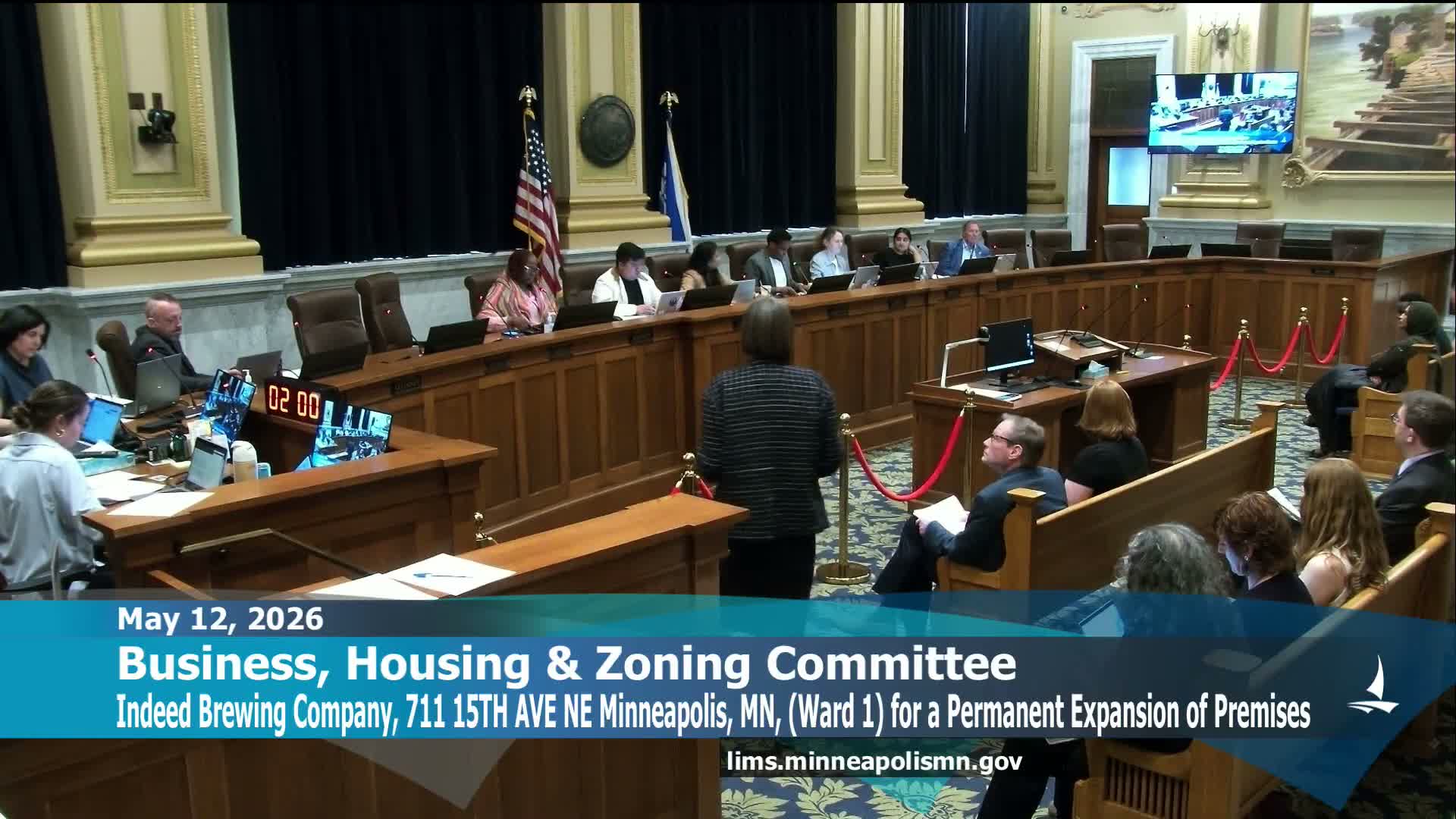
The Minneapolis Housing & Zoning Committee voted May 12 to approve an interim use permit for 2222 Blaisdell Avenue to operate as a state‑credentialed care facility serving up to 16 residents, with the permit set to expire April 1, 2031.
City planner Lindsay Silas told the committee that the property is a 12‑unit building and that staff found the proposal met the zoning findings for an interim use permit. "So staff is recommending approval of the application with 2 interim use, conditions," Silas said, citing the occupancy cap and the expiration date as recommended conditions.
The proposal, brought forward by the operator Pathway to Recovery, would serve parents who are recovering from substance use disorder and their minor children. Several neighbors and community representatives questioned the applicant's capacity to run the program and asked for stronger transparency and local contact points. Janine Marchesso, the owner and occupant of the building immediately south of the site, said she opposed the permit and raised concerns about "documented issues with service provided" and with how planning had been shared with the neighborhood.
Mary Ali, HR director for Pathway to Recovery, pushed back that the organization has not "failed 1 inspection" and described 24‑hour supervision, on‑site cameras and trained staff, adding that the program includes detox, withdrawal management and outpatient programming and has produced successful graduates. "We have staff that's trained for de‑escalation," she said.
Council members pressed staff and the operator for details about licensing, supervision and child‑safety procedures. Staff and the applicant confirmed the operator holds a 245G licensure for substance‑use treatment, said supervised visitation space would be available, and that child‑protection and court systems would be involved where appropriate. CPED land‑use staff also showed a spacing map and explained that the proposed 16‑person facility meets spacing requirements that apply to state‑credentialed care facilities of this size.
Vice chair Chowdhury and others urged visible, ongoing neighborhood communication; the operator agreed to provide on‑site contact information and said they maintain on‑call staff to cover shifts. Several council members noted the interim use permit's five‑year duration provides a future checkpoint and said the approval could include additional conditions if concerns arise.
After extended discussion the committee approved the interim use permit, with staff conditions capping occupancy at 16 residents and setting the expiration date of 04/01/2031. Chair Jamal Osman moved approval; the motion was seconded and passed.
The permit allows the facility to operate while assuring periodic review; staff said the applicant could pursue rezoning or a permanent conditional use permit later if it seeks a longer‑term authorization.
City planner Lindsay Silas told the committee that the property is a 12‑unit building and that staff found the proposal met the zoning findings for an interim use permit. "So staff is recommending approval of the application with 2 interim use, conditions," Silas said, citing the occupancy cap and the expiration date as recommended conditions.
The proposal, brought forward by the operator Pathway to Recovery, would serve parents who are recovering from substance use disorder and their minor children. Several neighbors and community representatives questioned the applicant's capacity to run the program and asked for stronger transparency and local contact points. Janine Marchesso, the owner and occupant of the building immediately south of the site, said she opposed the permit and raised concerns about "documented issues with service provided" and with how planning had been shared with the neighborhood.
Mary Ali, HR director for Pathway to Recovery, pushed back that the organization has not "failed 1 inspection" and described 24‑hour supervision, on‑site cameras and trained staff, adding that the program includes detox, withdrawal management and outpatient programming and has produced successful graduates. "We have staff that's trained for de‑escalation," she said.
Council members pressed staff and the operator for details about licensing, supervision and child‑safety procedures. Staff and the applicant confirmed the operator holds a 245G licensure for substance‑use treatment, said supervised visitation space would be available, and that child‑protection and court systems would be involved where appropriate. CPED land‑use staff also showed a spacing map and explained that the proposed 16‑person facility meets spacing requirements that apply to state‑credentialed care facilities of this size.
Vice chair Chowdhury and others urged visible, ongoing neighborhood communication; the operator agreed to provide on‑site contact information and said they maintain on‑call staff to cover shifts. Several council members noted the interim use permit's five‑year duration provides a future checkpoint and said the approval could include additional conditions if concerns arise.
After extended discussion the committee approved the interim use permit, with staff conditions capping occupancy at 16 residents and setting the expiration date of 04/01/2031. Chair Jamal Osman moved approval; the motion was seconded and passed.
The permit allows the facility to operate while assuring periodic review; staff said the applicant could pursue rezoning or a permanent conditional use permit later if it seeks a longer‑term authorization.
View the Full Meeting & All Its Details
This article offers just a summary. Unlock complete video, transcripts, and insights as a Founder Member.
✓
Watch full, unedited meeting videos
✓
Search every word spoken in unlimited transcripts
✓
AI summaries & real-time alerts (all government levels)
✓
Permanent access to expanding government content
30-day money-back guarantee
