Richland County staff propose FY27 general‑fund plan with no mill increase, step pay and phased retiree benefit changes
May 13, 2026 | Richland County, South Carolina
This article was created by AI summarizing key points discussed. AI makes mistakes, so for full details and context, please refer to the video of the full meeting. Please report any errors so we can fix them. Report an error »
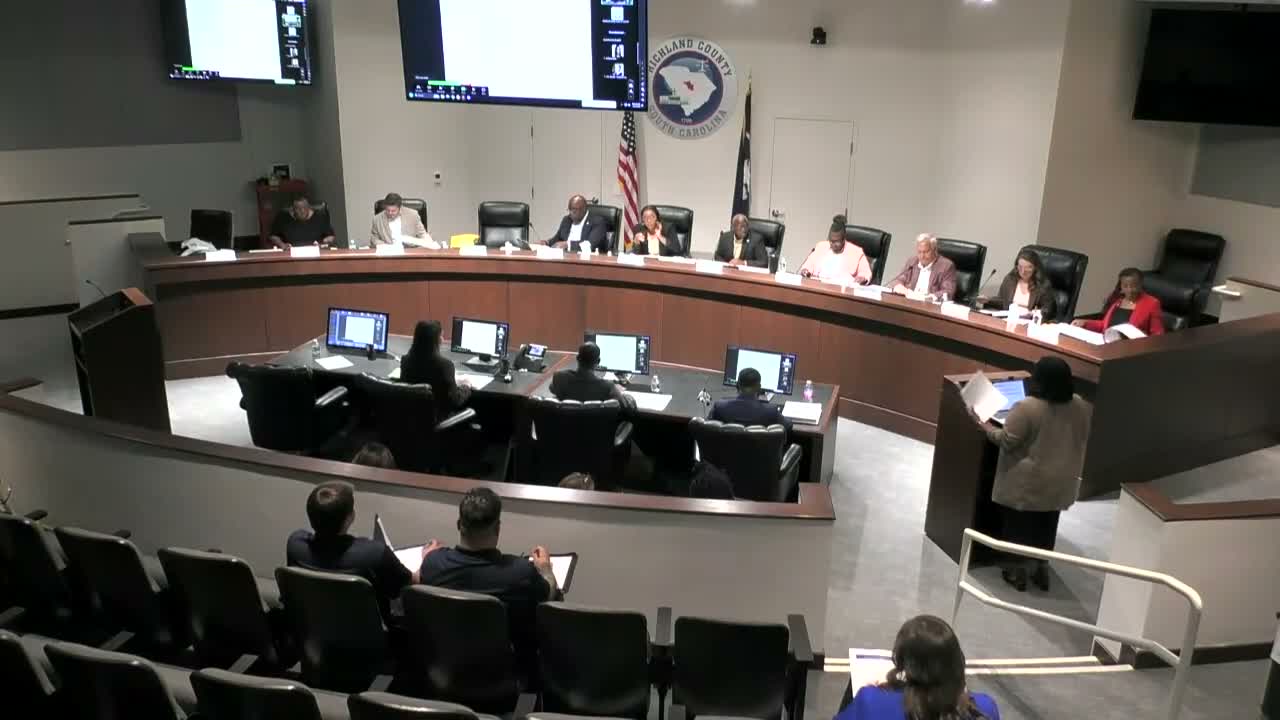
Chair called the May 19 work session to order and Administrator Brown introduced staff recommendations for the FY2027 general fund, saying the administrator would not propose a mill increase for the general fund while recommending adjustments in certain special revenue funds.
Director Britney Hammond presented the general‑fund overview, saying the FY27 revenue forecast is about $251,900,000 and that operating revenue shows stable growth. Hammond said assigned fund balance would be used for some capital items and ambulance purchases and that the county remains within its 20–35% unassigned fund‑balance policy. "This fund is used to account for all financial transactions not accounted for in one of the other funds," Hammond said in the presentation.
Hammond walked council through departmental expenditures and said most growth is in public‑safety cost centers; she told council the presentation includes requested and recommended personnel items. The administrators' personnel proposal recommends seven positions, four of which are existing employees transitioning from grant funding. "The total impact between the new positions and the reclassifications come to about $362,000," Hammond said.
Council members questioned EMS staffing; staff replied they did not add new authorized positions while existing authorized positions remain unfilled and that ambulance availability—not just staffing—affects response times. Administrator Brown said the recommended budget includes funding to help purchase additional ambulances.
Assistant County Administrator Thomas and HR director presented sustainability and compensation proposals tied to the county's step program. Thomas said the FY27 step‑pay funding request is approximately $2,093,000 and described eligibility tied to satisfactory performance or alternate measurable criteria where performance evaluations are not used. "Administration recommends that council approve these measures in, as, consistent application across all departments," Thomas said.
HR staff also proposed benefit‑structure changes to reduce long‑term retiree liabilities. The HR presentation recommended discontinuing a one‑time 10% retiree longevity payout (estimated annual savings about $225,000) and modifying retiree health subsidies for dependents. Staff said the county currently pays 100% of retiree premiums for employees with 25+ years and 62.2% of dependent costs in some tiers; the recommended structure would narrow premium subsidies and recognize service at 20 years. The HR director said changes would be phased for current retirees (dependent subsidies reduced 50% in 2027, another 50% in 2028, and dependents fully responsible in 2029) while employees retiring after 06/30/2026 would follow the new structure. Staff estimated dependent‑subsidy savings in the range of $125,000 per year in each of the first two years of the transition for current retirees.
Council members asked for counts and fiscal detail for specific cohorts (for example, how many employees have 20+ years). HR said staff would provide that data and noted peer governments often do not subsidize dependents.
Risk management presented a consolidated fleet and driver management manual intended to centralize vehicle policies, clarify take‑home rules and implement telematics and cabin cameras. Director of Risk Britney Terry Hall said the proposed changes standardize forms and workflows and clarified take‑home vehicle use "only when they are responding to emergencies to protect life or property," and staff estimated roughly $300,000 in annual savings from take‑home policy changes.
What happens next: staff will provide the recommended budget book, open the motion period and distribute forms; the first readings and public hearing dates were reviewed. The work session was informational only; staff said motions may be filed during the motion period and final readings are scheduled in June.
Director Britney Hammond presented the general‑fund overview, saying the FY27 revenue forecast is about $251,900,000 and that operating revenue shows stable growth. Hammond said assigned fund balance would be used for some capital items and ambulance purchases and that the county remains within its 20–35% unassigned fund‑balance policy. "This fund is used to account for all financial transactions not accounted for in one of the other funds," Hammond said in the presentation.
Hammond walked council through departmental expenditures and said most growth is in public‑safety cost centers; she told council the presentation includes requested and recommended personnel items. The administrators' personnel proposal recommends seven positions, four of which are existing employees transitioning from grant funding. "The total impact between the new positions and the reclassifications come to about $362,000," Hammond said.
Council members questioned EMS staffing; staff replied they did not add new authorized positions while existing authorized positions remain unfilled and that ambulance availability—not just staffing—affects response times. Administrator Brown said the recommended budget includes funding to help purchase additional ambulances.
Assistant County Administrator Thomas and HR director presented sustainability and compensation proposals tied to the county's step program. Thomas said the FY27 step‑pay funding request is approximately $2,093,000 and described eligibility tied to satisfactory performance or alternate measurable criteria where performance evaluations are not used. "Administration recommends that council approve these measures in, as, consistent application across all departments," Thomas said.
HR staff also proposed benefit‑structure changes to reduce long‑term retiree liabilities. The HR presentation recommended discontinuing a one‑time 10% retiree longevity payout (estimated annual savings about $225,000) and modifying retiree health subsidies for dependents. Staff said the county currently pays 100% of retiree premiums for employees with 25+ years and 62.2% of dependent costs in some tiers; the recommended structure would narrow premium subsidies and recognize service at 20 years. The HR director said changes would be phased for current retirees (dependent subsidies reduced 50% in 2027, another 50% in 2028, and dependents fully responsible in 2029) while employees retiring after 06/30/2026 would follow the new structure. Staff estimated dependent‑subsidy savings in the range of $125,000 per year in each of the first two years of the transition for current retirees.
Council members asked for counts and fiscal detail for specific cohorts (for example, how many employees have 20+ years). HR said staff would provide that data and noted peer governments often do not subsidize dependents.
Risk management presented a consolidated fleet and driver management manual intended to centralize vehicle policies, clarify take‑home rules and implement telematics and cabin cameras. Director of Risk Britney Terry Hall said the proposed changes standardize forms and workflows and clarified take‑home vehicle use "only when they are responding to emergencies to protect life or property," and staff estimated roughly $300,000 in annual savings from take‑home policy changes.
What happens next: staff will provide the recommended budget book, open the motion period and distribute forms; the first readings and public hearing dates were reviewed. The work session was informational only; staff said motions may be filed during the motion period and final readings are scheduled in June.
View the Full Meeting & All Its Details
This article offers just a summary. Unlock complete video, transcripts, and insights as a Founder Member.
✓
Watch full, unedited meeting videos
✓
Search every word spoken in unlimited transcripts
✓
AI summaries & real-time alerts (all government levels)
✓
Permanent access to expanding government content
30-day money-back guarantee
