City staff recommend shifting cosmetic GLP‑1 weight‑loss drugs to full member cost to rein in Fort Worth employee health spending
May 13, 2026 | Fort Worth, Tarrant County, Texas
This article was created by AI summarizing key points discussed. AI makes mistakes, so for full details and context, please refer to the video of the full meeting. Please report any errors so we can fix them. Report an error »
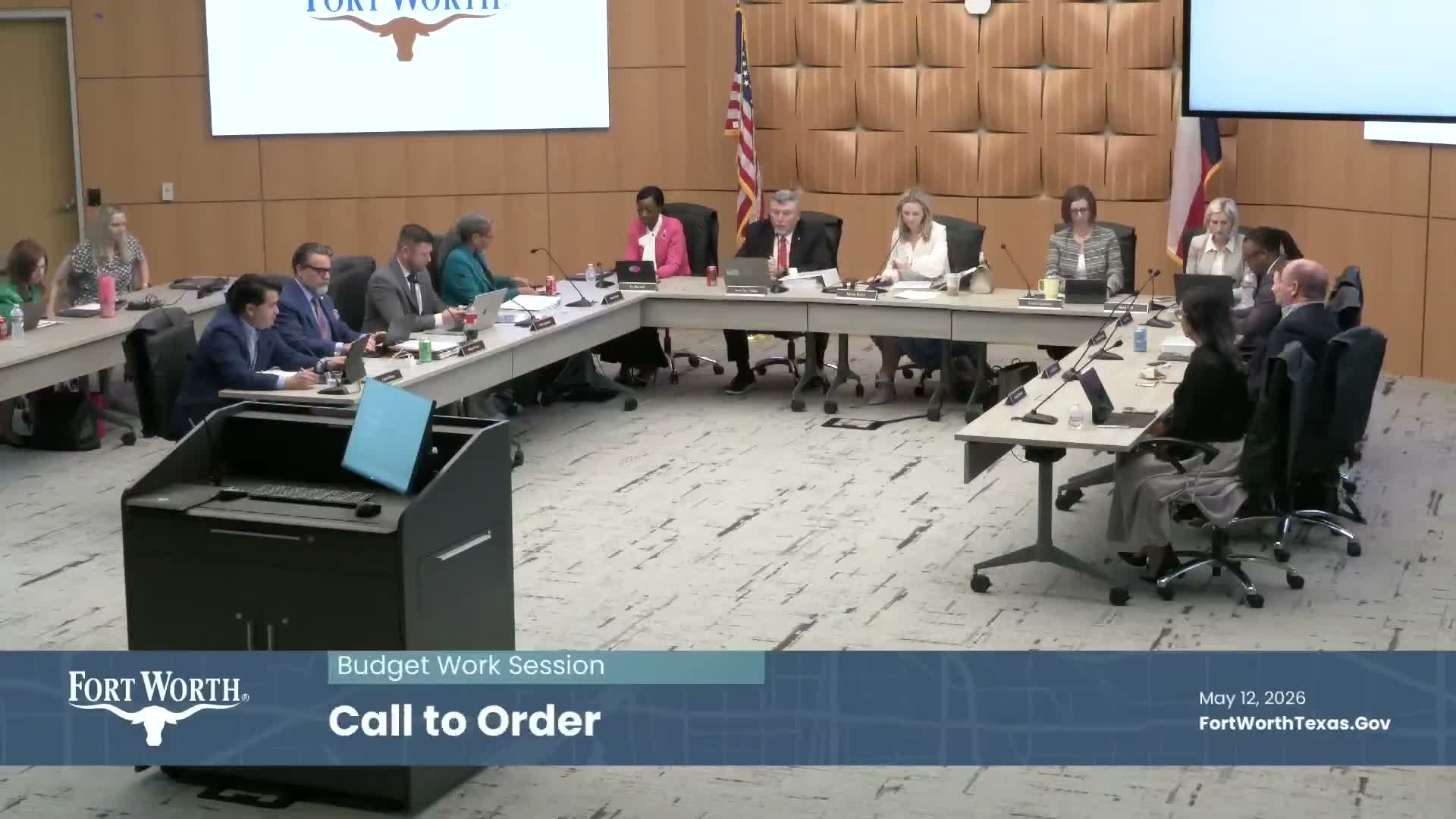
City staff told the Fort Worth City Council during a budget work session that rising use of GLP‑1 weight‑loss medications has sharply increased pharmacy spending in the employee health plan and recommended making cosmetic uses of those drugs entirely member‑paid.
Kristen, a city benefits staff member who led the presentation, said GLP‑1 medications represented about 40% of total pharmacy costs over a recent six‑month period — roughly $7,000,000 — and that approximately $5,000,000 of that amount was for purely cosmetic uses. "For just a six‑month period, GLP‑1s represented about 40% of our total pharmacy cost," Kristen said. She told the council that Zepbound and Wegovy have seen rapid increases in utilization and that a newly available oral formulation could further accelerate demand.
The recommendation presented would keep employer coverage when GLP‑1s are used for qualifying medical comorbidities (for example, diabetes as currently defined by staff) but move cosmetic, weight‑loss‑only prescriptions to a 100% member cost share, with a 90‑day notice to affected employees. Kristen said the change was expected to produce about $10,000,000 in savings from the GLP‑1 weight‑loss category and $13–14,000,000 when combined with other immediate best‑practice interventions.
Council members questioned how the city would define "medically necessary" versus "cosmetic" use, and several urged that determinations be tied to clinician documentation rather than staff judgment. Councilmember Roback asked for the clinical boundary between necessity and cosmetic use; Kristen replied that coverage triggers would rely on documented comorbidities and that the administrator would need objective eligibility criteria. "If we allow it for any comorbidity that's out there, you can expect that to continue to increase," Kristen said.
Members also requested more detailed data: historical rates of increase in employee health costs, average out‑of‑pocket spending for employees, the number of plan participants using GLP‑1s and how many of those uses are linked to qualifying comorbidities. Kristen said the plan had roughly 12,000 members and that Zepbound/Wegovy weight‑loss participation rose from about 600 members in 2025 to about 800 as of April 2026, representing more than 40% of pharmacy spend for those members.
Councilmember Hill asked about the city's contract with Blue Cross Blue Shield, the plan administrator; staff said the administration is under a multiyear contract (typically three to five years) and that a formal bid process exists. Councilors asked staff to provide contract cost history and to benchmark policy choices against peer municipalities; Kristen said Dallas is the only benchmark city currently offering GLP‑1 coverage for cosmetic use through a controlled program.
Kristen also outlined other immediate containment steps: dependent verification audits, a review of direct contracts and targeted management for musculoskeletal care and imaging. She said fund reserves have declined more than 80% over five years and presented a FY27 estimated full funding need of about $108,000,000 with a proposed 83/17 employer/employee split; staff said employee contribution levels would remain flat under the proposal.
No formal action or vote was taken at the session. Council members asked staff to return with the requested participant counts, cost‑per‑member ranges, detailed comorbidity delineation that would trigger employer coverage, contract payment history and comparative municipality data before any policy change is finalized. The council recessed for five minutes at the end of the work session.
Kristen, a city benefits staff member who led the presentation, said GLP‑1 medications represented about 40% of total pharmacy costs over a recent six‑month period — roughly $7,000,000 — and that approximately $5,000,000 of that amount was for purely cosmetic uses. "For just a six‑month period, GLP‑1s represented about 40% of our total pharmacy cost," Kristen said. She told the council that Zepbound and Wegovy have seen rapid increases in utilization and that a newly available oral formulation could further accelerate demand.
The recommendation presented would keep employer coverage when GLP‑1s are used for qualifying medical comorbidities (for example, diabetes as currently defined by staff) but move cosmetic, weight‑loss‑only prescriptions to a 100% member cost share, with a 90‑day notice to affected employees. Kristen said the change was expected to produce about $10,000,000 in savings from the GLP‑1 weight‑loss category and $13–14,000,000 when combined with other immediate best‑practice interventions.
Council members questioned how the city would define "medically necessary" versus "cosmetic" use, and several urged that determinations be tied to clinician documentation rather than staff judgment. Councilmember Roback asked for the clinical boundary between necessity and cosmetic use; Kristen replied that coverage triggers would rely on documented comorbidities and that the administrator would need objective eligibility criteria. "If we allow it for any comorbidity that's out there, you can expect that to continue to increase," Kristen said.
Members also requested more detailed data: historical rates of increase in employee health costs, average out‑of‑pocket spending for employees, the number of plan participants using GLP‑1s and how many of those uses are linked to qualifying comorbidities. Kristen said the plan had roughly 12,000 members and that Zepbound/Wegovy weight‑loss participation rose from about 600 members in 2025 to about 800 as of April 2026, representing more than 40% of pharmacy spend for those members.
Councilmember Hill asked about the city's contract with Blue Cross Blue Shield, the plan administrator; staff said the administration is under a multiyear contract (typically three to five years) and that a formal bid process exists. Councilors asked staff to provide contract cost history and to benchmark policy choices against peer municipalities; Kristen said Dallas is the only benchmark city currently offering GLP‑1 coverage for cosmetic use through a controlled program.
Kristen also outlined other immediate containment steps: dependent verification audits, a review of direct contracts and targeted management for musculoskeletal care and imaging. She said fund reserves have declined more than 80% over five years and presented a FY27 estimated full funding need of about $108,000,000 with a proposed 83/17 employer/employee split; staff said employee contribution levels would remain flat under the proposal.
No formal action or vote was taken at the session. Council members asked staff to return with the requested participant counts, cost‑per‑member ranges, detailed comorbidity delineation that would trigger employer coverage, contract payment history and comparative municipality data before any policy change is finalized. The council recessed for five minutes at the end of the work session.
Don't Miss a Word: See the Full Meeting!
Go beyond summaries. Unlock every video, transcript, and key insight with a Founder Membership.
✓
Get instant access to full meeting videos
✓
Search and clip any phrase from complete transcripts
✓
Receive AI-powered summaries & custom alerts
✓
Enjoy lifetime, unrestricted access to government data
30-day money-back guarantee
