St. Tammany commission adopts solar‑farm rules, postpones shooting‑range changes after extended debate
May 13, 2026 | St. Tammany Parish, Louisiana
This article was created by AI summarizing key points discussed. AI makes mistakes, so for full details and context, please refer to the video of the full meeting. Please report any errors so we can fix them. Report an error »
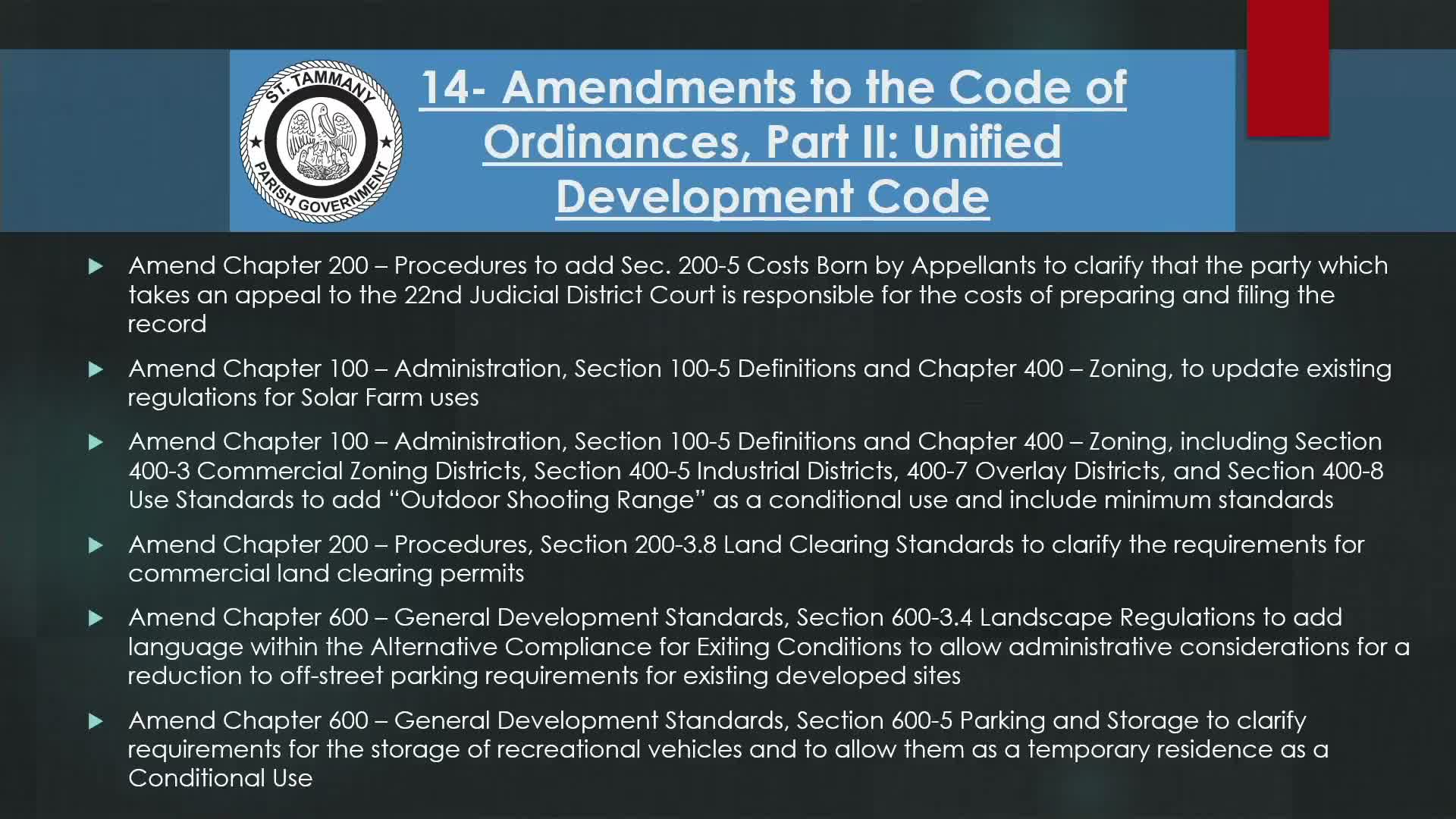
The St. Tammany Parish Planning and Zoning Commission approved a package of amendments to the Unified Development Code that tightened local standards for utility‑scale solar projects and battery energy storage while postponing a contentious amendment on outdoor shooting ranges for further drafting.
Staff summarized the solar standards noted in the amendments: 100‑foot setbacks from property or lease lines for solar components, a 50‑foot natural buffer, a 300‑foot setback from existing residential structures, a 15‑foot maximum panel height, a 7‑foot chain‑link anti‑climb fence with security features, limits on ground elevation changes (no more than 2 feet), and noise limits capped at the lesser of 60 dBA at property lines or 10 dBA above preconstruction ambient at the nearest occupied dwelling. Battery energy storage systems must provide an emergency response plan and 24‑hour contact information for the parish fire marshal and supply an environmental protection plan to prevent on‑site pollution. The draft also adds FAA filing obligations where applicable.
Jeff Arnold, executive director of the America First Energy Project — who identified himself and his organization at the hearing — told the commission the group supports reasonable, enforceable industry standards that protect neighborhoods while respecting property rights. The commission adopted the solar amendment with an added requirement, proposed by a commissioner, to record a notice or instrument identifying prior industrial use or decommissioning obligations tied to the land so future buyers would be notified of any decommissioning obligations.
Commissioners then debated a separate amendment to allow outdoor shooting ranges as a conditional use with extensive containment, setback and buffer requirements and a suggested baseline parcel size of 100 acres. Commissioners and members of the public raised questions about the amendment's effect on hunting preserves and smaller sporting‑clay operations, how to define "commercial" ranges versus private or noncommercial uses, and appropriate advertising and administrative review procedures. After detailed discussion and several suggested wordsmithing changes, the commission voted to postpone the shooting‑range amendment for one month to allow staff to refine definitions, exceptions and procedural provisions.
Other amendments approved during the meeting included clarifications requiring commercial and industrial land‑clearing applications to show existing and proposed servitudes and utilities, administrative waivers to parking requirements for redevelopment where strict modern standards are impractical, and a provision allowing temporary RV occupancy tied to building permits and inspections for owners rebuilding after fire or flood events (the commission modified this to allow certain administrative permitting and time limits).
Next steps: the approved UDC text will move to the parish council as part of the normal legislative process; staff will incorporate the recorded‑notice language for solar and work on refined language for the shooting‑range amendment for the commission's next meeting.
Staff summarized the solar standards noted in the amendments: 100‑foot setbacks from property or lease lines for solar components, a 50‑foot natural buffer, a 300‑foot setback from existing residential structures, a 15‑foot maximum panel height, a 7‑foot chain‑link anti‑climb fence with security features, limits on ground elevation changes (no more than 2 feet), and noise limits capped at the lesser of 60 dBA at property lines or 10 dBA above preconstruction ambient at the nearest occupied dwelling. Battery energy storage systems must provide an emergency response plan and 24‑hour contact information for the parish fire marshal and supply an environmental protection plan to prevent on‑site pollution. The draft also adds FAA filing obligations where applicable.
Jeff Arnold, executive director of the America First Energy Project — who identified himself and his organization at the hearing — told the commission the group supports reasonable, enforceable industry standards that protect neighborhoods while respecting property rights. The commission adopted the solar amendment with an added requirement, proposed by a commissioner, to record a notice or instrument identifying prior industrial use or decommissioning obligations tied to the land so future buyers would be notified of any decommissioning obligations.
Commissioners then debated a separate amendment to allow outdoor shooting ranges as a conditional use with extensive containment, setback and buffer requirements and a suggested baseline parcel size of 100 acres. Commissioners and members of the public raised questions about the amendment's effect on hunting preserves and smaller sporting‑clay operations, how to define "commercial" ranges versus private or noncommercial uses, and appropriate advertising and administrative review procedures. After detailed discussion and several suggested wordsmithing changes, the commission voted to postpone the shooting‑range amendment for one month to allow staff to refine definitions, exceptions and procedural provisions.
Other amendments approved during the meeting included clarifications requiring commercial and industrial land‑clearing applications to show existing and proposed servitudes and utilities, administrative waivers to parking requirements for redevelopment where strict modern standards are impractical, and a provision allowing temporary RV occupancy tied to building permits and inspections for owners rebuilding after fire or flood events (the commission modified this to allow certain administrative permitting and time limits).
Next steps: the approved UDC text will move to the parish council as part of the normal legislative process; staff will incorporate the recorded‑notice language for solar and work on refined language for the shooting‑range amendment for the commission's next meeting.
View the Full Meeting & All Its Details
This article offers just a summary. Unlock complete video, transcripts, and insights as a Founder Member.
✓
Watch full, unedited meeting videos
✓
Search every word spoken in unlimited transcripts
✓
AI summaries & real-time alerts (all government levels)
✓
Permanent access to expanding government content
30-day money-back guarantee
