Lake Elmo council weighs whether homeowners or the city should clear paved trails after snowstorms
May 13, 2026 | Lake Elmo City, Washington County, Minnesota
This article was created by AI summarizing key points discussed. AI makes mistakes, so for full details and context, please refer to the video of the full meeting. Please report any errors so we can fix them. Report an error »
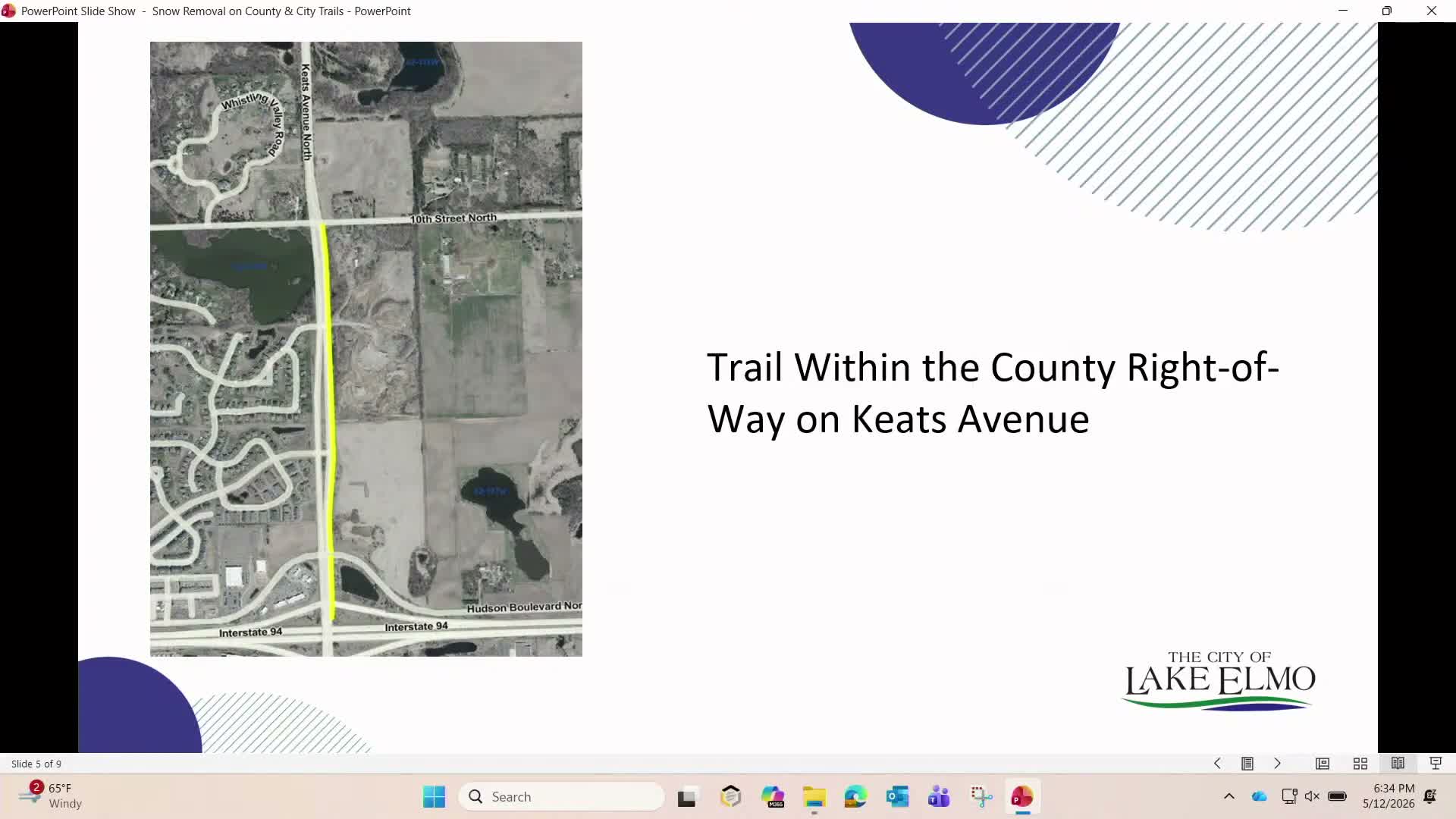
Lake Elmo City officials debated whether paved trails that function like sidewalks should be treated as private responsibility or municipal duty, and whether the city should buy new equipment to clear deeper winter snows. At the council meeting, a public works staff member described a short paved trail segment near Stillwater Boulevard and Jamicot Avenue and explained the operational trade-offs: "Early season snows that take 1 pickup truck" require about "1 to 2 hours" per event, but "late season snow" needs a blower-equipped articulating machine and "estimated 3 to 4 hours" because it travels much slower. The staff member added that a machine for that work would cost "about a 100,000, a 120,000."
The discussion centered on who should clear paved surfaces. One council member noted the city's sidewalk ordinance requires adjacent property owners to clear snow on sidewalks in front of their homes but does not apply to separate paved trails, saying, "the city ordinance says the adjacent property owner must clear the snow from the front of the sidewalk on their home" and asking whether the ordinance could be rewritten to cover paved frontage. Several council members proposed a practical compromise: keep roads and sidewalks as the highest priorities, and identify a small set of high-use paved trail segments the city would clear on a low-priority basis while leaving most other trails to residents, HOAs, or as-available public-works service.
Staff told the council the city has about 26 miles of trails; clearing all of them reliably would likely require more staff or multiple pieces of specialized equipment and could be a sustained drain on operations when late-season storms hit repeatedly. Council members asked staff to return with draft ordinance language that would treat "paved frontage" in front of a property as the homeowner's responsibility when a sidewalk exists on the other side of the street, while also offering a carve-out for specific high-use corridors where the city might take on clearing as a low-priority service.
Next steps: staff will prepare proposed ordinance wording and an operational plan showing which paved trail segments the city would prioritize for clearing, plus estimated capital and staffing costs for consideration at a future meeting.
The discussion centered on who should clear paved surfaces. One council member noted the city's sidewalk ordinance requires adjacent property owners to clear snow on sidewalks in front of their homes but does not apply to separate paved trails, saying, "the city ordinance says the adjacent property owner must clear the snow from the front of the sidewalk on their home" and asking whether the ordinance could be rewritten to cover paved frontage. Several council members proposed a practical compromise: keep roads and sidewalks as the highest priorities, and identify a small set of high-use paved trail segments the city would clear on a low-priority basis while leaving most other trails to residents, HOAs, or as-available public-works service.
Staff told the council the city has about 26 miles of trails; clearing all of them reliably would likely require more staff or multiple pieces of specialized equipment and could be a sustained drain on operations when late-season storms hit repeatedly. Council members asked staff to return with draft ordinance language that would treat "paved frontage" in front of a property as the homeowner's responsibility when a sidewalk exists on the other side of the street, while also offering a carve-out for specific high-use corridors where the city might take on clearing as a low-priority service.
Next steps: staff will prepare proposed ordinance wording and an operational plan showing which paved trail segments the city would prioritize for clearing, plus estimated capital and staffing costs for consideration at a future meeting.
View the Full Meeting & All Its Details
This article offers just a summary. Unlock complete video, transcripts, and insights as a Founder Member.
✓
Watch full, unedited meeting videos
✓
Search every word spoken in unlimited transcripts
✓
AI summaries & real-time alerts (all government levels)
✓
Permanent access to expanding government content
30-day money-back guarantee
