County data show large health gaps for American Indian, Alaska Native and Mesoamerican indigenous residents
May 13, 2026 | Alameda County, California
This article was created by AI summarizing key points discussed. AI makes mistakes, so for full details and context, please refer to the video of the full meeting. Please report any errors so we can fix them. Report an error »
Alameda County health officials told the county Health Committee on March 25 that American Indian, Alaska Native and other indigenous residents in the county face substantial and persistent health disparities.
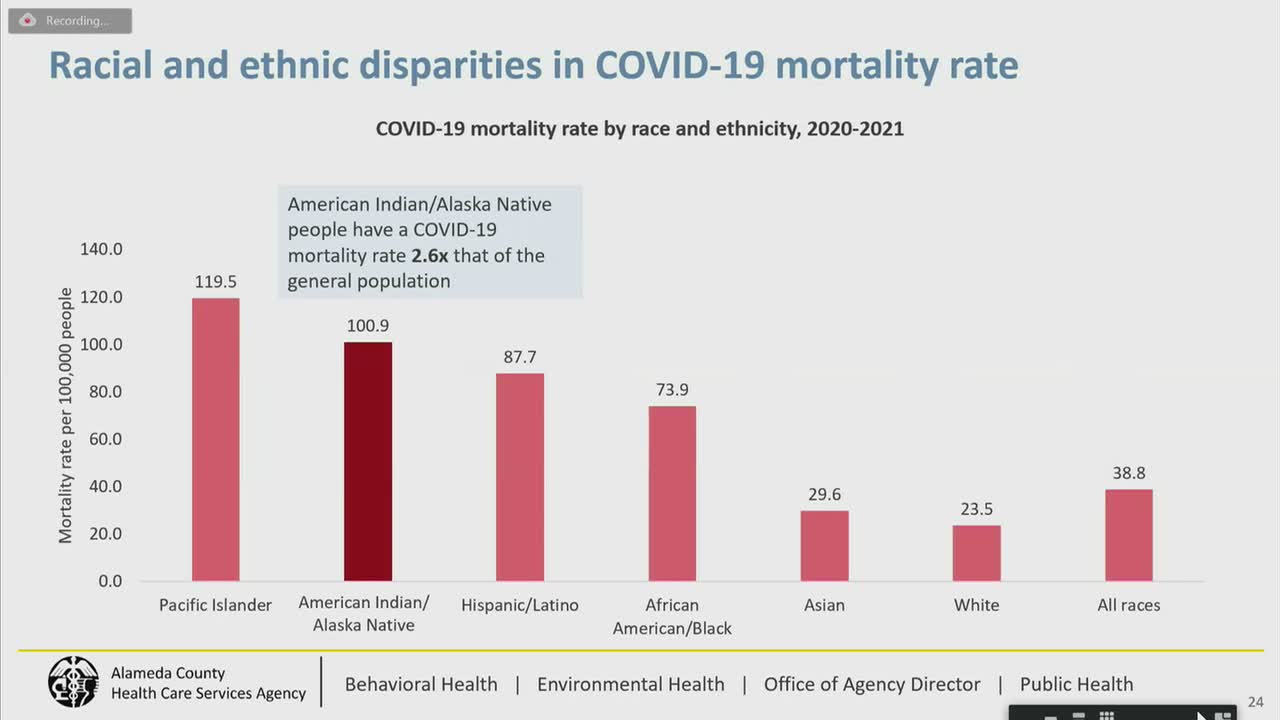
Public Health Director Kimmy Watkins Tard and data lead Julia Raifman presented figures showing the county’s American Indian and Alaska Native population had a life expectancy roughly 7.3 years lower than the county average in 2020–21 and disproportionately high mortality from heart disease, COVID-19 and diabetes. "The American Indian and Alaska Native population was 2.6 times the mortality rate of the general population for COVID-19," Raifman said, and heart-disease mortality was about 1.6 times higher.
The presenters said these disparities are driven by structural factors such as forced relocation and policies that produced intergenerational trauma, constrained access to culturally appropriate health care and concentrated poverty. "The data we're presenting today is a result of a racist, violent and traumatizing history," Watkins Tard said, adding that some statistics may be triggering.
County presenters also flagged shortages in data and the need to disaggregate indigenous subgroups. "There is a need for more accurate, disaggregated and contextualized data to help us truly understand the needs of the native and indigenous communities," Raifman said. Supervisors asked whether state reporting lumps Mesoamerican indigenous immigrants with Hispanic/Latino categories; county staff said state systems often do and that improved collection is needed.
The presentation included local measures: Alameda County’s American Indian and Alaska Native population was reported as 48,407 residents (alone or in combination with other groups); unemployment for that population was cited at about 7 percent; overcrowding and rent burden rates were reported at about 30 percent and 41 percent, respectively. Raifman noted outcomes varied by condition: cancer mortality was comparable to the general population, while diabetes and COVID outcomes were substantially worse.
Officials and community partners recommended a mix of strategies: sustained multiyear funding, expanded bilingual/bicultural staffing and peer-provider roles, improved language access for oral-language communities, culturally affirming behavioral-health programming, better data systems to allow subgroup disaggregation, and deeper community partnerships to guide service design. "Improving the health of American Indian, Alaska Native, and indigenous residents will take structural and policy solutions and deep partnerships with community members and leaders," Watkins Tard said.
The committee did not take formal action at the meeting. County staff committed to returning with additional historical and program-evaluation data where available and to follow up on measurement questions raised by supervisors.
Public Health Director Kimmy Watkins Tard and data lead Julia Raifman presented figures showing the county’s American Indian and Alaska Native population had a life expectancy roughly 7.3 years lower than the county average in 2020–21 and disproportionately high mortality from heart disease, COVID-19 and diabetes. "The American Indian and Alaska Native population was 2.6 times the mortality rate of the general population for COVID-19," Raifman said, and heart-disease mortality was about 1.6 times higher.
The presenters said these disparities are driven by structural factors such as forced relocation and policies that produced intergenerational trauma, constrained access to culturally appropriate health care and concentrated poverty. "The data we're presenting today is a result of a racist, violent and traumatizing history," Watkins Tard said, adding that some statistics may be triggering.
County presenters also flagged shortages in data and the need to disaggregate indigenous subgroups. "There is a need for more accurate, disaggregated and contextualized data to help us truly understand the needs of the native and indigenous communities," Raifman said. Supervisors asked whether state reporting lumps Mesoamerican indigenous immigrants with Hispanic/Latino categories; county staff said state systems often do and that improved collection is needed.
The presentation included local measures: Alameda County’s American Indian and Alaska Native population was reported as 48,407 residents (alone or in combination with other groups); unemployment for that population was cited at about 7 percent; overcrowding and rent burden rates were reported at about 30 percent and 41 percent, respectively. Raifman noted outcomes varied by condition: cancer mortality was comparable to the general population, while diabetes and COVID outcomes were substantially worse.
Officials and community partners recommended a mix of strategies: sustained multiyear funding, expanded bilingual/bicultural staffing and peer-provider roles, improved language access for oral-language communities, culturally affirming behavioral-health programming, better data systems to allow subgroup disaggregation, and deeper community partnerships to guide service design. "Improving the health of American Indian, Alaska Native, and indigenous residents will take structural and policy solutions and deep partnerships with community members and leaders," Watkins Tard said.
The committee did not take formal action at the meeting. County staff committed to returning with additional historical and program-evaluation data where available and to follow up on measurement questions raised by supervisors.
View the Full Meeting & All Its Details
This article offers just a summary. Unlock complete video, transcripts, and insights as a Founder Member.
✓
Watch full, unedited meeting videos
✓
Search every word spoken in unlimited transcripts
✓
AI summaries & real-time alerts (all government levels)
✓
Permanent access to expanding government content
30-day money-back guarantee
