Council debates roads test: unit thresholds or trips-based study area?
May 13, 2026 | Howard County, Maryland
This article was created by AI summarizing key points discussed. AI makes mistakes, so for full details and context, please refer to the video of the full meeting. Please report any errors so we can fix them. Report an error »
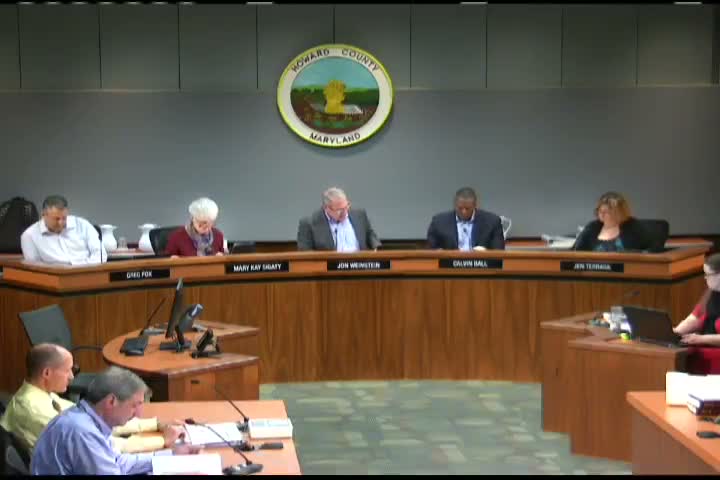
Howard County councilors spent a major portion of a legislative work session debating how to update the roads impact portion of the Adequate Public Facilities Ordinance (APFO).
Council proposals ranged from a two‑tier unit‑based test (a 100‑unit threshold distinguishing small and large projects) to an approach driven by traffic generation counts. Public Works staff recommended using net peak‑hour trips and established trip thresholds similar to those already used in Downtown Columbia rather than relying on a blunt unit count, which can under‑ or overstate impact for mixed‑use projects.
Public Works argued that peak‑hour trip counts are more reliable: staff pointed to the department's practice in Downtown Columbia, where trip ranges dictate how many signalized intersections are included in a study (e.g., 20–100 trips = one intersection; 101–500 = two intersections) and recommended using ITE trip‑generation manuals to calculate net trips for different land uses. "We would prefer to see something tied directly to traffic, which would be the number of trips," said a Public Works official.
Several council members said they feared losing predictability for developers if DPZ or staff were given too much ad‑hoc discretion. Chairman Bryant and others proposed drafting language that generally uses the trips approach but includes a narrowly defined exception allowing DPZ to add an out‑of‑area intersection when evidence shows it would bear the majority of project trips. Advocates of unit thresholds said a simple tiers approach gives clarity for both staff and applicants.
What was said: "It's just the use of terms like instead of saying units, we would prefer to see something tied directly to traffic," said the Public Works official. Chairman Bryant asked staff to craft workable language that balances precision and predictability for applicants.
What happens next: Council members asked DPZ and Public Works to draft revised language that leans toward trips‑based measures while limiting discretionary exceptions so that developers have clear expectations about when a traffic study will be required.
Council proposals ranged from a two‑tier unit‑based test (a 100‑unit threshold distinguishing small and large projects) to an approach driven by traffic generation counts. Public Works staff recommended using net peak‑hour trips and established trip thresholds similar to those already used in Downtown Columbia rather than relying on a blunt unit count, which can under‑ or overstate impact for mixed‑use projects.
Public Works argued that peak‑hour trip counts are more reliable: staff pointed to the department's practice in Downtown Columbia, where trip ranges dictate how many signalized intersections are included in a study (e.g., 20–100 trips = one intersection; 101–500 = two intersections) and recommended using ITE trip‑generation manuals to calculate net trips for different land uses. "We would prefer to see something tied directly to traffic, which would be the number of trips," said a Public Works official.
Several council members said they feared losing predictability for developers if DPZ or staff were given too much ad‑hoc discretion. Chairman Bryant and others proposed drafting language that generally uses the trips approach but includes a narrowly defined exception allowing DPZ to add an out‑of‑area intersection when evidence shows it would bear the majority of project trips. Advocates of unit thresholds said a simple tiers approach gives clarity for both staff and applicants.
What was said: "It's just the use of terms like instead of saying units, we would prefer to see something tied directly to traffic," said the Public Works official. Chairman Bryant asked staff to craft workable language that balances precision and predictability for applicants.
What happens next: Council members asked DPZ and Public Works to draft revised language that leans toward trips‑based measures while limiting discretionary exceptions so that developers have clear expectations about when a traffic study will be required.
Don't Miss a Word: See the Full Meeting!
Go beyond summaries. Unlock every video, transcript, and key insight with a Founder Membership.
✓
Get instant access to full meeting videos
✓
Search and clip any phrase from complete transcripts
✓
Receive AI-powered summaries & custom alerts
✓
Enjoy lifetime, unrestricted access to government data
30-day money-back guarantee
