Council debates adding high‑school APFO test as school system warns program uses complicate capacity calculations
May 13, 2026 | Howard County, Maryland
This article was created by AI summarizing key points discussed. AI makes mistakes, so for full details and context, please refer to the video of the full meeting. Please report any errors so we can fix them. Report an error »
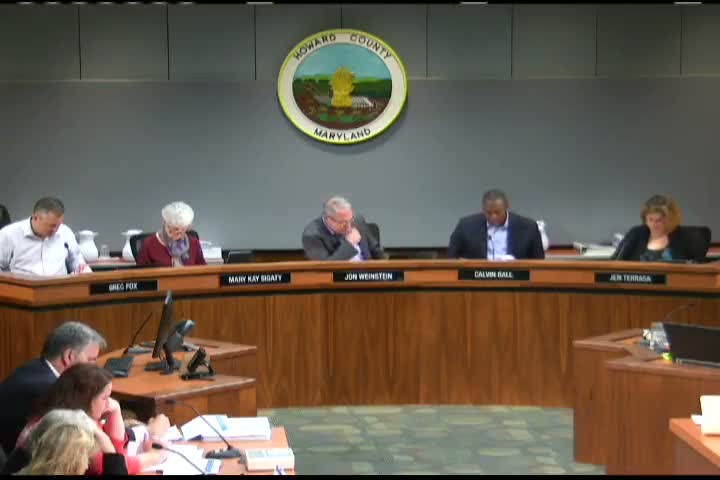
Howard County councilors debated multiple competing amendments that would add or change a high‑school test to the APFO.
Dr. Ball proposed amendment H to ensure separate elementary, middle and high‑school tests, setting a 105% threshold for individual high schools and 100% for regions; he also suggested delaying the high‑school test until 2022 in recognition of a new school coming online. Other council members proposed different thresholds and region‑based variations.
School system official Kamen explained how state participation and local calculations work: the school system uses a projection that combines current enrollment with a seven‑year outlook, and the board counts teaching stations (rooms meeting design criteria, typically >660 square feet) and applies an 80% or 85% factor to account for programmatic spaces and non‑classroom uses. "You can't use every single classroom space 100% of the day," Kamen said, describing the MSDE‑aligned approach used to evaluate capacity for funding and construction needs.
Council members expressed concern that a 105% trigger, measured against a reduced (80–85%) capacity metric, might understate the practical crowding experienced in schools. Members also discussed adjacency tests and how redistricting and program allocation (magnet or regional programs) can shift utilization among schools.
What was said: "So my amendment H... makes it 105% individually or 100% for the region," Dr. Ball said. Kamen responded that program spaces should be accounted for and that state participation requires showing at least 50% of a new school's capacity can be filled by adjacent attendance areas.
What happens next: Council asked for more analysis and sample state forms and asked the school system and staff to provide clearer comparisons of how various proposed thresholds would affect open/closed charts and capital planning.
Dr. Ball proposed amendment H to ensure separate elementary, middle and high‑school tests, setting a 105% threshold for individual high schools and 100% for regions; he also suggested delaying the high‑school test until 2022 in recognition of a new school coming online. Other council members proposed different thresholds and region‑based variations.
School system official Kamen explained how state participation and local calculations work: the school system uses a projection that combines current enrollment with a seven‑year outlook, and the board counts teaching stations (rooms meeting design criteria, typically >660 square feet) and applies an 80% or 85% factor to account for programmatic spaces and non‑classroom uses. "You can't use every single classroom space 100% of the day," Kamen said, describing the MSDE‑aligned approach used to evaluate capacity for funding and construction needs.
Council members expressed concern that a 105% trigger, measured against a reduced (80–85%) capacity metric, might understate the practical crowding experienced in schools. Members also discussed adjacency tests and how redistricting and program allocation (magnet or regional programs) can shift utilization among schools.
What was said: "So my amendment H... makes it 105% individually or 100% for the region," Dr. Ball said. Kamen responded that program spaces should be accounted for and that state participation requires showing at least 50% of a new school's capacity can be filled by adjacent attendance areas.
What happens next: Council asked for more analysis and sample state forms and asked the school system and staff to provide clearer comparisons of how various proposed thresholds would affect open/closed charts and capital planning.
Don't Miss a Word: See the Full Meeting!
Go beyond summaries. Unlock every video, transcript, and key insight with a Founder Membership.
✓
Get instant access to full meeting videos
✓
Search and clip any phrase from complete transcripts
✓
Receive AI-powered summaries & custom alerts
✓
Enjoy lifetime, unrestricted access to government data
30-day money-back guarantee
