Committee advances bill to codify appeals path for EPR producer dues after split testimony
May 12, 2026 | 2026 Legislature CO, Colorado
This article was created by AI summarizing key points discussed. AI makes mistakes, so for full details and context, please refer to the video of the full meeting. Please report any errors so we can fix them. Report an error »
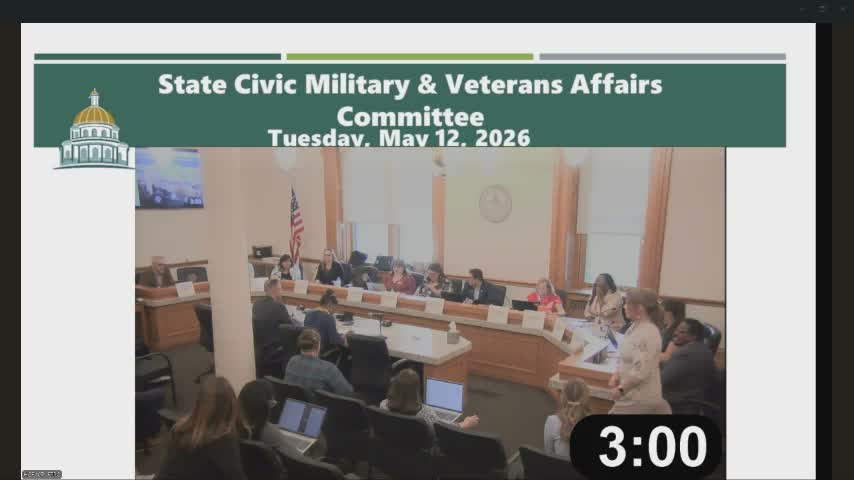
Senate Bill 192, a narrow measure to clarify appeals for producer dues under Colorado's extended producer responsibility (EPR) program, advanced from the State Civic, Military and Veterans Affairs Committee on a 7-4 vote.
Sponsors and agency officials said the bill simply affirms a multi-step appeals path tied to a rule the Solid and Hazardous Waste Commission adopted in November 2025. Representative Joseph, a sponsor, told the panel the legislation "reaffirms and makes abundantly clear that Colorado's EPR advisory board can make recommendation to CDPHE on appeals of producer dues amounts," and stressed that the department retains final decision authority and that parties may seek judicial review.
Opponents, including trade groups and some committee members, warned that vesting a recommendation role with the advisory board risks due process problems and conflicts of interest. Erin Radin of the Consumer Brands Association said the advisory board is not "the appropriate venue" because members include local governments, haulers and recyclers who benefit from program funds, and she warned that Colorado's public‑meeting laws could force disclosure of producers' confidential business information. Andrea Albersheim of the American Chemistry Council echoed those concerns, urging the department to administer any formal appeals under established administrative processes.
Supporters from environmental organizations and the department argued the advisory board brings technical expertise needed to evaluate ecomodulation factors and that the board only issues recommendations, not final agency actions. Randy Mormon of EcoCycle said the appeals process is "essential to meet due process requirements" and to build trust in the program, while Wolf Cray of the Colorado Department of Public Health and Environment explained that Rule 18.2.0.7 tasked the advisory board with review and that the department makes the final ruling. Cray also cited a confidential business information clause in the solid waste regulations intended to protect proprietary data.
Much of the committee's debate centered on two legal questions: whether the advisory board qualifies as an "agency" under the Colorado Administrative Procedure Act (APA) and whether retroactively validating the November 2025 rule could itself create litigation risks. Representative Soper, a co-sponsor, acknowledged concern about retroactivity but said the statute needs clarity so that the program can continue. Representative Espinosa and several other members said they were unconvinced by the Office of the Attorney General's memo and relied on the Office of Legislative Legal Services' contrary opinion at the legal services committee, calling the statutory delegation and potential conflicts problematic.
After a short recess and no amendments, Vice Chair Clifford moved to advance SB 192 to the Committee of the Whole with a favorable recommendation; the motion was seconded by Representative Wynne. The committee polled and the bill passed 7-4.
What happens next: SB 192 will go to the Committee of the Whole for further consideration. If the bill becomes law, it would codify the advisory board's role in the appeals sequence described in committee testimony; any change to who conducts evidentiary hearings or how confidential information is handled would require statutory or rule changes or further departmental process.
Sponsors and agency officials said the bill simply affirms a multi-step appeals path tied to a rule the Solid and Hazardous Waste Commission adopted in November 2025. Representative Joseph, a sponsor, told the panel the legislation "reaffirms and makes abundantly clear that Colorado's EPR advisory board can make recommendation to CDPHE on appeals of producer dues amounts," and stressed that the department retains final decision authority and that parties may seek judicial review.
Opponents, including trade groups and some committee members, warned that vesting a recommendation role with the advisory board risks due process problems and conflicts of interest. Erin Radin of the Consumer Brands Association said the advisory board is not "the appropriate venue" because members include local governments, haulers and recyclers who benefit from program funds, and she warned that Colorado's public‑meeting laws could force disclosure of producers' confidential business information. Andrea Albersheim of the American Chemistry Council echoed those concerns, urging the department to administer any formal appeals under established administrative processes.
Supporters from environmental organizations and the department argued the advisory board brings technical expertise needed to evaluate ecomodulation factors and that the board only issues recommendations, not final agency actions. Randy Mormon of EcoCycle said the appeals process is "essential to meet due process requirements" and to build trust in the program, while Wolf Cray of the Colorado Department of Public Health and Environment explained that Rule 18.2.0.7 tasked the advisory board with review and that the department makes the final ruling. Cray also cited a confidential business information clause in the solid waste regulations intended to protect proprietary data.
Much of the committee's debate centered on two legal questions: whether the advisory board qualifies as an "agency" under the Colorado Administrative Procedure Act (APA) and whether retroactively validating the November 2025 rule could itself create litigation risks. Representative Soper, a co-sponsor, acknowledged concern about retroactivity but said the statute needs clarity so that the program can continue. Representative Espinosa and several other members said they were unconvinced by the Office of the Attorney General's memo and relied on the Office of Legislative Legal Services' contrary opinion at the legal services committee, calling the statutory delegation and potential conflicts problematic.
After a short recess and no amendments, Vice Chair Clifford moved to advance SB 192 to the Committee of the Whole with a favorable recommendation; the motion was seconded by Representative Wynne. The committee polled and the bill passed 7-4.
What happens next: SB 192 will go to the Committee of the Whole for further consideration. If the bill becomes law, it would codify the advisory board's role in the appeals sequence described in committee testimony; any change to who conducts evidentiary hearings or how confidential information is handled would require statutory or rule changes or further departmental process.
Don't Miss a Word: See the Full Meeting!
Go beyond summaries. Unlock every video, transcript, and key insight with a Founder Membership.
✓
Get instant access to full meeting videos
✓
Search and clip any phrase from complete transcripts
✓
Receive AI-powered summaries & custom alerts
✓
Enjoy lifetime, unrestricted access to government data
30-day money-back guarantee
