Vermont committee hears split over proposed limits on crypto kiosks
May 13, 2026 | Commerce & Economic Development, HOUSE OF REPRESENTATIVES, Committees, Legislative , Vermont
This article was created by AI summarizing key points discussed. AI makes mistakes, so for full details and context, please refer to the video of the full meeting. Please report any errors so we can fix them. Report an error »
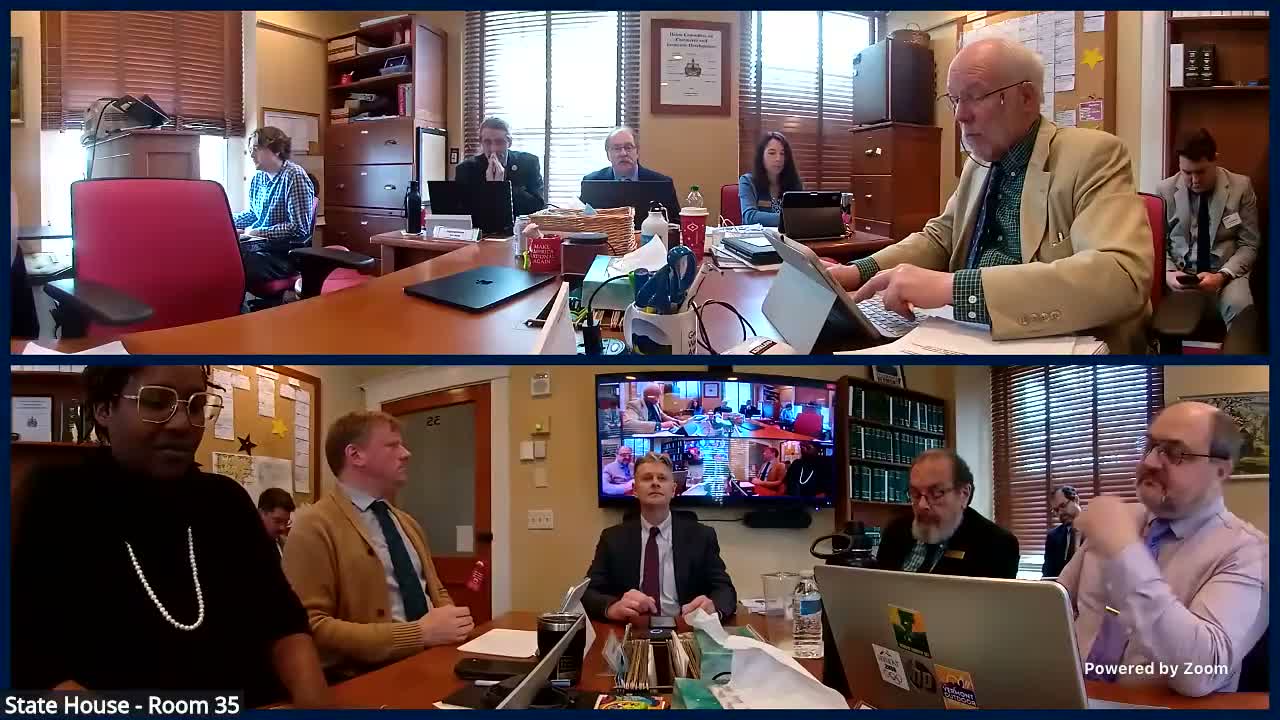
The Vermont House Committee on Commerce & Economic Development on May 12 heard competing views on a proposed amendment to the senate proposal of amendment to H.648 that would extend or expand restrictions on crypto kiosks.
Christopher Curtis, assistant attorney general and director of the Consumer Assistance Program, told the committee his office logged about 45 cryptocurrency complaints from 2022'1024 that together alleged more than $3 million in losses, and said roughly 14 to 15 of those complaints involved transfers made at crypto kiosks. "These crypto kiosks, the risks far outweigh any reward," Curtis said, arguing the machines are unsupervised, placed in retail settings and give victims an easy way to transmit cash to scammers.
Curtis said a prior legislative moratorium and related rules appear to have reduced the number of kiosks in Vermont and the flow of complaints, but he urged caution because the kiosk transactions provide no person on site to intervene when a consumer is under pressure. He recommended that operators have financial responsibilities that create "skin in the game," including refund mechanisms and other protections, and said his office previously provided a 2024 letter to the Department of Financial Regulation summarizing those concerns.
Aleip, general counsel for CoinFlip, the company that runs the two kiosks currently in Vermont, disputed several of Curtis's points and described his company's protections. He said CoinFlip has two Vermont kiosks and since the law took effect July 1, 2025, the company recorded 410 transactions totaling $188,000 and reported that one attempted fraud was stopped and the customer was refunded. "There have been no scam victims in this state," Aleip said, and he described requirements the company has adopted, including money-transmitter registration with FinCEN, paper and digital receipts, photographing customers, wallet PINs, blockchain analytics to block flagged wallets, a fee cap of 15 percent and live customer service.
Committee members asked detailed questions about the design and limits of current protections. One member said the statute's refund window (a 90-day new-customer period in current law) could be too short for some victims and asked whether operators should bear strict liability because they are best positioned to detect scams. Aleip said the company would consider a longer refund window (he suggested 120 days as an option) but warned that unlimited liability could invite false claims; he proposed a mechanism that would require a court determination for some refunds to reduce abuse. "If a court determines that someone is a scam victim, they should get a full refund," he said as one possible approach.
The committee also questioned how CoinFlip's customer-contact measures work in practice. Aleip described a scripted phone call for customers age 60 and older that asks about the purpose of the transaction, whether the customer is under duress and whether the customer understands the wallet mechanics; CoinFlip staff are trained on fraud techniques twice per year, he said. The company also said it places a temporary hold (described in testimony as a 48-hour hold, and mentioned elsewhere as a 40-hour hold) on transactions to allow time for customers to report suspected fraud.
Members asked for the Attorney General's 2024 letter to the Department of Financial Regulation and for data on merchant cash advance complaints; Curtis said he would provide the letter and run reports on merchant cash advances and relay those numbers to the committee. No final vote was taken; the chair said the committee may move the amendment the following day.
The hearing included a brief heated exchange when a member said phrasing that kiosks "protect people from themselves" was offensive; Aleip apologized and clarified he did not mean to blame victims but to describe measures that can stop scammers.
The committee recessed briefly to address an audio issue before continuing its schedule. Next steps: committee members signaled they expect to consider the amendment soon and requested the AG's letter and follow-up data on merchant cash advances.
Christopher Curtis, assistant attorney general and director of the Consumer Assistance Program, told the committee his office logged about 45 cryptocurrency complaints from 2022'1024 that together alleged more than $3 million in losses, and said roughly 14 to 15 of those complaints involved transfers made at crypto kiosks. "These crypto kiosks, the risks far outweigh any reward," Curtis said, arguing the machines are unsupervised, placed in retail settings and give victims an easy way to transmit cash to scammers.
Curtis said a prior legislative moratorium and related rules appear to have reduced the number of kiosks in Vermont and the flow of complaints, but he urged caution because the kiosk transactions provide no person on site to intervene when a consumer is under pressure. He recommended that operators have financial responsibilities that create "skin in the game," including refund mechanisms and other protections, and said his office previously provided a 2024 letter to the Department of Financial Regulation summarizing those concerns.
Aleip, general counsel for CoinFlip, the company that runs the two kiosks currently in Vermont, disputed several of Curtis's points and described his company's protections. He said CoinFlip has two Vermont kiosks and since the law took effect July 1, 2025, the company recorded 410 transactions totaling $188,000 and reported that one attempted fraud was stopped and the customer was refunded. "There have been no scam victims in this state," Aleip said, and he described requirements the company has adopted, including money-transmitter registration with FinCEN, paper and digital receipts, photographing customers, wallet PINs, blockchain analytics to block flagged wallets, a fee cap of 15 percent and live customer service.
Committee members asked detailed questions about the design and limits of current protections. One member said the statute's refund window (a 90-day new-customer period in current law) could be too short for some victims and asked whether operators should bear strict liability because they are best positioned to detect scams. Aleip said the company would consider a longer refund window (he suggested 120 days as an option) but warned that unlimited liability could invite false claims; he proposed a mechanism that would require a court determination for some refunds to reduce abuse. "If a court determines that someone is a scam victim, they should get a full refund," he said as one possible approach.
The committee also questioned how CoinFlip's customer-contact measures work in practice. Aleip described a scripted phone call for customers age 60 and older that asks about the purpose of the transaction, whether the customer is under duress and whether the customer understands the wallet mechanics; CoinFlip staff are trained on fraud techniques twice per year, he said. The company also said it places a temporary hold (described in testimony as a 48-hour hold, and mentioned elsewhere as a 40-hour hold) on transactions to allow time for customers to report suspected fraud.
Members asked for the Attorney General's 2024 letter to the Department of Financial Regulation and for data on merchant cash advance complaints; Curtis said he would provide the letter and run reports on merchant cash advances and relay those numbers to the committee. No final vote was taken; the chair said the committee may move the amendment the following day.
The hearing included a brief heated exchange when a member said phrasing that kiosks "protect people from themselves" was offensive; Aleip apologized and clarified he did not mean to blame victims but to describe measures that can stop scammers.
The committee recessed briefly to address an audio issue before continuing its schedule. Next steps: committee members signaled they expect to consider the amendment soon and requested the AG's letter and follow-up data on merchant cash advances.
View the Full Meeting & All Its Details
This article offers just a summary. Unlock complete video, transcripts, and insights as a Founder Member.
✓
Watch full, unedited meeting videos
✓
Search every word spoken in unlimited transcripts
✓
AI summaries & real-time alerts (all government levels)
✓
Permanent access to expanding government content
30-day money-back guarantee
