Larimer County proclaims May 2026 as Clean Air Month after health department briefing
May 11, 2026 | Larimer County, Colorado
This article was created by AI summarizing key points discussed. AI makes mistakes, so for full details and context, please refer to the video of the full meeting. Please report any errors so we can fix them. Report an error »
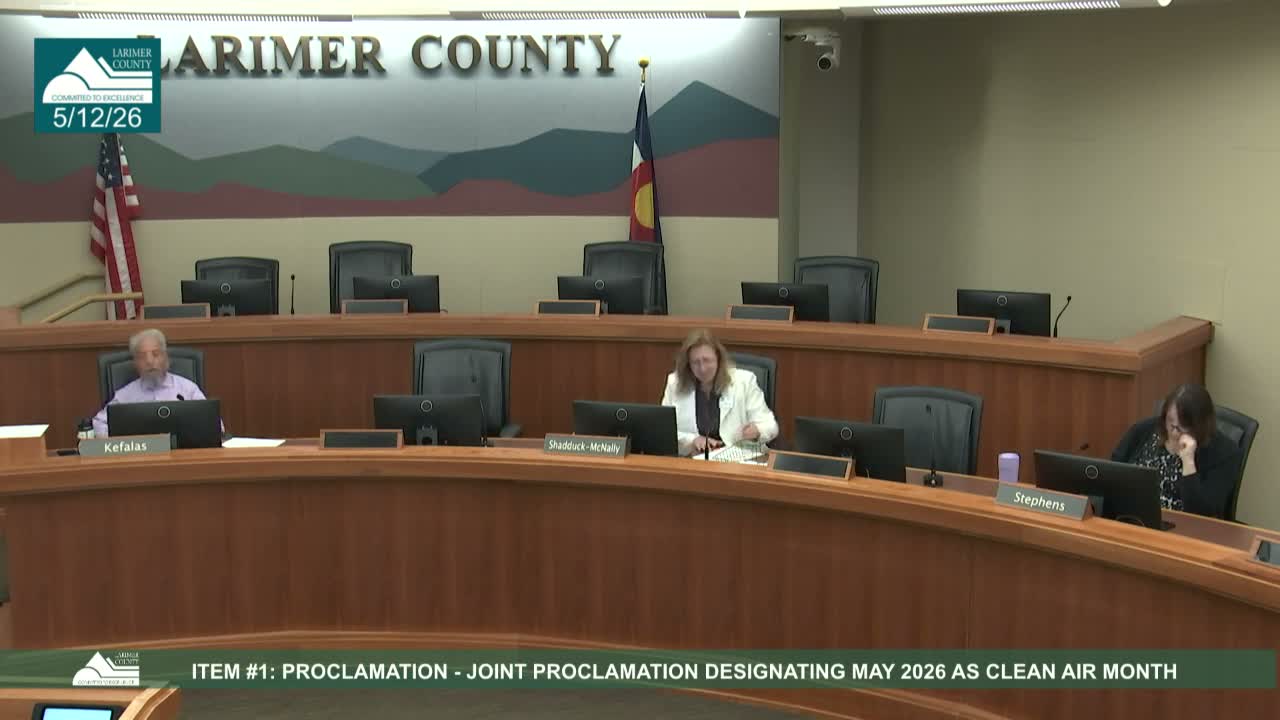
The Larimer County Board of County Commissioners on May 12 voted unanimously to approve a joint proclamation with the Larimer County Board of Health declaring May 2026 as Clean Air Month following a presentation by county health staff.
The proclamation — read and moved by Commissioner Kristen Stevens — cites the county’s expanded monitoring, education and partner work as part of efforts to reduce ozone and other air pollution that affect local residents. "It's something we all use," Bob McDonald, the county's director for environmental health, said of clean air, adding that many pollution sources affecting Larimer County originate outside the county and require collaboration with partners.
During the presentation, Noelle Udell, environmental health specialist lead for air quality at the Larimer County Department of Health and Environment (LCDHE), summarized the county’s contract work with the Colorado Department of Public Health and Environment (CDPHE): routine inspections and complaint investigations for permitted sources (including oil and gas, mining, concrete and asphalt plants, auto repair shops and fuel stations), operation and maintenance of county monitors that are part of the statewide network, and review of burn permits in coordination with local fire authorities.
Udell said the county's 2025 contract year included about 58 air‑quality complaints investigated and, through March 2026, 41 complaints had been investigated so far. She described a new emphasis on fuel‑station inspections using optical gas imaging: in 2025 six stations were inspected and emissions were identified at four of those sites during fuel deliveries; reinspections and enforcement coordination with CDPHE followed, and four sites inspected in 2026 showed no emissions during subsequent checks.
The health department also reported results from a radon outreach campaign funded by CDPHE. "Through April, we have had 180 test kits submitted to the laboratory for testing," Udell said. She said Loveland had the highest number of tests analyzed (68) and that 59 percent of test results were at or above the EPA’s recommended action level of 4 picocuries per liter. The highest individual test reported was 182.6 picocuries per liter in the Red Feather Lakes area. For homes at or above the action level, the department notifies residents and provides information on mitigation resources such as the state’s Low Income Radon Mitigation Assistance (LERMA) program; since Jan. 1, 2025, Udell said 35 homes have received mitigation assistance, with seven currently undergoing mitigation and 17 applications in process.
Leah Schneider, who led the department’s radon outreach, said LCDHE has targeted health‑care providers with a dedicated radon website and newsletter, launched podcast episodes on radon, and used social media and geotargeted digital ads to increase awareness and testing. She also discussed an ongoing ozone study led by Colorado State University in partnership with the Regional Air Quality Council and the state health department that received $1.3 million to monitor ozone and analyze precursor pollutants (NOx and VOCs). Schneider said additional monitors funded by Larimer County in Loveland and Timnath and surface monitoring combined with satellite data are helping researchers identify precursor sources and regional transport patterns.
Commissioners thanked staff for the briefing, asked questions about inspection selection and follow‑up on violations, and discussed public outreach to schools and community groups. Commissioner John Kefalas commended the department’s public engagement efforts and noted grant programs to support vehicle repairs and electrification for small businesses.
The board’s vote to approve the proclamation was 3–0. The meeting paused briefly for a photo with public health staff following the vote. The county emphasized that the proclamation is intended to raise awareness and encourage actions such as replacing gas‑powered lawn equipment, reducing vehicle trips and refueling in the evening to reduce ozone‑forming emissions.
The board moved on to routine business after the proclamation; no further decisions related to the presentation were recorded.
The proclamation — read and moved by Commissioner Kristen Stevens — cites the county’s expanded monitoring, education and partner work as part of efforts to reduce ozone and other air pollution that affect local residents. "It's something we all use," Bob McDonald, the county's director for environmental health, said of clean air, adding that many pollution sources affecting Larimer County originate outside the county and require collaboration with partners.
During the presentation, Noelle Udell, environmental health specialist lead for air quality at the Larimer County Department of Health and Environment (LCDHE), summarized the county’s contract work with the Colorado Department of Public Health and Environment (CDPHE): routine inspections and complaint investigations for permitted sources (including oil and gas, mining, concrete and asphalt plants, auto repair shops and fuel stations), operation and maintenance of county monitors that are part of the statewide network, and review of burn permits in coordination with local fire authorities.
Udell said the county's 2025 contract year included about 58 air‑quality complaints investigated and, through March 2026, 41 complaints had been investigated so far. She described a new emphasis on fuel‑station inspections using optical gas imaging: in 2025 six stations were inspected and emissions were identified at four of those sites during fuel deliveries; reinspections and enforcement coordination with CDPHE followed, and four sites inspected in 2026 showed no emissions during subsequent checks.
The health department also reported results from a radon outreach campaign funded by CDPHE. "Through April, we have had 180 test kits submitted to the laboratory for testing," Udell said. She said Loveland had the highest number of tests analyzed (68) and that 59 percent of test results were at or above the EPA’s recommended action level of 4 picocuries per liter. The highest individual test reported was 182.6 picocuries per liter in the Red Feather Lakes area. For homes at or above the action level, the department notifies residents and provides information on mitigation resources such as the state’s Low Income Radon Mitigation Assistance (LERMA) program; since Jan. 1, 2025, Udell said 35 homes have received mitigation assistance, with seven currently undergoing mitigation and 17 applications in process.
Leah Schneider, who led the department’s radon outreach, said LCDHE has targeted health‑care providers with a dedicated radon website and newsletter, launched podcast episodes on radon, and used social media and geotargeted digital ads to increase awareness and testing. She also discussed an ongoing ozone study led by Colorado State University in partnership with the Regional Air Quality Council and the state health department that received $1.3 million to monitor ozone and analyze precursor pollutants (NOx and VOCs). Schneider said additional monitors funded by Larimer County in Loveland and Timnath and surface monitoring combined with satellite data are helping researchers identify precursor sources and regional transport patterns.
Commissioners thanked staff for the briefing, asked questions about inspection selection and follow‑up on violations, and discussed public outreach to schools and community groups. Commissioner John Kefalas commended the department’s public engagement efforts and noted grant programs to support vehicle repairs and electrification for small businesses.
The board’s vote to approve the proclamation was 3–0. The meeting paused briefly for a photo with public health staff following the vote. The county emphasized that the proclamation is intended to raise awareness and encourage actions such as replacing gas‑powered lawn equipment, reducing vehicle trips and refueling in the evening to reduce ozone‑forming emissions.
The board moved on to routine business after the proclamation; no further decisions related to the presentation were recorded.
Don't Miss a Word: See the Full Meeting!
Go beyond summaries. Unlock every video, transcript, and key insight with a Founder Membership.
✓
Get instant access to full meeting videos
✓
Search and clip any phrase from complete transcripts
✓
Receive AI-powered summaries & custom alerts
✓
Enjoy lifetime, unrestricted access to government data
30-day money-back guarantee
