Carlsbad panel reviews incentives to protect historic homes, weighs limits on signage and district designation
May 11, 2026 | Carlsbad, San Diego County, California
This article was created by AI summarizing key points discussed. AI makes mistakes, so for full details and context, please refer to the video of the full meeting. Please report any errors so we can fix them. Report an error »
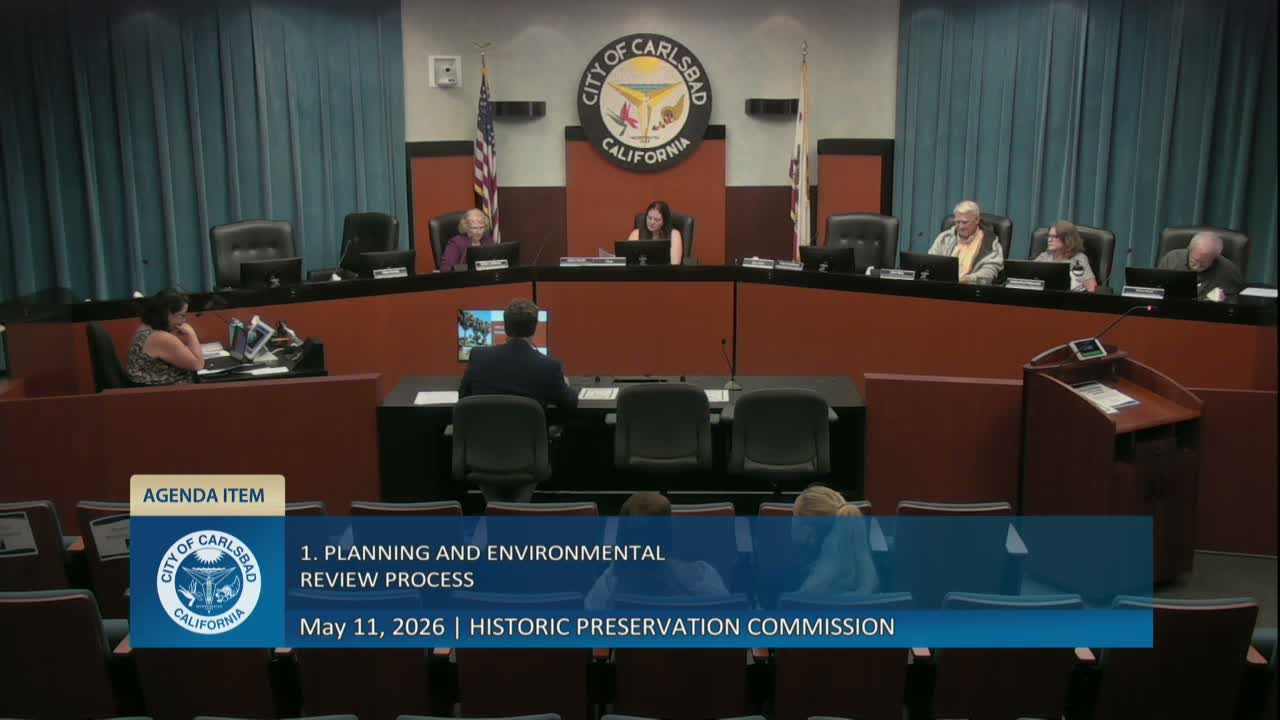
Mike Strong, director of community development for the City of Carlsbad, told the Historic Preservation Commission on Tuesday that staff has drafted two regulatory approaches to encourage the preservation of historic properties: a "major home occupation" allowance for designated historic residences and a new historic-preservation variance tailored to on-site resource protection.
The proposed major home-occupation rule would allow more intensive commercial activity within a dwelling or accessory structure designated as a historic resource, including limited employees and deliveries and use of up to 50% of a property's total floor area for the business, Strong said. The draft would also permit some limited alterations to mechanical, electrical and plumbing systems under Historic Preservation Commission review, while requiring exterior compatibility that preserves the building features that convey historical or architectural value.
The other proposal, a historic-preservation variance, would tailor standard zoning-variance findings (for setbacks, parking or height) to focus on preserving the historic resource on-site. Under the draft, the variance would be available only to properties on a federal, state or local historic register and would require documentation that the project advances preservation without adversely impacting neighboring properties or the character of a district, Strong said.
Commissioners pressed staff for details about the city's inventory of historic resources. A commissioner asked about an earlier reference to 19 recognized properties versus 13 currently on the local register; Strong said the agenda packet includes an Excel spreadsheet showing the 19, with red strikeouts for the six lost or delisted properties, and that the city website lists the 13 properties currently designated. "We do have a couple of resources for landmarking," Strong said, pointing to a 1991 windshield survey and the current online walking tour map.
The commission debated draft language that would bar commercial signage on major home occupations. "It seems to me I've already seen a lot of historic buildings around town that have signs that are tasteful," one commissioner said, urging the body to allow sensitive sign designs that identify home-based businesses. Strong said the current draft prohibits commercial signage on the premises but that staff could revise the language to allow tasteful signs that complement the historic resource if the commission directs that change.
On incentives and outreach, Strong said the city council has directed staff as part of the budget process to prepare a waiver of processing and user fees for enrollment in the local register and the Mills Act program for the next two cycles; those fee waivers are scheduled to take effect Sept. 1. He also said the council's work plan includes exploring Certified Local Government (CLG) membership, a step that typically requires an updated survey of historic resources.
A commissioner suggested the village and master-plan area be evaluated for designation as a historic district to facilitate Mills Act enrollment and broader preservation; the chair asked staff to add information about what district designation would involve to a future agenda. Strong said staff will reconvene an outreach subcommittee in the fall after the fee-waiver timetable is confirmed.
Separately, Strong announced a May 19 student-art proclamation and awards event: about eight or nine schools will participate and 31 student entries will be displayed in the council chamber before moving to Cole Library for the summer. The meeting was adjourned at 7:10 p.m.
The commission took no formal vote on the ordinance language at the meeting; staff said the draft will be released for public review and the Planning Commission will consider staff recommendations in late summer before the city council considers any ordinance in October–December.
The proposed major home-occupation rule would allow more intensive commercial activity within a dwelling or accessory structure designated as a historic resource, including limited employees and deliveries and use of up to 50% of a property's total floor area for the business, Strong said. The draft would also permit some limited alterations to mechanical, electrical and plumbing systems under Historic Preservation Commission review, while requiring exterior compatibility that preserves the building features that convey historical or architectural value.
The other proposal, a historic-preservation variance, would tailor standard zoning-variance findings (for setbacks, parking or height) to focus on preserving the historic resource on-site. Under the draft, the variance would be available only to properties on a federal, state or local historic register and would require documentation that the project advances preservation without adversely impacting neighboring properties or the character of a district, Strong said.
Commissioners pressed staff for details about the city's inventory of historic resources. A commissioner asked about an earlier reference to 19 recognized properties versus 13 currently on the local register; Strong said the agenda packet includes an Excel spreadsheet showing the 19, with red strikeouts for the six lost or delisted properties, and that the city website lists the 13 properties currently designated. "We do have a couple of resources for landmarking," Strong said, pointing to a 1991 windshield survey and the current online walking tour map.
The commission debated draft language that would bar commercial signage on major home occupations. "It seems to me I've already seen a lot of historic buildings around town that have signs that are tasteful," one commissioner said, urging the body to allow sensitive sign designs that identify home-based businesses. Strong said the current draft prohibits commercial signage on the premises but that staff could revise the language to allow tasteful signs that complement the historic resource if the commission directs that change.
On incentives and outreach, Strong said the city council has directed staff as part of the budget process to prepare a waiver of processing and user fees for enrollment in the local register and the Mills Act program for the next two cycles; those fee waivers are scheduled to take effect Sept. 1. He also said the council's work plan includes exploring Certified Local Government (CLG) membership, a step that typically requires an updated survey of historic resources.
A commissioner suggested the village and master-plan area be evaluated for designation as a historic district to facilitate Mills Act enrollment and broader preservation; the chair asked staff to add information about what district designation would involve to a future agenda. Strong said staff will reconvene an outreach subcommittee in the fall after the fee-waiver timetable is confirmed.
Separately, Strong announced a May 19 student-art proclamation and awards event: about eight or nine schools will participate and 31 student entries will be displayed in the council chamber before moving to Cole Library for the summer. The meeting was adjourned at 7:10 p.m.
The commission took no formal vote on the ordinance language at the meeting; staff said the draft will be released for public review and the Planning Commission will consider staff recommendations in late summer before the city council considers any ordinance in October–December.
Don't Miss a Word: See the Full Meeting!
Go beyond summaries. Unlock every video, transcript, and key insight with a Founder Membership.
✓
Get instant access to full meeting videos
✓
Search and clip any phrase from complete transcripts
✓
Receive AI-powered summaries & custom alerts
✓
Enjoy lifetime, unrestricted access to government data
30-day money-back guarantee
