Clermont County IT director outlines camera, access control and cybersecurity upgrades
May 11, 2026 | Clermont County, Ohio
This article was created by AI summarizing key points discussed. AI makes mistakes, so for full details and context, please refer to the video of the full meeting. Please report any errors so we can fix them. Report an error »
Chris Davis, director of Information Services and Development (ISD), gave the board a multi‑part technology update May 11 that detailed recent equipment replacements and next steps for cybersecurity and connectivity.
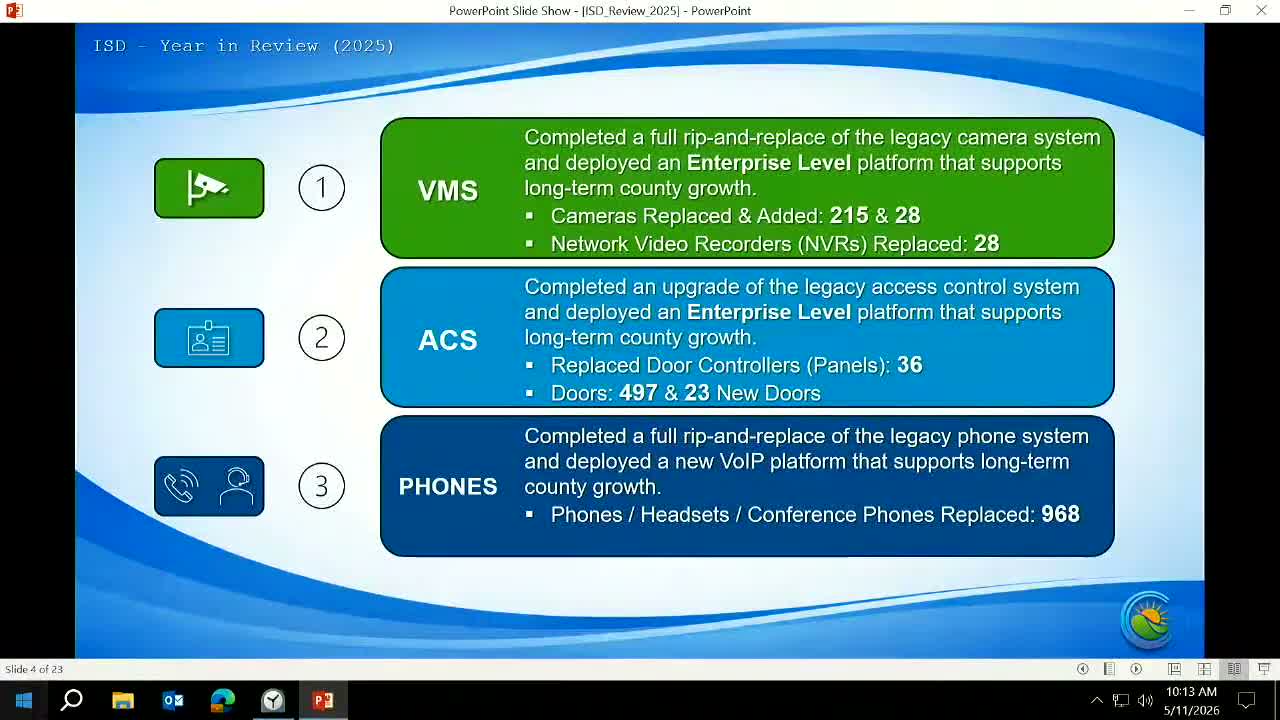
Davis said ISD replaced 215 cameras across three county campuses, added 28 new cameras and replaced 28 network video recorders to establish an enterprise‑level video management system (VMS) intended to improve security and support public‑records retrieval. He said ISD also removed and replaced the county’s access control system, retaining roughly 95 percent of existing door hardware, replacing about 40 door controllers (each handling about 10–12 doors), bringing the system to cover 497 door endpoints and adding 23 new doors.
The county also migrated to a voice‑over‑IP phone system; Davis said ISD replaced about 968 pieces of phone hardware (desk phones, headsets and conference phones) over a 48‑hour window and has been tuning call queues and auto attendants to address user issues.
On cybersecurity, Davis referenced Ohio House Bill 96 requirements that political subdivisions formally adopt cybersecurity programs aligned with best practices and noted the county chose the Center for Internet Security (CIS) Controls as its framework. He said incident reporting and parts of the program were due earlier and that the county completed an initial gateway and will work with the Ohio Public Cybersecurity Initiative (OPCI) to finalize policy and training; ISD plans a network penetration test once broadband and networking changes are complete.
Davis reviewed operational metrics: ISD logged 3,317 support tickets in 2025, with account and email issues among the top categories. He said the TDD rate sheet had not been updated since about 2017 and that ISD made a modest adjustment to that rate. Regarding broadband, Davis said the fiber boring was expected to finish in July with connection work and final hookups completed by September; ISD will use VITRO software to manage connections and will perform a penetration test to validate infrastructure changes.
Davis also described a recent redesign of county websites to meet updated ADA accessibility requirements (the state moved the deadline out one year), including an accessibility widget and standardized tiles for common services across roughly 33 county sites. He invited feedback from commissioners and staff to refine site content and accessibility.
Board members thanked Davis for the concise briefing; Davis said ISD will slow new project rollouts in 2026 to focus on stabilizing and optimizing the recently installed systems.
Davis said ISD replaced 215 cameras across three county campuses, added 28 new cameras and replaced 28 network video recorders to establish an enterprise‑level video management system (VMS) intended to improve security and support public‑records retrieval. He said ISD also removed and replaced the county’s access control system, retaining roughly 95 percent of existing door hardware, replacing about 40 door controllers (each handling about 10–12 doors), bringing the system to cover 497 door endpoints and adding 23 new doors.
The county also migrated to a voice‑over‑IP phone system; Davis said ISD replaced about 968 pieces of phone hardware (desk phones, headsets and conference phones) over a 48‑hour window and has been tuning call queues and auto attendants to address user issues.
On cybersecurity, Davis referenced Ohio House Bill 96 requirements that political subdivisions formally adopt cybersecurity programs aligned with best practices and noted the county chose the Center for Internet Security (CIS) Controls as its framework. He said incident reporting and parts of the program were due earlier and that the county completed an initial gateway and will work with the Ohio Public Cybersecurity Initiative (OPCI) to finalize policy and training; ISD plans a network penetration test once broadband and networking changes are complete.
Davis reviewed operational metrics: ISD logged 3,317 support tickets in 2025, with account and email issues among the top categories. He said the TDD rate sheet had not been updated since about 2017 and that ISD made a modest adjustment to that rate. Regarding broadband, Davis said the fiber boring was expected to finish in July with connection work and final hookups completed by September; ISD will use VITRO software to manage connections and will perform a penetration test to validate infrastructure changes.
Davis also described a recent redesign of county websites to meet updated ADA accessibility requirements (the state moved the deadline out one year), including an accessibility widget and standardized tiles for common services across roughly 33 county sites. He invited feedback from commissioners and staff to refine site content and accessibility.
Board members thanked Davis for the concise briefing; Davis said ISD will slow new project rollouts in 2026 to focus on stabilizing and optimizing the recently installed systems.
View the Full Meeting & All Its Details
This article offers just a summary. Unlock complete video, transcripts, and insights as a Founder Member.
✓
Watch full, unedited meeting videos
✓
Search every word spoken in unlimited transcripts
✓
AI summaries & real-time alerts (all government levels)
✓
Permanent access to expanding government content
30-day money-back guarantee
