Assembly advances 11th budget extender to keep state operations funded through May 14
May 12, 2026 | 2026 Legislature NY, New York
This article was created by AI summarizing key points discussed. AI makes mistakes, so for full details and context, please refer to the video of the full meeting. Please report any errors so we can fix them. Report an error »
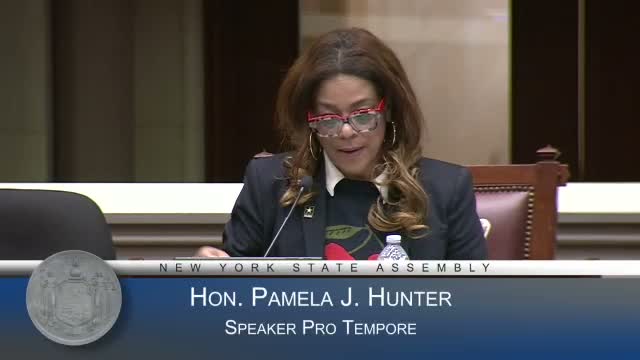
The New York State Assembly passed Assembly No. 11295 on May 11, advancing an 11th budget extender intended to keep state operations and critical programs funded through May 14.
Mister Pretlow, chair of the Assembly Committee on Rules, told members that the extender is a stopgap while leaders continue negotiating a full budget. "This extender would ensure funding for state operations and other programs through May 14," he said during an explanation on the floor.
Pretlow listed the categories the extender covers, including institutional payroll, adoption subsidies, public benefit payments, health programs, unemployment insurance, OPWDD services, veterans programs and general state charges. In response to questions, he said the total amount appropriated so far under extenders is $23,100,000,000 and that this measure increases that total by $2,900,000,000.
Assembly member Mister Palmisano pressed for clarity on outstanding negotiations. Pretlow said specifics remained difficult to disclose because public disclosure can jeopardize ongoing negotiations: "When you're at this stage of the budget process, you really don't want to divulge anything because you're under risk of blowing it up," he said. On the timetable, Pretlow said detailed conferencing of nine remaining budget bills is required and that he expects much of that work next week rather than this week.
Lawmakers also used the extender debate to press policy questions tied to the budget. Members asked about proposals to lower auto‑insurance costs and reduce fraud, housing siting and contamination language, immigration proposals that remain unsettled, and changes to 'Tier 6' pension rules. Pretlow said Tier 6 reforms were raised by counties and municipalities to curb local pension costs but cautioned that altering benefits raises significant actuarial and fiscal complications.
Palmisano also urged a delay to the state's EV school‑bus mandate — which currently requires districts to begin purchasing electric buses in 2027 and complete conversions by 2035 — calling it an "unfunded mandate" on local school districts. Pretlow said the matter is "a big discussion right now" but provided no final commitment.
On process and transparency, members reiterated a demand for a financial plan to be made publicly available before the remaining budget bills are taken up. Pretlow said he was "pretty sure" a financial plan would be available but acknowledged that adhering to the constitutionally required three‑day aging period for each bill could be infeasible given time constraints; leaders may use a message of necessity to expedite votes.
The clerk recorded the vote on Assembly No. 11295 as Ayes 138, Nays 0. The bill passed.
What happens next: The chair said remaining budget bills must be conferred in detail by committees and leadership from both sides; members were told to expect debate and conferencing next week. Members urged that the final package be accompanied by a clear, public financial plan so constituents, local governments and providers can assess fiscal and policy impacts.
Mister Pretlow, chair of the Assembly Committee on Rules, told members that the extender is a stopgap while leaders continue negotiating a full budget. "This extender would ensure funding for state operations and other programs through May 14," he said during an explanation on the floor.
Pretlow listed the categories the extender covers, including institutional payroll, adoption subsidies, public benefit payments, health programs, unemployment insurance, OPWDD services, veterans programs and general state charges. In response to questions, he said the total amount appropriated so far under extenders is $23,100,000,000 and that this measure increases that total by $2,900,000,000.
Assembly member Mister Palmisano pressed for clarity on outstanding negotiations. Pretlow said specifics remained difficult to disclose because public disclosure can jeopardize ongoing negotiations: "When you're at this stage of the budget process, you really don't want to divulge anything because you're under risk of blowing it up," he said. On the timetable, Pretlow said detailed conferencing of nine remaining budget bills is required and that he expects much of that work next week rather than this week.
Lawmakers also used the extender debate to press policy questions tied to the budget. Members asked about proposals to lower auto‑insurance costs and reduce fraud, housing siting and contamination language, immigration proposals that remain unsettled, and changes to 'Tier 6' pension rules. Pretlow said Tier 6 reforms were raised by counties and municipalities to curb local pension costs but cautioned that altering benefits raises significant actuarial and fiscal complications.
Palmisano also urged a delay to the state's EV school‑bus mandate — which currently requires districts to begin purchasing electric buses in 2027 and complete conversions by 2035 — calling it an "unfunded mandate" on local school districts. Pretlow said the matter is "a big discussion right now" but provided no final commitment.
On process and transparency, members reiterated a demand for a financial plan to be made publicly available before the remaining budget bills are taken up. Pretlow said he was "pretty sure" a financial plan would be available but acknowledged that adhering to the constitutionally required three‑day aging period for each bill could be infeasible given time constraints; leaders may use a message of necessity to expedite votes.
The clerk recorded the vote on Assembly No. 11295 as Ayes 138, Nays 0. The bill passed.
What happens next: The chair said remaining budget bills must be conferred in detail by committees and leadership from both sides; members were told to expect debate and conferencing next week. Members urged that the final package be accompanied by a clear, public financial plan so constituents, local governments and providers can assess fiscal and policy impacts.
View the Full Meeting & All Its Details
This article offers just a summary. Unlock complete video, transcripts, and insights as a Founder Member.
✓
Watch full, unedited meeting videos
✓
Search every word spoken in unlimited transcripts
✓
AI summaries & real-time alerts (all government levels)
✓
Permanent access to expanding government content
30-day money-back guarantee
