Frederick County officials say special-education vacancies remain a pressing challenge; task force recommendations due next month
May 12, 2026 | FREDERICK CO PBLC SCHS, School Districts, Virginia
This article was created by AI summarizing key points discussed. AI makes mistakes, so for full details and context, please refer to the video of the full meeting. Please report any errors so we can fix them. Report an error »
At a May 11 personnel committee meeting, Dr. Hummer told the Frederick High School Board’s personnel committee that special‑education vacancies continue to be the district’s most persistent staffing challenge.
“It's a nationwide challenge,” Dr. Hummer said, describing a task force of general‑education and special‑education teachers, central office staff and administrators the division has formed to diagnose causes and recommend changes. He told the committee the division had adopted lower local caseload targets than the state guideline and will bring formal recommendations back to the board next month.
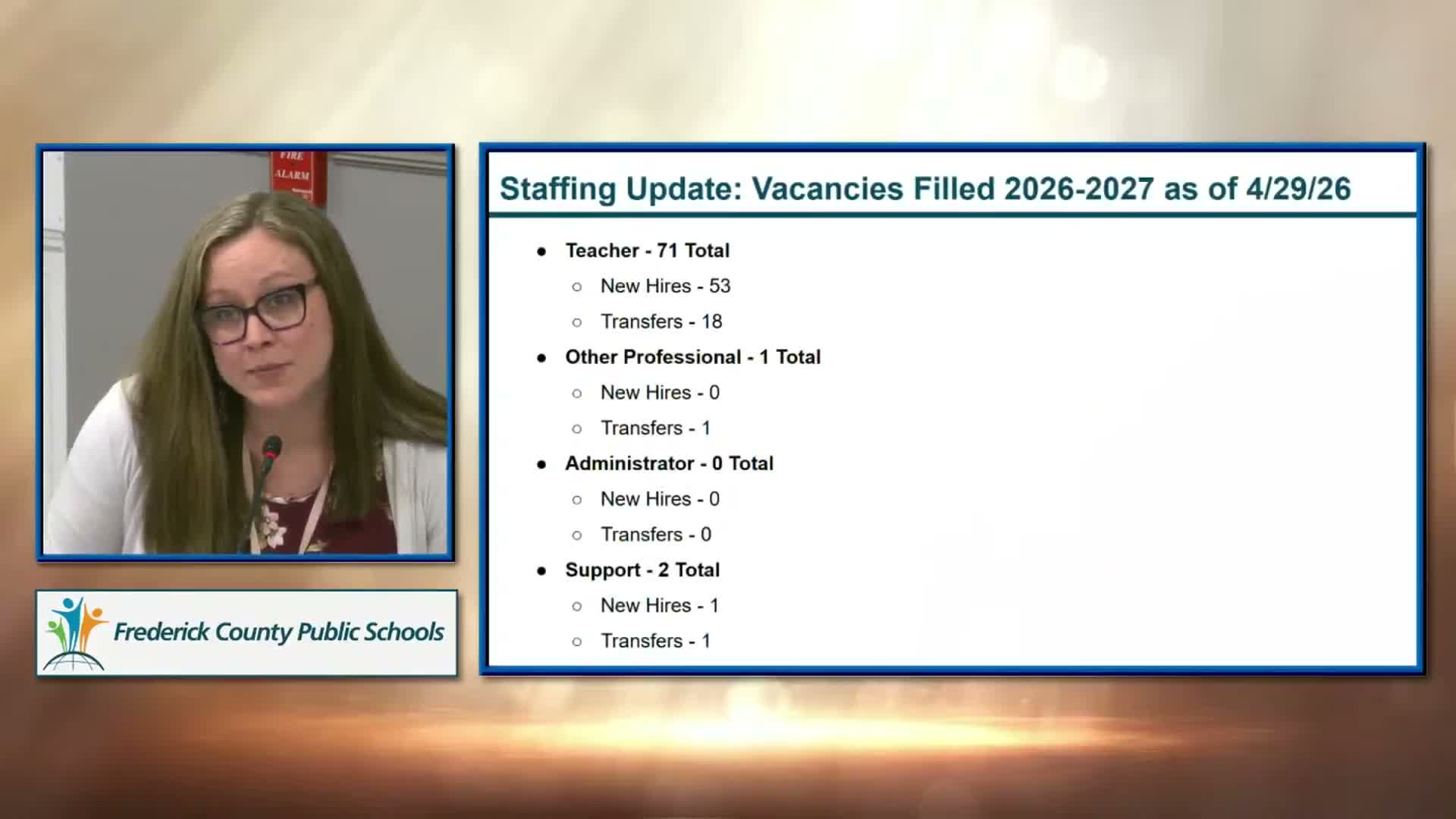
Rachel Rinker, who led the staffing update, reported vacancies by level and content area and said support‑staff vacancies have declined since last year while special‑education openings remain the top category. Rinker also reviewed resignations for this point in the year compared with the prior two years and reported vacancies filled for the 26‑27 school year as of April 29.
Dr. Hummer cited caseload numbers to illustrate workload pressures: the state maximum cited for one level of case management is 24 students; the division has set lower targets of 18 for secondary and 15 for elementary caseloads. He said that even the lower targets can be arduous when students have substantial needs and when meetings and administrative processes consume staff time.
Committee members and staff flagged the time and resource burden of state complaint and due‑process procedures tied to Individualized Education Programs (IEPs). Dr. Hummer said these processes can require extensive administrative or legal time and urged the state to update long‑standing caseload standards.
The committee discussed contracting with outside providers to deliver services in the short term. Staff said contracting can be substantially more expensive because the division pays both the contracted entity and the individual provider and those contractors are not covered by the state retirement system; staff also said contracted providers are drawn from the same regional labor pool and that the division has already added some contracted specialized supports while budgeting for the cost.
As local mitigation, Rinker and other staff described internal changes: the OSIS department has appointed special‑education lead teachers at larger elementary schools (with smaller schools sharing leads) to reduce paperwork and provide in‑school guidance. They also described a mentorship program and differentiated professional supports tailored to teachers’ pathways and coursework.
Dr. Hummer said the division will raise the caseload and procedural concerns at the division’s legislative summit and will present the task‑force recommendations to the board at the next meeting for possible policy or staffing adjustments.
The personnel committee received the information items; no formal policy vote on SPED staffing was taken during the meeting.
“It's a nationwide challenge,” Dr. Hummer said, describing a task force of general‑education and special‑education teachers, central office staff and administrators the division has formed to diagnose causes and recommend changes. He told the committee the division had adopted lower local caseload targets than the state guideline and will bring formal recommendations back to the board next month.
Rachel Rinker, who led the staffing update, reported vacancies by level and content area and said support‑staff vacancies have declined since last year while special‑education openings remain the top category. Rinker also reviewed resignations for this point in the year compared with the prior two years and reported vacancies filled for the 26‑27 school year as of April 29.
Dr. Hummer cited caseload numbers to illustrate workload pressures: the state maximum cited for one level of case management is 24 students; the division has set lower targets of 18 for secondary and 15 for elementary caseloads. He said that even the lower targets can be arduous when students have substantial needs and when meetings and administrative processes consume staff time.
Committee members and staff flagged the time and resource burden of state complaint and due‑process procedures tied to Individualized Education Programs (IEPs). Dr. Hummer said these processes can require extensive administrative or legal time and urged the state to update long‑standing caseload standards.
The committee discussed contracting with outside providers to deliver services in the short term. Staff said contracting can be substantially more expensive because the division pays both the contracted entity and the individual provider and those contractors are not covered by the state retirement system; staff also said contracted providers are drawn from the same regional labor pool and that the division has already added some contracted specialized supports while budgeting for the cost.
As local mitigation, Rinker and other staff described internal changes: the OSIS department has appointed special‑education lead teachers at larger elementary schools (with smaller schools sharing leads) to reduce paperwork and provide in‑school guidance. They also described a mentorship program and differentiated professional supports tailored to teachers’ pathways and coursework.
Dr. Hummer said the division will raise the caseload and procedural concerns at the division’s legislative summit and will present the task‑force recommendations to the board at the next meeting for possible policy or staffing adjustments.
The personnel committee received the information items; no formal policy vote on SPED staffing was taken during the meeting.
View the Full Meeting & All Its Details
This article offers just a summary. Unlock complete video, transcripts, and insights as a Founder Member.
✓
Watch full, unedited meeting videos
✓
Search every word spoken in unlimited transcripts
✓
AI summaries & real-time alerts (all government levels)
✓
Permanent access to expanding government content
30-day money-back guarantee
