Philadelphia council holds hearing on driverless rideshares as concerns mount over safety, jobs and data
May 12, 2026 | Philadelphia City, Pennsylvania
This article was created by AI summarizing key points discussed. AI makes mistakes, so for full details and context, please refer to the video of the full meeting. Please report any errors so we can fix them. Report an error »
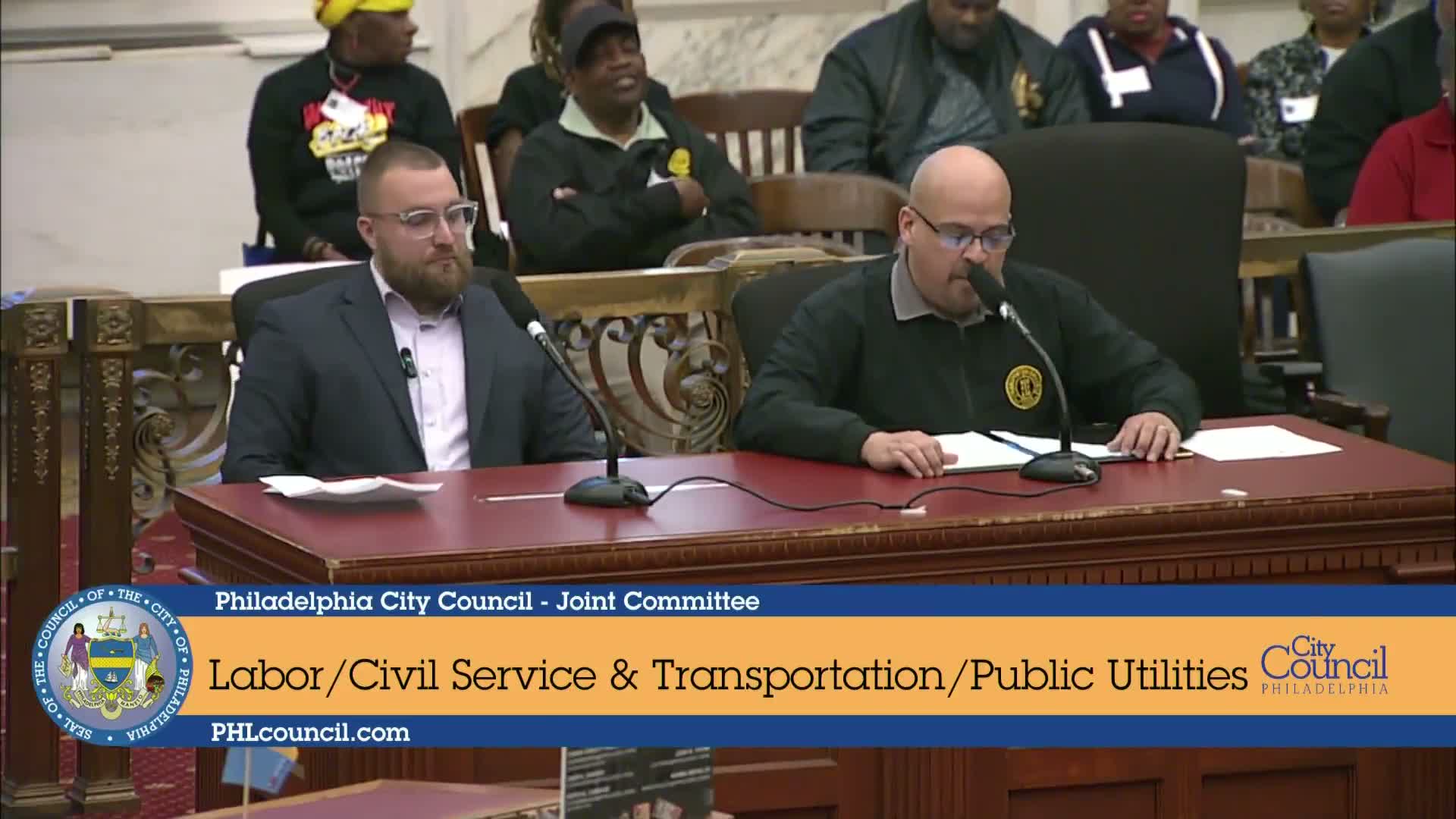
Philadelphia’s City Council convened a joint public hearing to examine the arrival of driverless rideshare vehicles in the city and the implications for worker protections, rider safety, emergency response and oversight.
Anna Kelly, senior policy adviser for EV and parking at the city’s Office of Transportation and Infrastructure Systems, told the joint committee that Pennsylvania’s Act 130 (2022) preempts local regulation of certified driverless vehicles and that Waymo has been testing in Philadelphia under a PennDOT permit since 2025. Kelly said the city has formed an intergovernmental working group — including Streets, Commerce, Police, Fire and other agencies — to prepare first-responder training and incident coordination, and that the city is coordinating with PennDOT and the Philadelphia Parking Authority on permitting and incident reporting.
The preemption under state law emerged repeatedly as a practical constraint. “While the city is entirely preempted in regulating this technology by state law, city agencies are actively preparing for commercial autonomous vehicle operations in Philadelphia,” Kelly said, adding that trainings are being planned in coordination with PennDOT and that Waymo has indicated a commercial launch timeline after major 2026 events.
Technical experts who testified said the vehicles can fail in unusual ways and urged independent audits and local incident records. “AI is not designed to work all the time,” said Sorelle Friedler, a computer science professor at Haverford College. Friedler urged independent cybersecurity and safety audits, local staff or reporting channels for incidents, and public records of test and operational mishaps.
Drexel University professor Matthew Stamm described failure modes that can produce unexpected behavior in dense urban conditions, and said many safety studies focus on highway miles rather than the stop-and-start conditions common to Philadelphia. He recommended rigorous, city-focused testing and more explicit data-handling policies.
Labor witnesses and drivers argued the economic consequences could be severe. Rob Burns, political director for SEIU 32BJ, said replacing thousands of local rideshare drivers would shift revenue away from city neighborhoods and concentrate profits with distant corporations. Full-time drivers at the hearing said rideshare work is their primary income. “Every ride that goes to a robot is a ride taken away from a real person,” said Stefan Hernandez, who described supporting relatives on driving income.
Several council members pressed the administration for specifics on what the working group will discuss and whether the city can require safeguards or negotiate community benefits. Council members also raised questions about liability and ticketing when a driverless vehicle violates traffic rules, and whether any surcharge revenues that now go to the school district would be affected.
Public testimony included accounts of incidents and near-misses. Rider Alex Kaufman described a March trip in Phoenix in which a Waymo vehicle “inched out into traffic” and later stopped perpendicular to oncoming vehicles; he said Waymo issued credits and a refund but offered limited technical explanation. Labor and community groups urged the council to press PennDOT for more stringent oversight and to consider asking the state legislature to revisit the preemption in Act 130.
The hearing produced no policy vote. Council members asked the administration to return with more details within 30 days: a clearer description of planned trainings, a list of incidents and a request to PennDOT for records of permitting and incident reports. Several members also said they would press Waymo directly for answers and may follow up with written questions or additional hearings.
The joint committee concluded the hearing after the public-comment period; no formal directive or ordinance was adopted at this session.
Anna Kelly, senior policy adviser for EV and parking at the city’s Office of Transportation and Infrastructure Systems, told the joint committee that Pennsylvania’s Act 130 (2022) preempts local regulation of certified driverless vehicles and that Waymo has been testing in Philadelphia under a PennDOT permit since 2025. Kelly said the city has formed an intergovernmental working group — including Streets, Commerce, Police, Fire and other agencies — to prepare first-responder training and incident coordination, and that the city is coordinating with PennDOT and the Philadelphia Parking Authority on permitting and incident reporting.
The preemption under state law emerged repeatedly as a practical constraint. “While the city is entirely preempted in regulating this technology by state law, city agencies are actively preparing for commercial autonomous vehicle operations in Philadelphia,” Kelly said, adding that trainings are being planned in coordination with PennDOT and that Waymo has indicated a commercial launch timeline after major 2026 events.
Technical experts who testified said the vehicles can fail in unusual ways and urged independent audits and local incident records. “AI is not designed to work all the time,” said Sorelle Friedler, a computer science professor at Haverford College. Friedler urged independent cybersecurity and safety audits, local staff or reporting channels for incidents, and public records of test and operational mishaps.
Drexel University professor Matthew Stamm described failure modes that can produce unexpected behavior in dense urban conditions, and said many safety studies focus on highway miles rather than the stop-and-start conditions common to Philadelphia. He recommended rigorous, city-focused testing and more explicit data-handling policies.
Labor witnesses and drivers argued the economic consequences could be severe. Rob Burns, political director for SEIU 32BJ, said replacing thousands of local rideshare drivers would shift revenue away from city neighborhoods and concentrate profits with distant corporations. Full-time drivers at the hearing said rideshare work is their primary income. “Every ride that goes to a robot is a ride taken away from a real person,” said Stefan Hernandez, who described supporting relatives on driving income.
Several council members pressed the administration for specifics on what the working group will discuss and whether the city can require safeguards or negotiate community benefits. Council members also raised questions about liability and ticketing when a driverless vehicle violates traffic rules, and whether any surcharge revenues that now go to the school district would be affected.
Public testimony included accounts of incidents and near-misses. Rider Alex Kaufman described a March trip in Phoenix in which a Waymo vehicle “inched out into traffic” and later stopped perpendicular to oncoming vehicles; he said Waymo issued credits and a refund but offered limited technical explanation. Labor and community groups urged the council to press PennDOT for more stringent oversight and to consider asking the state legislature to revisit the preemption in Act 130.
The hearing produced no policy vote. Council members asked the administration to return with more details within 30 days: a clearer description of planned trainings, a list of incidents and a request to PennDOT for records of permitting and incident reports. Several members also said they would press Waymo directly for answers and may follow up with written questions or additional hearings.
The joint committee concluded the hearing after the public-comment period; no formal directive or ordinance was adopted at this session.
Don't Miss a Word: See the Full Meeting!
Go beyond summaries. Unlock every video, transcript, and key insight with a Founder Membership.
✓
Get instant access to full meeting videos
✓
Search and clip any phrase from complete transcripts
✓
Receive AI-powered summaries & custom alerts
✓
Enjoy lifetime, unrestricted access to government data
30-day money-back guarantee
