Howard County work session backs a $50M five‑year Ellicott City mitigation plan while engineers warn tunnels remain costly and uncertain
May 12, 2026 | Howard County, Maryland
This article was created by AI summarizing key points discussed. AI makes mistakes, so for full details and context, please refer to the video of the full meeting. Please report any errors so we can fix them. Report an error »
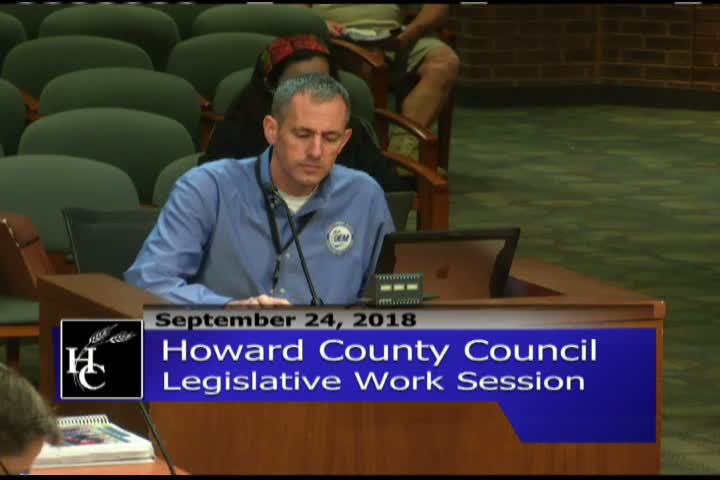
Howard County officials and outside consultants spent the work session reviewing the county’s five‑year Ellicott City flood mitigation plan and the modeling that underpins it, with repeated emphasis on tradeoffs among speed, cost and constructability.
Mark DeLuca, who led the technical briefing, said the package of projects in the five‑year option (noted in the staff memo as option 16C) would ‘‘bring the water levels down on the lower part of Main Street from 6 to 8 feet down to approximately 4 to 6 feet and reduce velocities . . . from as high as 22 feet per second to about 6.5 feet per second.’’ He cautioned the modeled reductions reflect the totality of the five‑year sequence rather than a single year’s work.
Why 16C: time, cost and measurable output
Consultants and planners told council members they judged option 16C to be the best balance of impact, schedule and cost. The team estimated the plan’s construction‑phase elements at roughly $50 million and said the model outputs show the largest reductions in flood height and velocity occur on Lower Main Street—where residents and businesses have seen the worst damage.
The presenters contrasted that outcome with an earlier 2016 package of 18 projects, which consultants said would cost on the order of $80 million and take considerably longer to deliver, and with conceptual long‑tunnel options that—while effective in modeling—carry large uncertainties.
Tunnels remain possible but risky
Engineers recounted how tunneling (conceptual bores of roughly 15–20 feet in diameter in prior studies) reduced modeled inundation in some runs but raised significant practical concerns: unknown subsurface conditions, shallow rock in places, complex staging and dewatering needs, risks to 100‑ to 200‑year‑old masonry buildings from vibration, and the possibility that high Patapsco River tailwater could render a tunnel ineffective during extreme events. ‘‘You could invest all that money in a tunnel, and the Patapsco could come up and render the tunnel . . . completely ineffective,’’ one consultant said.
That exchange drew invited public comment. Gil Gothrop, a local general‑contracting contractor, told the council he had sought local tunneling analogs and said some private estimates suggested much lower linear‑foot costs for short bores; he urged further targeted study. Consultants replied that analogs vary and that conservatism is appropriate until geotechnical data are gathered.
Property acquisitions, appraisals and demolition plans
County real‑estate staff described the acquisition component of the plan. For FY19 the county is targeting a set of downtown and Valleymeade parcels tied to the Lower Main terracing and culvert projects. Staff said they have completed appraisals for the parcels (using pre‑flood market assumptions) and shared appraisal results with owners but have not made formal offers because legal authority and spending allocations are not yet finalized. The staff estimate for acquisition funding in the FY19 request is roughly $10.5 million, with a possible additional state contribution.
Early‑warning upgrades and public safety measures
Emergency management and public‑safety staff said the county is expanding sensing and alert capacity: a DHS/NWS stream sensor project has deployed the first round of approximately 16 sensors, the county has placed variable message boards at key downtown locations, and police/fire use targeted public‑address and road‑closure procedures when the National Weather Service issues flash‑flood warnings. Staff emphasized forecast lead‑time and human‑behavior limits but said new sensors and better coordination will improve warning specificity over time.
Where B&O Museum and the culverts fit in
Consultants showed model output for the B&O Museum and Maryland Avenue area and said the five‑year plan produces modest improvements there (commonly 2–4 feet of reduction locally, with some 4–6 foot reductions in the plaza area). For the Maryland Avenue constraint the team described a smaller‑diameter, twin‑culvert alternative (two 10‑foot pipes) as hydraulically effective in the modeled combinations and less impactful to train operations than larger bored tunnels—while noting feasibility hinges on subsurface conditions near the railroad.
What’s next
Staff pledged to provide the council with the model outputs for the 16 planning iterations, a clearer year‑by‑year project schedule, and supporting engineering breakout sheets; they also said they will supply cost and timing detail for the tunnel and culvert options once additional subsurface and design data are collected. The council paused the work session to allow staff time to compile the requested supplemental materials.
Ending
The work session closed after the council discussed related procedural items (Council Bill 70) and next steps. No formal vote on the five‑year plan occurred at the session; council members asked for additional model outputs, a clearer construction timeline, and further documentation tying acquisitions to each project before any appropriation vote.
Mark DeLuca, who led the technical briefing, said the package of projects in the five‑year option (noted in the staff memo as option 16C) would ‘‘bring the water levels down on the lower part of Main Street from 6 to 8 feet down to approximately 4 to 6 feet and reduce velocities . . . from as high as 22 feet per second to about 6.5 feet per second.’’ He cautioned the modeled reductions reflect the totality of the five‑year sequence rather than a single year’s work.
Why 16C: time, cost and measurable output
Consultants and planners told council members they judged option 16C to be the best balance of impact, schedule and cost. The team estimated the plan’s construction‑phase elements at roughly $50 million and said the model outputs show the largest reductions in flood height and velocity occur on Lower Main Street—where residents and businesses have seen the worst damage.
The presenters contrasted that outcome with an earlier 2016 package of 18 projects, which consultants said would cost on the order of $80 million and take considerably longer to deliver, and with conceptual long‑tunnel options that—while effective in modeling—carry large uncertainties.
Tunnels remain possible but risky
Engineers recounted how tunneling (conceptual bores of roughly 15–20 feet in diameter in prior studies) reduced modeled inundation in some runs but raised significant practical concerns: unknown subsurface conditions, shallow rock in places, complex staging and dewatering needs, risks to 100‑ to 200‑year‑old masonry buildings from vibration, and the possibility that high Patapsco River tailwater could render a tunnel ineffective during extreme events. ‘‘You could invest all that money in a tunnel, and the Patapsco could come up and render the tunnel . . . completely ineffective,’’ one consultant said.
That exchange drew invited public comment. Gil Gothrop, a local general‑contracting contractor, told the council he had sought local tunneling analogs and said some private estimates suggested much lower linear‑foot costs for short bores; he urged further targeted study. Consultants replied that analogs vary and that conservatism is appropriate until geotechnical data are gathered.
Property acquisitions, appraisals and demolition plans
County real‑estate staff described the acquisition component of the plan. For FY19 the county is targeting a set of downtown and Valleymeade parcels tied to the Lower Main terracing and culvert projects. Staff said they have completed appraisals for the parcels (using pre‑flood market assumptions) and shared appraisal results with owners but have not made formal offers because legal authority and spending allocations are not yet finalized. The staff estimate for acquisition funding in the FY19 request is roughly $10.5 million, with a possible additional state contribution.
Early‑warning upgrades and public safety measures
Emergency management and public‑safety staff said the county is expanding sensing and alert capacity: a DHS/NWS stream sensor project has deployed the first round of approximately 16 sensors, the county has placed variable message boards at key downtown locations, and police/fire use targeted public‑address and road‑closure procedures when the National Weather Service issues flash‑flood warnings. Staff emphasized forecast lead‑time and human‑behavior limits but said new sensors and better coordination will improve warning specificity over time.
Where B&O Museum and the culverts fit in
Consultants showed model output for the B&O Museum and Maryland Avenue area and said the five‑year plan produces modest improvements there (commonly 2–4 feet of reduction locally, with some 4–6 foot reductions in the plaza area). For the Maryland Avenue constraint the team described a smaller‑diameter, twin‑culvert alternative (two 10‑foot pipes) as hydraulically effective in the modeled combinations and less impactful to train operations than larger bored tunnels—while noting feasibility hinges on subsurface conditions near the railroad.
What’s next
Staff pledged to provide the council with the model outputs for the 16 planning iterations, a clearer year‑by‑year project schedule, and supporting engineering breakout sheets; they also said they will supply cost and timing detail for the tunnel and culvert options once additional subsurface and design data are collected. The council paused the work session to allow staff time to compile the requested supplemental materials.
Ending
The work session closed after the council discussed related procedural items (Council Bill 70) and next steps. No formal vote on the five‑year plan occurred at the session; council members asked for additional model outputs, a clearer construction timeline, and further documentation tying acquisitions to each project before any appropriation vote.
View the Full Meeting & All Its Details
This article offers just a summary. Unlock complete video, transcripts, and insights as a Founder Member.
✓
Watch full, unedited meeting videos
✓
Search every word spoken in unlimited transcripts
✓
AI summaries & real-time alerts (all government levels)
✓
Permanent access to expanding government content
30-day money-back guarantee
