Marshall County warned of roughly $4 million revenue gap as jail bonds end; council to study tax options
May 12, 2026 | Marshall County, Indiana
This article was created by AI summarizing key points discussed. AI makes mistakes, so for full details and context, please refer to the video of the full meeting. Please report any errors so we can fix them. Report an error »
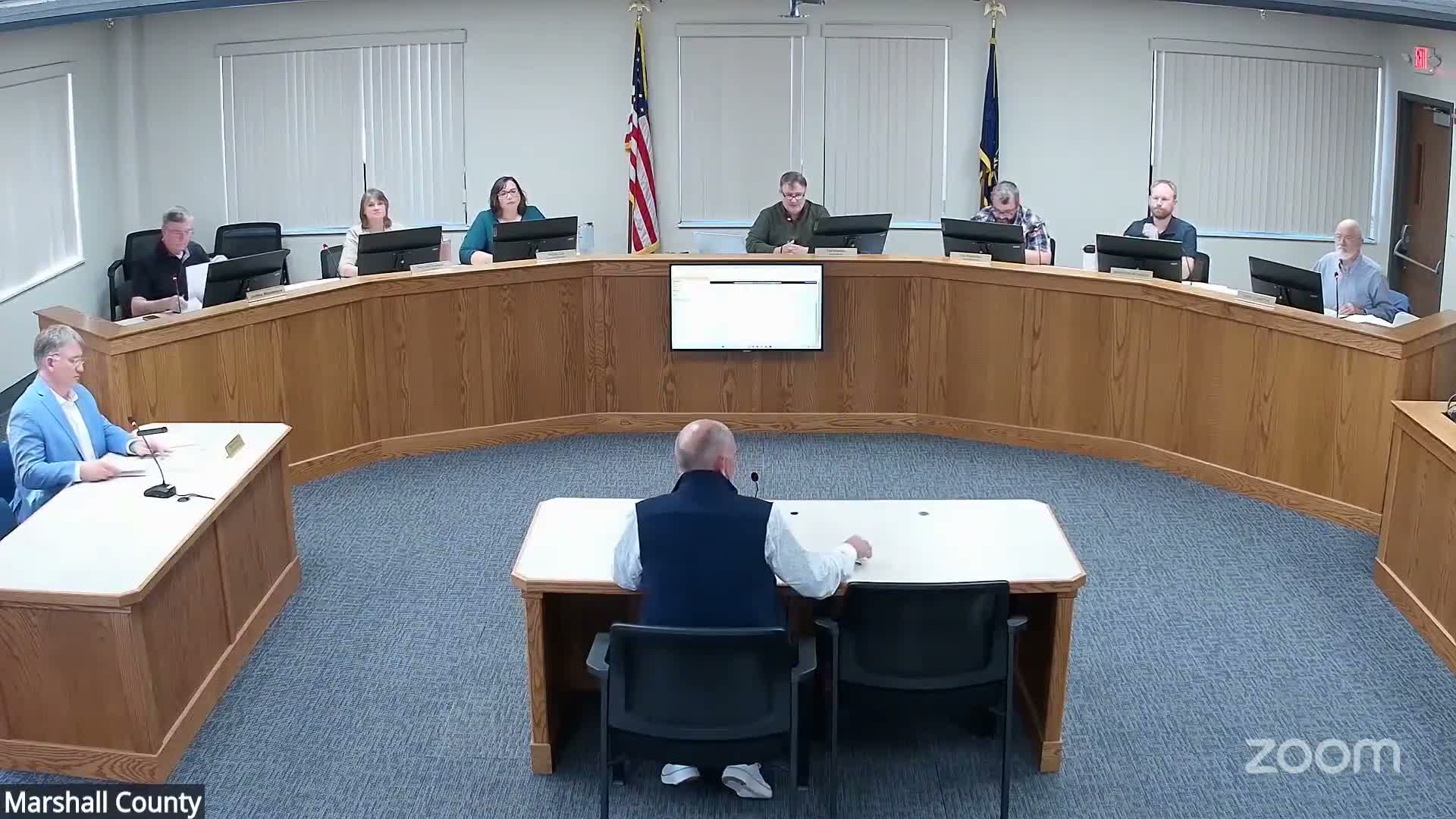
Steve Dalton, a county financial adviser, told the Marshall County Council on a May 2026 agenda that the 0.25 percentage point of the local income tax now used for jail bond payments will disappear when those bonds are paid off next year, creating a substantial hole in the general fund.
"We're gonna have to replace the lion's share of those dollars," Dalton said, noting that the current 0.25 contribution is bringing in roughly $336,771 a month — about $4,041,000 a year. He added the bond payoff is scheduled for 2027 and that the revenue loss will require action by the council and commissioners.
Why it matters: The 0.25 share has funded jail operations and debt service. Dalton told the council that eliminating it without replacement would leave the county with a multimillion-dollar gap that could require spending cuts or a tax increase, and he urged forming a working group to model options before state deadlines.
Dalton proposed a short-term transition approach and recommended a joint working session with county commissioners and staff to run scenarios. "Whether it's this fall or the following fall, you'll need to replace the lion's share of those dollars," he said. He cautioned the council against making major, immediate changes without running numbers and suggested the council consider using a portion of the expiring 0.25 to continue funding jail operations while exploring other revenue or spending adjustments.
Council members asked for specifics about rate changes and how much would be required to replace the revenue. A council speaker calculated from the discussion: "The 0.25 rate is bringing in 336,771 a month right now... It's $4,041,000." Dalton agreed that scenario modeling is needed and that timelines under pending state changes could shift the long-term tax framework.
Dalton also noted the county will face a short policy 'parenthesis' while the state moves to a new income-tax regime: he said the county may need to bridge one to two years before a new, longer-term structure takes effect. The council agreed to schedule a public working session that would include commissioners and staff to run projections, with staff noting an administrative deadline of Sept. 1 to have local action in place for some options and Oct. 1 for wheel-tax implementation.
What comes next: The council instructed staff to set a working session with the commissioners to model options and timelines. No formal tax change was made at the meeting; Dalton framed his remarks as advisory and recommended further number-crunching before any vote.
"We're gonna have to replace the lion's share of those dollars," Dalton said, noting that the current 0.25 contribution is bringing in roughly $336,771 a month — about $4,041,000 a year. He added the bond payoff is scheduled for 2027 and that the revenue loss will require action by the council and commissioners.
Why it matters: The 0.25 share has funded jail operations and debt service. Dalton told the council that eliminating it without replacement would leave the county with a multimillion-dollar gap that could require spending cuts or a tax increase, and he urged forming a working group to model options before state deadlines.
Dalton proposed a short-term transition approach and recommended a joint working session with county commissioners and staff to run scenarios. "Whether it's this fall or the following fall, you'll need to replace the lion's share of those dollars," he said. He cautioned the council against making major, immediate changes without running numbers and suggested the council consider using a portion of the expiring 0.25 to continue funding jail operations while exploring other revenue or spending adjustments.
Council members asked for specifics about rate changes and how much would be required to replace the revenue. A council speaker calculated from the discussion: "The 0.25 rate is bringing in 336,771 a month right now... It's $4,041,000." Dalton agreed that scenario modeling is needed and that timelines under pending state changes could shift the long-term tax framework.
Dalton also noted the county will face a short policy 'parenthesis' while the state moves to a new income-tax regime: he said the county may need to bridge one to two years before a new, longer-term structure takes effect. The council agreed to schedule a public working session that would include commissioners and staff to run projections, with staff noting an administrative deadline of Sept. 1 to have local action in place for some options and Oct. 1 for wheel-tax implementation.
What comes next: The council instructed staff to set a working session with the commissioners to model options and timelines. No formal tax change was made at the meeting; Dalton framed his remarks as advisory and recommended further number-crunching before any vote.
View the Full Meeting & All Its Details
This article offers just a summary. Unlock complete video, transcripts, and insights as a Founder Member.
✓
Watch full, unedited meeting videos
✓
Search every word spoken in unlimited transcripts
✓
AI summaries & real-time alerts (all government levels)
✓
Permanent access to expanding government content
30-day money-back guarantee
