Upson County planning commission debates broad zoning text amendments, postpones two items into consolidated package
May 12, 2026 | Upson County, Georgia
This article was created by AI summarizing key points discussed. AI makes mistakes, so for full details and context, please refer to the video of the full meeting. Please report any errors so we can fix them. Report an error »
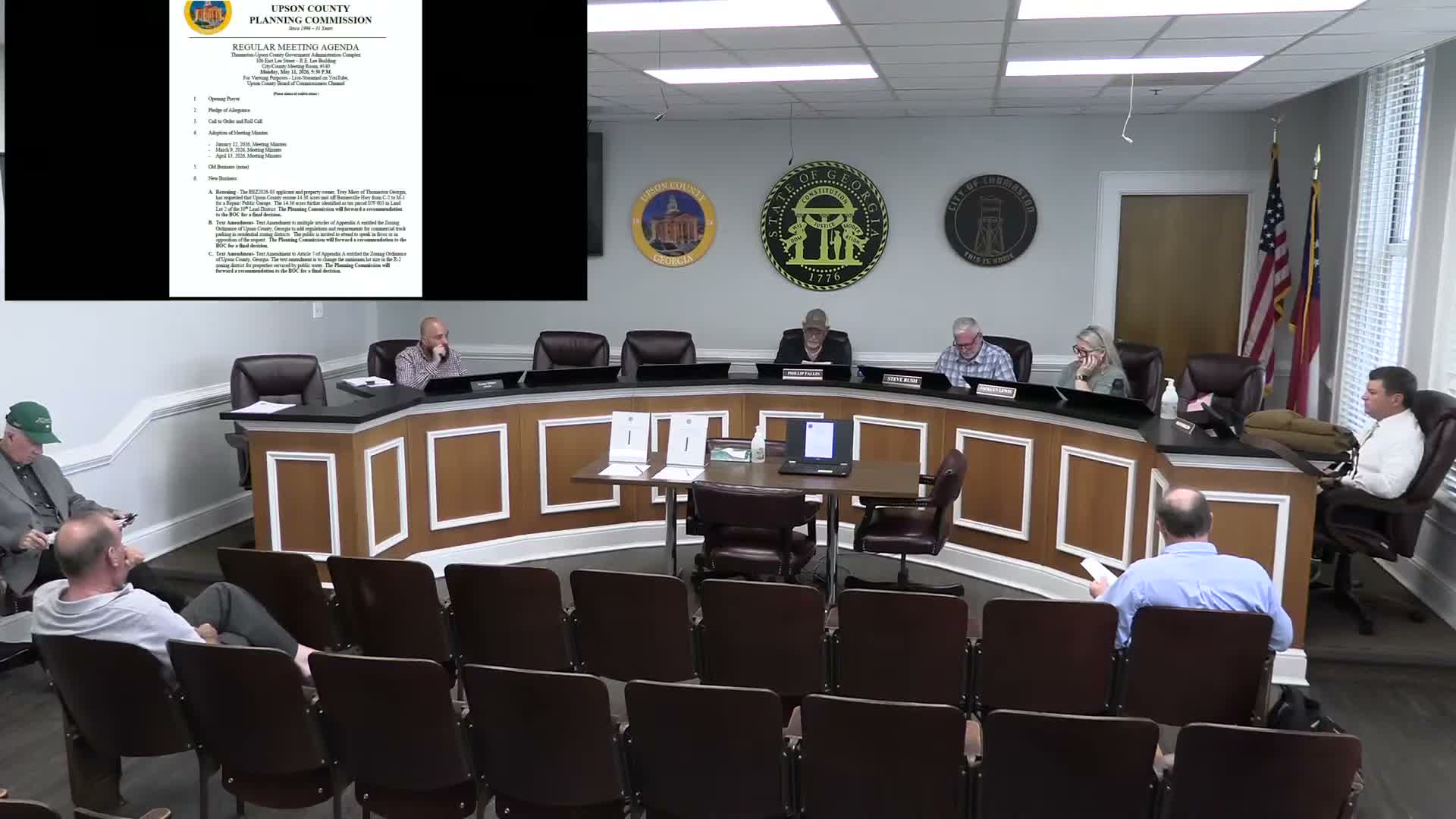
Upson County planning commissioners spent a large portion of their meeting reviewing draft text amendments to the county's zoning ordinance, debating how to handle accessory dwelling units (ADUs), tiny homes, lot‑size and frontage rules, flag‑lot standards, a proposed reversion clause and new rules for commercial truck parking.
At the start of the discussion the commission agreed to postpone two discrete text amendments and fold them into a single consolidated packet that staff and the consultant will refine and return to the commission for a workshop and then forward to the board of commissioners by the end of July. A motion to postpone and include amendments B and C in the larger package carried by voice vote.
Consultant (speaker S4) described several of the substantive changes under review: adding clear definitions for accessory dwelling units and tiny homes, adjusting variance and conditional‑zoning language in Article 4 to align with recent state zoning‑procedure law changes, and shifting some regulatory language from the definitions section into individual zoning districts. Commissioners discussed whether ADUs should be rent‑permitted, how to prevent conversion of accessory structures into de‑facto multifamily housing, and whether to retain allowances for a second primary residence on larger agricultural parcels.
The board debated a proposed reversion clause that would trigger reconsideration of previously approved rezonings if development milestones were not met. Staff (S3) and the board attorney (S6) cautioned that zoning cannot be automatically reverted by condition; instead the county could initiate a rezoning process and hold public hearings. Staff warned that language allowing automatic reversion would conflict with due‑process requirements and existing legislative procedures.
Commissioners also examined lot‑size and frontage proposals: the draft moves toward a 5‑acre minimum for AR (agricultural/residential) zoning, raises questions about minimum lot width (200 vs. 225 feet), and recommends measuring frontage at the right‑of‑way to reduce flag lots. For residential zoning the commission discussed raising minimum lot widths where septic is used so rules align with Department of Public Health guidance.
Truck‑parking rules and commercial‑vehicle definitions prompted substantial technical discussion. Staff referenced a 26,000‑pound gross vehicle weight as an industry cutoff for larger commercial vehicles subject to parking restrictions, and commissioners debated how to craft language that prevents semi‑tractors and large dump trucks from parking in smaller residential subdivisions while not unduly restricting small service vehicles.
What commissioners asked staff to do: redraft confusing or duplicative wording (particularly any clause that could be read as permitting automatic reversion), align minimums and notices with state zoning procedure law and DPH standards where appropriate, refine the ADU/rental language and maximum/minimum sizing, and return a consolidated package for a workshop and subsequent referral to the board of commissioners.
Why it matters: The changes would affect how development occurs across Upson County — from where commercial activity and truck parking are allowed to how many dwellings can exist on a single lot and how the county treats long‑dormant rezonings.
What's next: Staff and the consultant will prepare redlines and a consolidated amendment packet for the commission's workshop; commissioners set a target to forward the complete package to the board of commissioners by July 28.
At the start of the discussion the commission agreed to postpone two discrete text amendments and fold them into a single consolidated packet that staff and the consultant will refine and return to the commission for a workshop and then forward to the board of commissioners by the end of July. A motion to postpone and include amendments B and C in the larger package carried by voice vote.
Consultant (speaker S4) described several of the substantive changes under review: adding clear definitions for accessory dwelling units and tiny homes, adjusting variance and conditional‑zoning language in Article 4 to align with recent state zoning‑procedure law changes, and shifting some regulatory language from the definitions section into individual zoning districts. Commissioners discussed whether ADUs should be rent‑permitted, how to prevent conversion of accessory structures into de‑facto multifamily housing, and whether to retain allowances for a second primary residence on larger agricultural parcels.
The board debated a proposed reversion clause that would trigger reconsideration of previously approved rezonings if development milestones were not met. Staff (S3) and the board attorney (S6) cautioned that zoning cannot be automatically reverted by condition; instead the county could initiate a rezoning process and hold public hearings. Staff warned that language allowing automatic reversion would conflict with due‑process requirements and existing legislative procedures.
Commissioners also examined lot‑size and frontage proposals: the draft moves toward a 5‑acre minimum for AR (agricultural/residential) zoning, raises questions about minimum lot width (200 vs. 225 feet), and recommends measuring frontage at the right‑of‑way to reduce flag lots. For residential zoning the commission discussed raising minimum lot widths where septic is used so rules align with Department of Public Health guidance.
Truck‑parking rules and commercial‑vehicle definitions prompted substantial technical discussion. Staff referenced a 26,000‑pound gross vehicle weight as an industry cutoff for larger commercial vehicles subject to parking restrictions, and commissioners debated how to craft language that prevents semi‑tractors and large dump trucks from parking in smaller residential subdivisions while not unduly restricting small service vehicles.
What commissioners asked staff to do: redraft confusing or duplicative wording (particularly any clause that could be read as permitting automatic reversion), align minimums and notices with state zoning procedure law and DPH standards where appropriate, refine the ADU/rental language and maximum/minimum sizing, and return a consolidated package for a workshop and subsequent referral to the board of commissioners.
Why it matters: The changes would affect how development occurs across Upson County — from where commercial activity and truck parking are allowed to how many dwellings can exist on a single lot and how the county treats long‑dormant rezonings.
What's next: Staff and the consultant will prepare redlines and a consolidated amendment packet for the commission's workshop; commissioners set a target to forward the complete package to the board of commissioners by July 28.
View the Full Meeting & All Its Details
This article offers just a summary. Unlock complete video, transcripts, and insights as a Founder Member.
✓
Watch full, unedited meeting videos
✓
Search every word spoken in unlimited transcripts
✓
AI summaries & real-time alerts (all government levels)
✓
Permanent access to expanding government content
30-day money-back guarantee
