Council advances RFQ for downtown civic‑area master plan after heated debate over police‑station scope
May 12, 2026 | Boca Raton, Palm Beach County, Florida
This article was created by AI summarizing key points discussed. AI makes mistakes, so for full details and context, please refer to the video of the full meeting. Please report any errors so we can fix them. Report an error »
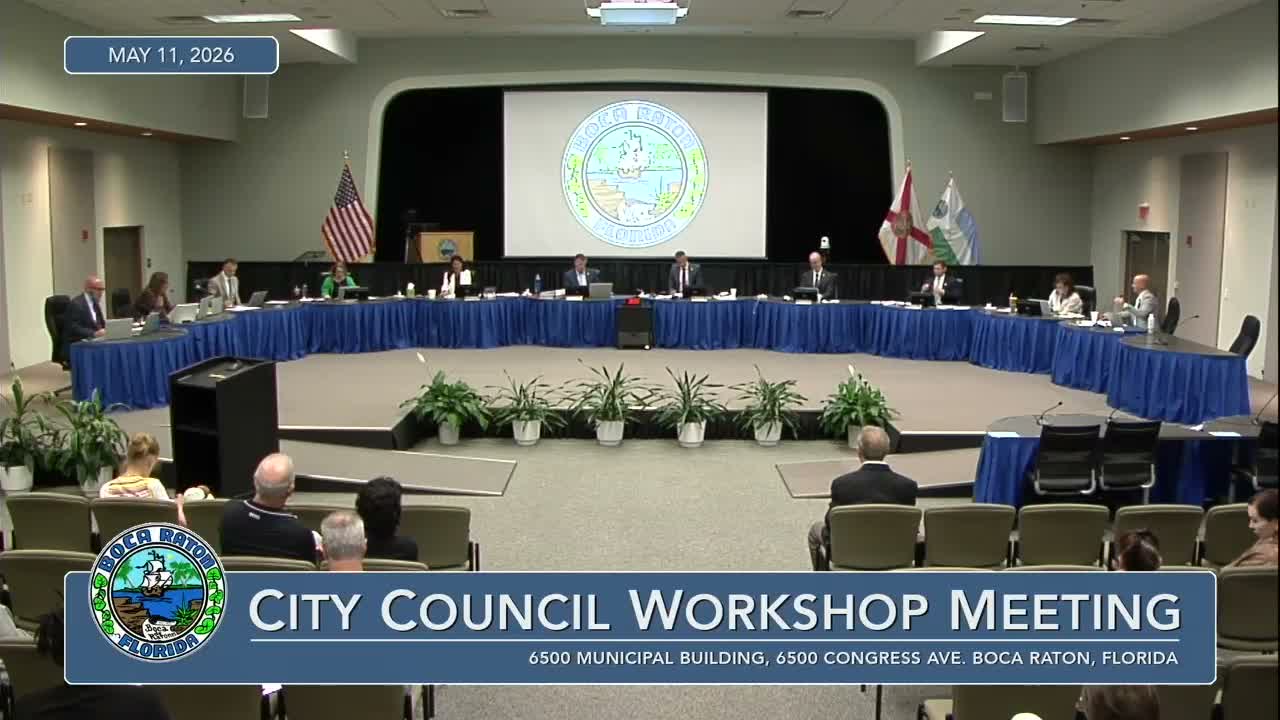
City staff told the Boca Raton City Council on May 15 that they intend to issue a qualifications‑based solicitation to hire a consultant to lead a downtown civic‑area master plan and public engagement program for the 17‑acre Memorial Park government campus.
Deputy City Manager Andy Lukasic described a six‑phase engagement approach — launch and alignment, active listening, validation, an open week‑long design charette, refinement/testing and finalization — with monthly council touchpoints and a target to bring a negotiated contract back for council action on July 28. “We’re gonna be giving firms about three weeks to respond,” he said, describing the timeline as “aggressive” but intended to allow completion of the master plan by January.
A major point of contention was whether the police‑department facility should be included in that RFQ/RFQ. Staff recommended treating the police facility separately, noting the city already has a body of work from an architect (identified in the discussion as ADG) and that an internal architect could begin work on police concepts immediately if the council directed it. “We don’t have any plans to proceed with this particular architect firm whatsoever without council direction,” a staff member said, adding staff would use prior ADG work only as a retained body of work if council chose differently.
Councilmember Perlman sharply criticized the prior ADG concept, characterizing it as an unaffordable proposal: “We paid ADG over half a million dollars to get a glimpse of this proposed $190,000,000 station,” he said, and urged that the police facility be included in the procurement to pursue efficiencies across the city hall, community center and police headquarters projects. Other council members, including Drucker and Sippel, said they supported robust public engagement and that the public should be asked whether the police headquarters belongs downtown or in another location. Deputy staff and the city attorney reminded the dais that state CCNA procurement rules require qualifications‑based selection for architectural services, with fee negotiations afterward, and explained procurement options including retaining ADG’s space‑needs analysis to inform future steps.
The council did not vote to change the RFQ’s scope at the workshop. Members agreed to continue with the RFQ/RFQ process for the downtown civic area while scheduling a separate workshop and additional data collection to address the police facility’s location, cost estimates and operational questions. Staff said it would provide council with a scope for survey/polling work to better understand why a prior ballot measure failed and to inform future decisions.
Next steps: staff intends to publish the RFQ in mid‑May, shortlist firms for public interviews in late June, negotiate a contract with the top‑ranked firm and present an agenda item for council action by July 28, while the council will schedule a dedicated workshop on police‑facility location and scope.
No formal motions or votes were recorded on the RFQ scope at the workshop; councilmembers emphasized the need for more data and resident input before making any final decisions about the police facility’s inclusion in procurement.
Deputy City Manager Andy Lukasic described a six‑phase engagement approach — launch and alignment, active listening, validation, an open week‑long design charette, refinement/testing and finalization — with monthly council touchpoints and a target to bring a negotiated contract back for council action on July 28. “We’re gonna be giving firms about three weeks to respond,” he said, describing the timeline as “aggressive” but intended to allow completion of the master plan by January.
A major point of contention was whether the police‑department facility should be included in that RFQ/RFQ. Staff recommended treating the police facility separately, noting the city already has a body of work from an architect (identified in the discussion as ADG) and that an internal architect could begin work on police concepts immediately if the council directed it. “We don’t have any plans to proceed with this particular architect firm whatsoever without council direction,” a staff member said, adding staff would use prior ADG work only as a retained body of work if council chose differently.
Councilmember Perlman sharply criticized the prior ADG concept, characterizing it as an unaffordable proposal: “We paid ADG over half a million dollars to get a glimpse of this proposed $190,000,000 station,” he said, and urged that the police facility be included in the procurement to pursue efficiencies across the city hall, community center and police headquarters projects. Other council members, including Drucker and Sippel, said they supported robust public engagement and that the public should be asked whether the police headquarters belongs downtown or in another location. Deputy staff and the city attorney reminded the dais that state CCNA procurement rules require qualifications‑based selection for architectural services, with fee negotiations afterward, and explained procurement options including retaining ADG’s space‑needs analysis to inform future steps.
The council did not vote to change the RFQ’s scope at the workshop. Members agreed to continue with the RFQ/RFQ process for the downtown civic area while scheduling a separate workshop and additional data collection to address the police facility’s location, cost estimates and operational questions. Staff said it would provide council with a scope for survey/polling work to better understand why a prior ballot measure failed and to inform future decisions.
Next steps: staff intends to publish the RFQ in mid‑May, shortlist firms for public interviews in late June, negotiate a contract with the top‑ranked firm and present an agenda item for council action by July 28, while the council will schedule a dedicated workshop on police‑facility location and scope.
No formal motions or votes were recorded on the RFQ scope at the workshop; councilmembers emphasized the need for more data and resident input before making any final decisions about the police facility’s inclusion in procurement.
View the Full Meeting & All Its Details
This article offers just a summary. Unlock complete video, transcripts, and insights as a Founder Member.
✓
Watch full, unedited meeting videos
✓
Search every word spoken in unlimited transcripts
✓
AI summaries & real-time alerts (all government levels)
✓
Permanent access to expanding government content
30-day money-back guarantee
