Families tell House panel Michigan ommunity mental health system is failing; lawmakers call for audit
May 11, 2026 | 2025-2026 House Legislature MI, Michigan
This article was created by AI summarizing key points discussed. AI makes mistakes, so for full details and context, please refer to the video of the full meeting. Please report any errors so we can fix them. Report an error »
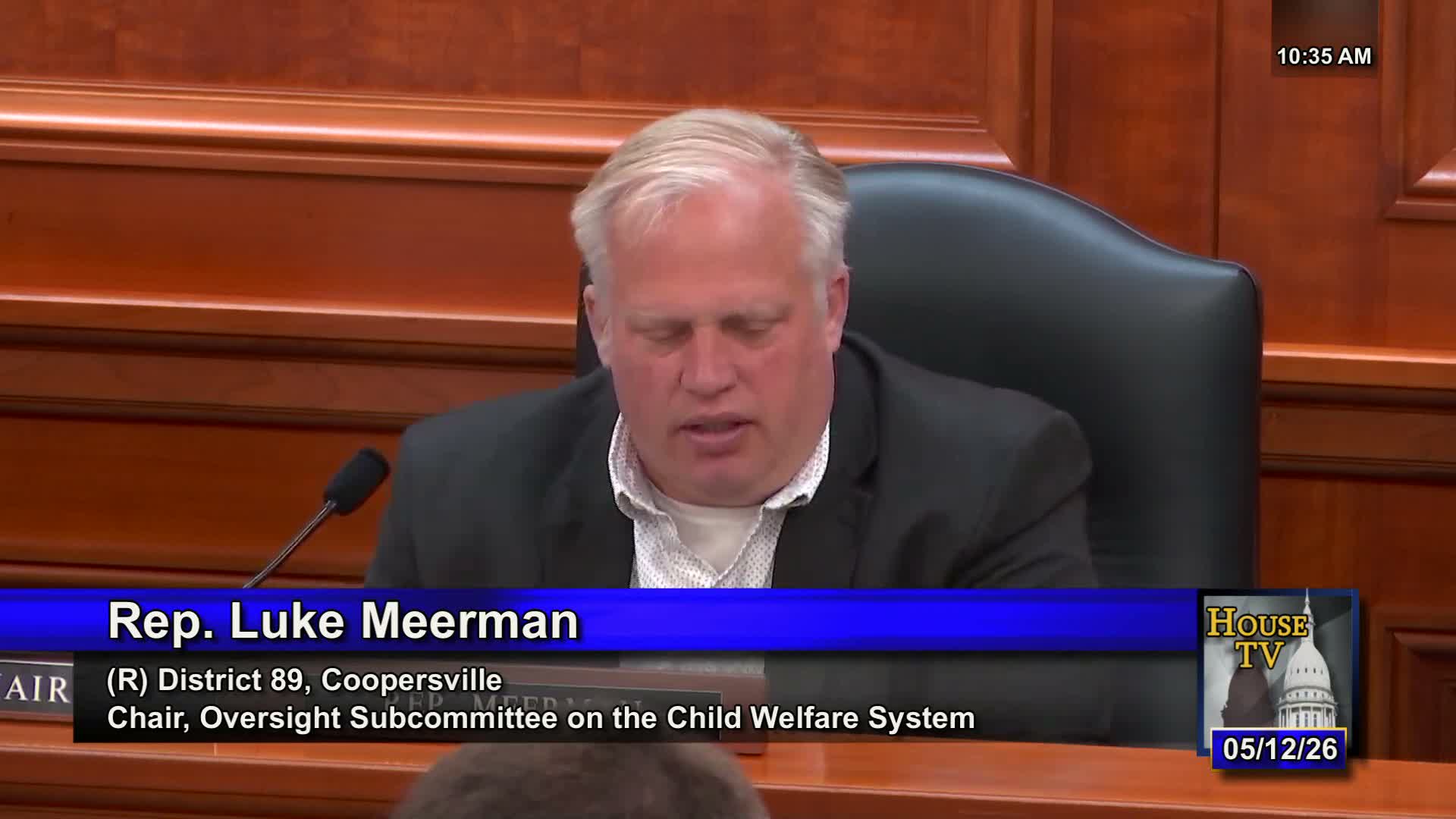
Chair Meerman convened the House Oversight Subcommittee on Child Welfare System hearing, saying Michigan spends about $5.3 billion annually on mental-health services and that the committee would hear testimony from families who said the system was failing.
Several witnesses described long-standing failures by regional community mental health (CMH) authorities to provide consistent, medically recommended care and said the gaps were causing harm. "For too long, you have struggled and struggled and not gotten the support and the help that you need," Meerman said as he opened the hearing.
Brian Green, a parent and alternate guardian for his stepson Dawson, told the committee the Bergman Center and other adult day programs in Northern Michigan were closed after funding actions by North Country Community Mental Health. Green said the Bergman Center gave North Country 30 days' notice of discontinuation; at a later board meeting he said the board directed its executive director to meet providers but then issued a cease-and-desist and did not negotiate. "I have no recourse even though the law, Medicaid, and mental health rules and regulation are on my son's side," Green said. He said he filed a class-action complaint and an individual rights complaint alleging failure to provide services and neglect that caused serious mental harm.
Green told the committee North Country has a roughly $68 million budget, about 96 percent funded by Medicaid, and "they are currently sitting on $8,000,000." He said providers had been operating on month-to-month contracts and argued that lack of long-term contracts and agreed-upon reimbursement rates for direct care workers were at the heart of the funding problems.
Courtney Wiggins described her friend Brianna's repeated hospitalizations and difficulty accessing long-term supports through Northern Lakes Community Mental Health. Wiggins said Brianna was hospitalized at least 55 times in five and a half years and that multiple recommended servicesEMDR, DBT, equine therapy and long-term residential carewere delayed or denied. Wiggins said the family crowdfunded $35,000 to pay for a six-month stay at Rose Hill residential campus because they believed other local CMHs contract with Rose Hill but Northern Lakes denied that option. "No one should have to crowdfund health care of any kind," Wiggins said.
Julie Padua testified on behalf of her child about treatment denials and alleged retaliatory and obstructive practices by Barry County Community Mental Health Authority. Padua described multiple denials, repeated changes of case managers, frozen self-directed budgets and difficulty obtaining records and effective appeals. She told the committee she had petitioned for state fair hearings and said the system blocked or delayed the process. Padua cited the U.S. Supreme Court's due-process decision in Goldberg v. Kelly (397 U.S. 254 (1970)) when arguing that denial of services without timely review can deprive families of critical supports.
Committee members expressed sympathy and said they will pursue follow-up. Representative Colin Conlan told witnesses the committee was looking at other states for models of better service portability and oversight. Representative McDonald said he is working on nonpartisan legislation to address conflicts of interest between PIHPs and CMHs and to create state-level binding authority over PIHP/CMH decisions.
Several witnesses urged stronger oversight of CMHs and MDHHS to ensure funds reach direct-care providers. Chair Meerman said the committee should consider a performance audit and a financial audit to trace where the $5.3 billion in mental-health funding goes. "Until the money gets to the person providing the care for the person that needs mental health, it's overhead," Meerman said.
The hearing produced no committee actions beyond approving the previous meeting's minutes. Members asked for written testimony and pledged local follow-up; the committee adjourned with direction to pursue auditing and oversight options.
The testimony highlighted three recurring problems: long waits or denials for medically recommended services, contract and reimbursement structures that providers say do not reflect local labor costs, and limited, slow or ineffective appeal and oversight processes. Committee members said next steps could include audits, legislative changes and more aggressive enforcement of standards through MDHHS.
Several witnesses described long-standing failures by regional community mental health (CMH) authorities to provide consistent, medically recommended care and said the gaps were causing harm. "For too long, you have struggled and struggled and not gotten the support and the help that you need," Meerman said as he opened the hearing.
Brian Green, a parent and alternate guardian for his stepson Dawson, told the committee the Bergman Center and other adult day programs in Northern Michigan were closed after funding actions by North Country Community Mental Health. Green said the Bergman Center gave North Country 30 days' notice of discontinuation; at a later board meeting he said the board directed its executive director to meet providers but then issued a cease-and-desist and did not negotiate. "I have no recourse even though the law, Medicaid, and mental health rules and regulation are on my son's side," Green said. He said he filed a class-action complaint and an individual rights complaint alleging failure to provide services and neglect that caused serious mental harm.
Green told the committee North Country has a roughly $68 million budget, about 96 percent funded by Medicaid, and "they are currently sitting on $8,000,000." He said providers had been operating on month-to-month contracts and argued that lack of long-term contracts and agreed-upon reimbursement rates for direct care workers were at the heart of the funding problems.
Courtney Wiggins described her friend Brianna's repeated hospitalizations and difficulty accessing long-term supports through Northern Lakes Community Mental Health. Wiggins said Brianna was hospitalized at least 55 times in five and a half years and that multiple recommended servicesEMDR, DBT, equine therapy and long-term residential carewere delayed or denied. Wiggins said the family crowdfunded $35,000 to pay for a six-month stay at Rose Hill residential campus because they believed other local CMHs contract with Rose Hill but Northern Lakes denied that option. "No one should have to crowdfund health care of any kind," Wiggins said.
Julie Padua testified on behalf of her child about treatment denials and alleged retaliatory and obstructive practices by Barry County Community Mental Health Authority. Padua described multiple denials, repeated changes of case managers, frozen self-directed budgets and difficulty obtaining records and effective appeals. She told the committee she had petitioned for state fair hearings and said the system blocked or delayed the process. Padua cited the U.S. Supreme Court's due-process decision in Goldberg v. Kelly (397 U.S. 254 (1970)) when arguing that denial of services without timely review can deprive families of critical supports.
Committee members expressed sympathy and said they will pursue follow-up. Representative Colin Conlan told witnesses the committee was looking at other states for models of better service portability and oversight. Representative McDonald said he is working on nonpartisan legislation to address conflicts of interest between PIHPs and CMHs and to create state-level binding authority over PIHP/CMH decisions.
Several witnesses urged stronger oversight of CMHs and MDHHS to ensure funds reach direct-care providers. Chair Meerman said the committee should consider a performance audit and a financial audit to trace where the $5.3 billion in mental-health funding goes. "Until the money gets to the person providing the care for the person that needs mental health, it's overhead," Meerman said.
The hearing produced no committee actions beyond approving the previous meeting's minutes. Members asked for written testimony and pledged local follow-up; the committee adjourned with direction to pursue auditing and oversight options.
The testimony highlighted three recurring problems: long waits or denials for medically recommended services, contract and reimbursement structures that providers say do not reflect local labor costs, and limited, slow or ineffective appeal and oversight processes. Committee members said next steps could include audits, legislative changes and more aggressive enforcement of standards through MDHHS.
View the Full Meeting & All Its Details
This article offers just a summary. Unlock complete video, transcripts, and insights as a Founder Member.
✓
Watch full, unedited meeting videos
✓
Search every word spoken in unlimited transcripts
✓
AI summaries & real-time alerts (all government levels)
✓
Permanent access to expanding government content
30-day money-back guarantee
