City attorney outlines stronger nuisance‑abatement tools; CMPD details enforcement approach
May 12, 2026 | Charlotte, Mecklenburg County, North Carolina
This article was created by AI summarizing key points discussed. AI makes mistakes, so for full details and context, please refer to the video of the full meeting. Please report any errors so we can fix them. Report an error »
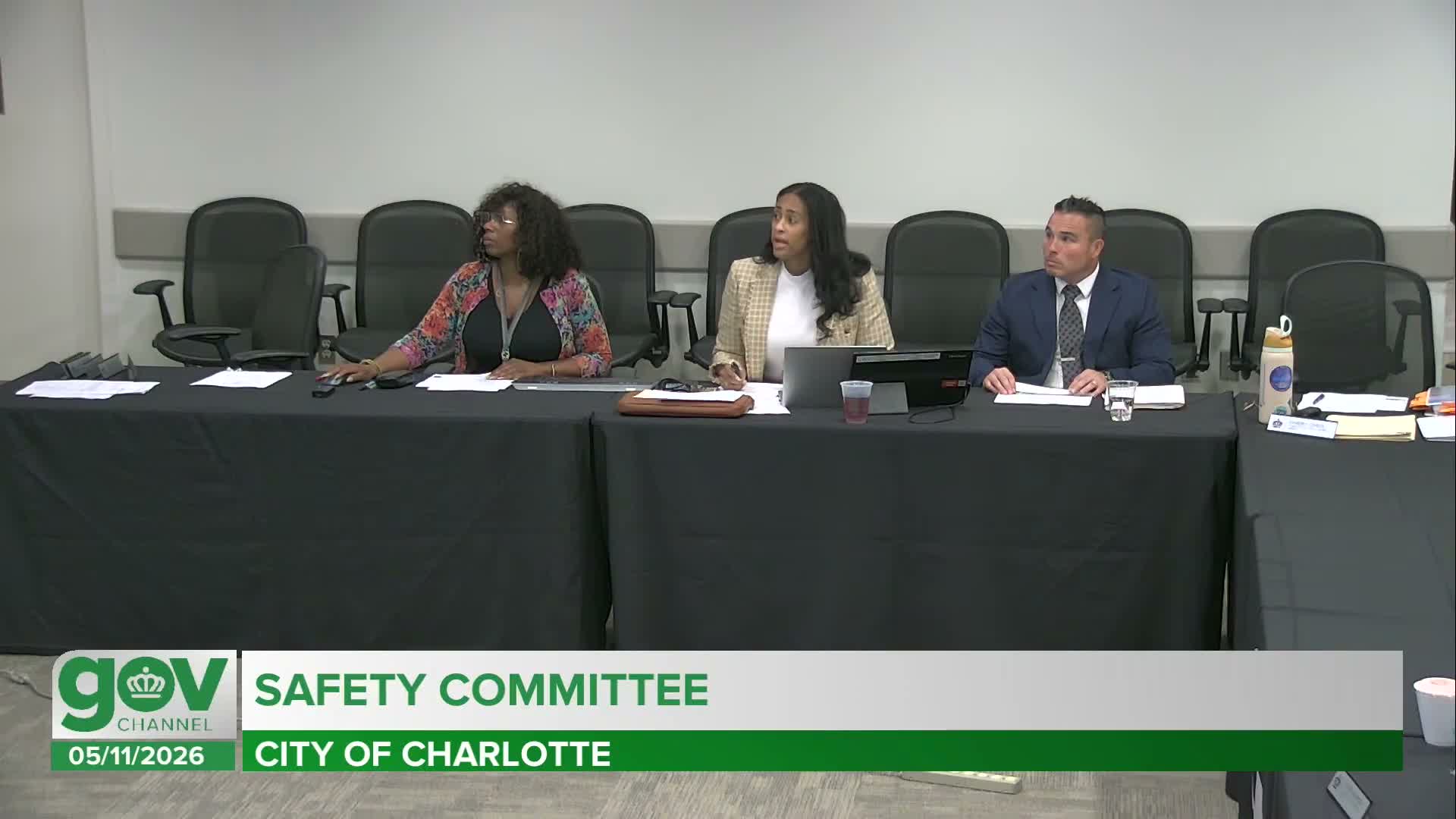
Jessica Battle, of the city attorney’s office, told the committee the city is re‑examining local nuisance authority and recommended a set of ordinance changes aimed at speeding enforcement against properties the state already identifies as nuisances.
Battle said state law (she cited Chapter 19 of the North Carolina General Statutes and a related local provision described in the presentation as 160A‑174) allows municipalities to define and abate nuisances and that some businesses—specifically arcades and certain adult‑oriented establishments—are nuisance per se under state law. She described a draft notice letter that would inform property owners the city attorney’s office is involved and could pursue civil abatement, including, if necessary, a court‑ordered abatement and seizure of property.
"Part of that includes a notice letter to nuisance properties," Battle said, describing a form that would identify the specific nuisance behaviors found on a property and warn that, if not abated, the city may seek civil remedies. She cited the Arlington Suites case (complaint filed in 2015; injunction entered in 2017) as an example where civil action, partner engagement and eventual property sale led to improved conditions.
Major Steven Fishback, who oversees CMPD’s Special Investigations Bureau, outlined how CMPD deploys patrol divisions, crime‑reduction units and plain‑clothes teams before escalating to civil remedies. Fishback emphasized starting with education and owner engagement: "A lot of times this starts off with education and resources that we're providing to the situation before we really even get into enforcement."
Committee members pressed staff on enforcement results and limits. Fishback said CMPD closed four arcades in the past year and noted that many other illegal machines are found in convenience stores. Battle said the city can pursue inspections and permit revocation similar to state ABC rules, and recommended three changes: (1) require post‑permit inspections for dance halls and adult‑oriented businesses, (2) add after‑hours consumption prohibitions to local ordinances, and (3) expand revocation grounds (for example adding breach‑of‑peace language) so permits can be revoked more quickly when conditions warrant.
Council members raised related issues including vape shops, zoning and street takeovers. Several members asked staff to investigate whether zoning distance rules (for vape shops or arcades) are legally available under state law and requested a district‑by‑district memo from planning on the tools the city already has. Battle said she will check whether zoning could be used to limit locations and noted the city can send notice letters and pursue civil abatement when property owners do not engage in remediation.
The committee asked staff to return with a tightened list of recommendations and district maps in the June meeting. The discussion also flagged practical tools for businesses: Battle described an "authority to act as agent" form that, when signed by an owner, authorizes officers to clear trespassers from a property after hours without requiring a business representative on site.
Next procedural steps: staff will research zoning options and produce a memo for the June meeting with proposed ordinance language and district mapping, as requested by the committee. The committee did not take a formal vote on ordinance changes at this meeting.
Battle said state law (she cited Chapter 19 of the North Carolina General Statutes and a related local provision described in the presentation as 160A‑174) allows municipalities to define and abate nuisances and that some businesses—specifically arcades and certain adult‑oriented establishments—are nuisance per se under state law. She described a draft notice letter that would inform property owners the city attorney’s office is involved and could pursue civil abatement, including, if necessary, a court‑ordered abatement and seizure of property.
"Part of that includes a notice letter to nuisance properties," Battle said, describing a form that would identify the specific nuisance behaviors found on a property and warn that, if not abated, the city may seek civil remedies. She cited the Arlington Suites case (complaint filed in 2015; injunction entered in 2017) as an example where civil action, partner engagement and eventual property sale led to improved conditions.
Major Steven Fishback, who oversees CMPD’s Special Investigations Bureau, outlined how CMPD deploys patrol divisions, crime‑reduction units and plain‑clothes teams before escalating to civil remedies. Fishback emphasized starting with education and owner engagement: "A lot of times this starts off with education and resources that we're providing to the situation before we really even get into enforcement."
Committee members pressed staff on enforcement results and limits. Fishback said CMPD closed four arcades in the past year and noted that many other illegal machines are found in convenience stores. Battle said the city can pursue inspections and permit revocation similar to state ABC rules, and recommended three changes: (1) require post‑permit inspections for dance halls and adult‑oriented businesses, (2) add after‑hours consumption prohibitions to local ordinances, and (3) expand revocation grounds (for example adding breach‑of‑peace language) so permits can be revoked more quickly when conditions warrant.
Council members raised related issues including vape shops, zoning and street takeovers. Several members asked staff to investigate whether zoning distance rules (for vape shops or arcades) are legally available under state law and requested a district‑by‑district memo from planning on the tools the city already has. Battle said she will check whether zoning could be used to limit locations and noted the city can send notice letters and pursue civil abatement when property owners do not engage in remediation.
The committee asked staff to return with a tightened list of recommendations and district maps in the June meeting. The discussion also flagged practical tools for businesses: Battle described an "authority to act as agent" form that, when signed by an owner, authorizes officers to clear trespassers from a property after hours without requiring a business representative on site.
Next procedural steps: staff will research zoning options and produce a memo for the June meeting with proposed ordinance language and district mapping, as requested by the committee. The committee did not take a formal vote on ordinance changes at this meeting.
View the Full Meeting & All Its Details
This article offers just a summary. Unlock complete video, transcripts, and insights as a Founder Member.
✓
Watch full, unedited meeting videos
✓
Search every word spoken in unlimited transcripts
✓
AI summaries & real-time alerts (all government levels)
✓
Permanent access to expanding government content
30-day money-back guarantee
